Elon Musk launched Tesla's Terafab chip factory project today in a $20 billion bet on AI supply independence
Tesla's Terafab project officially launched today, aiming to produce next-gen AI chips in-house and end reliance on outside foundries.
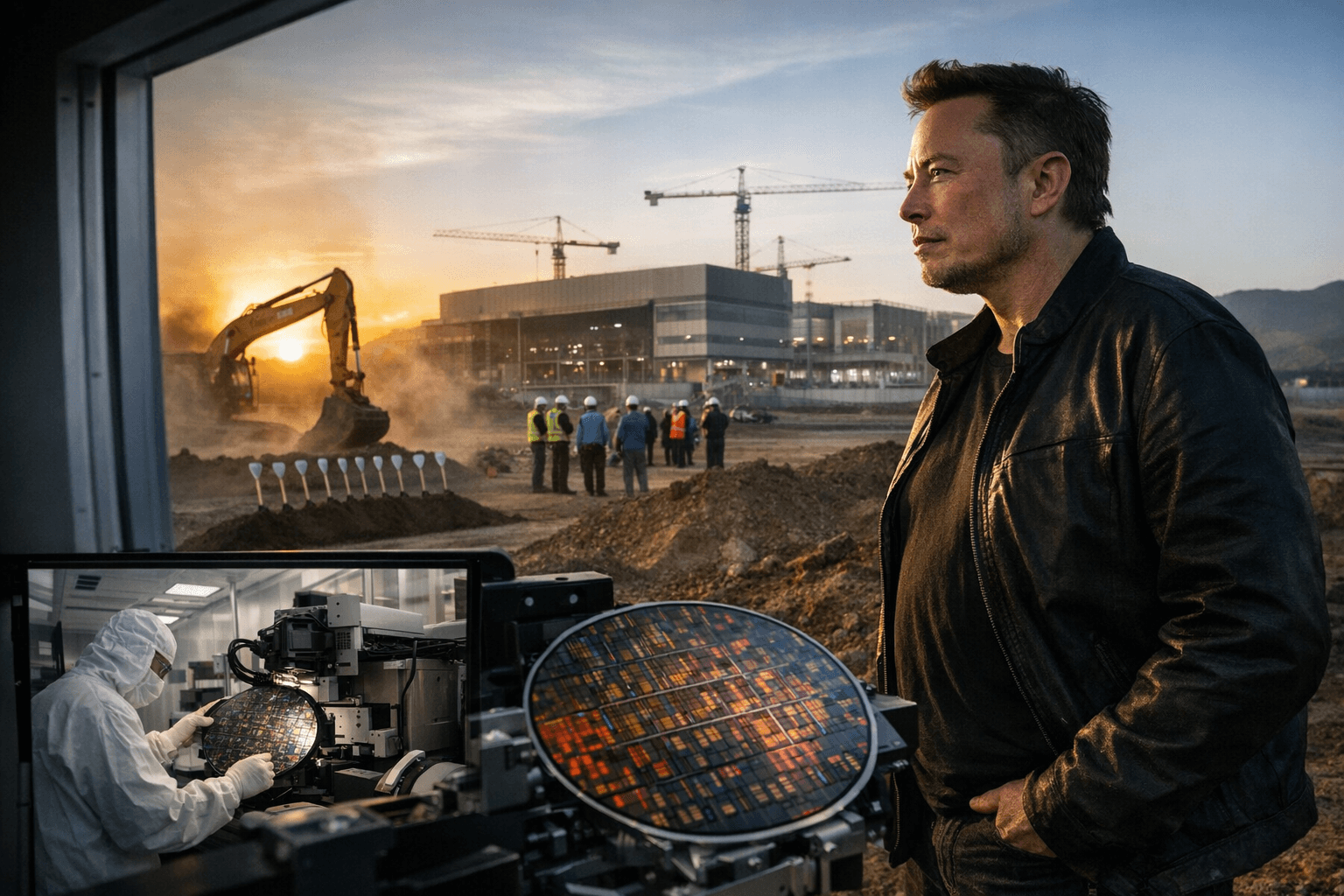
Elon Musk launched Tesla's "Terafab Project" today, kicking off what the company describes as a vertically integrated semiconductor fabrication operation designed to produce Tesla's next-generation AI chips and reduce dependence on outside foundries. The announcement follows Musk's post on X last week: "Terafab Project launches in 7 days."
The facility, estimated to cost roughly $20 billion, is intended to combine logic processing, memory production, and advanced packaging under one roof. Chips produced there, branded internally as "AI5," are slated to serve not only Tesla but also Musk's other ventures, xAI and SpaceX. A broader roadmap includes a reported $16.5 billion Samsung deal tied to a subsequent AI6 generation, with speculative AI7 and AI8 chips beyond that.
Musk first flagged the need for an in-house fabrication facility during Tesla's January 28 earnings call and repeated the argument at the company's 2025 annual shareholder meeting, citing a projected global chip supply crunch expected within three to four years that could constrain Tesla's autonomous driving and robotics ambitions. On March 19, he posted: "It's in testing right now. Wide release in a few weeks."
The project's technical ambitions are substantial. According to reporting, Terafab is targeting chips built on 2-nanometre process technology, with an annual production goal of 100 to 200 billion AI and memory chips. A 10-module facility design, with each module handling 100,000 chips monthly, forms the physical backbone of the plan. AI5 mass production is eyed for mid-2027, with full capacity targeted by 2029.
Several key details remain unresolved. The facility's exact location has not been confirmed, though Texas has been widely cited as the likely site, consistent with Musk's existing corporate presence there. The precise definition of today's "launch" is also unclear: no ground-breaking ceremony or construction permit details have been publicly confirmed, and at least one industry publication noted that no new plant had yet been built at the proposed location, suggesting the date may mark a construction start rather than operational production.
The capital math also carries uncertainty. Industry experts estimate a modern chip fabrication plant requires between $20 and $30 billion to build; TSMC's own estimates for a comparable facility in Arizona run to $165 billion. Tesla has not released a finalized project budget or confirmed manufacturing equipment vendors.
Markets responded with caution. Tesla's stock slipped toward its 200-day moving average following the announcement, reflecting investor concern about the project's capital intensity and execution risk. The 4680 battery program, which faced years of production delays, looms as a precedent investors have not forgotten.
There is also the question of process innovation. Reports have surfaced that Musk may pursue an unconventional approach to cleanroom design to cut costs, potentially sidestepping the hermetically sealed environments standard in chip fabrication. No technical details or expert validation of that approach have been made public.
If Terafab delivers on its targets, the consequences extend well beyond Tesla's vehicle lineup. Securing a domestic, proprietary chip supply at scale could underpin the company's ambitions for Robotaxi fleets, Cybercab deployment, and mass production of Optimus humanoid robots, each of which demands enormous volumes of AI accelerators. The next real test arrives in mid-2027, when AI5 mass production is supposed to begin.
This article was produced by Prism’s automated news system from verified source data, official records, and press releases, then run through automated quality and moderation checks before publishing. The system is built and supervised by the people who set the standards it runs under. Read our full AI policy.
Did this article answer your question?