Emerson poll shows Democrats with 11-point generic ballot lead
Democrats led Republicans 53% to 42% in Emerson’s July national generic ballot, an 11-point edge among likely 2026 voters. The margin widened from April, but the map and turnout still matter.
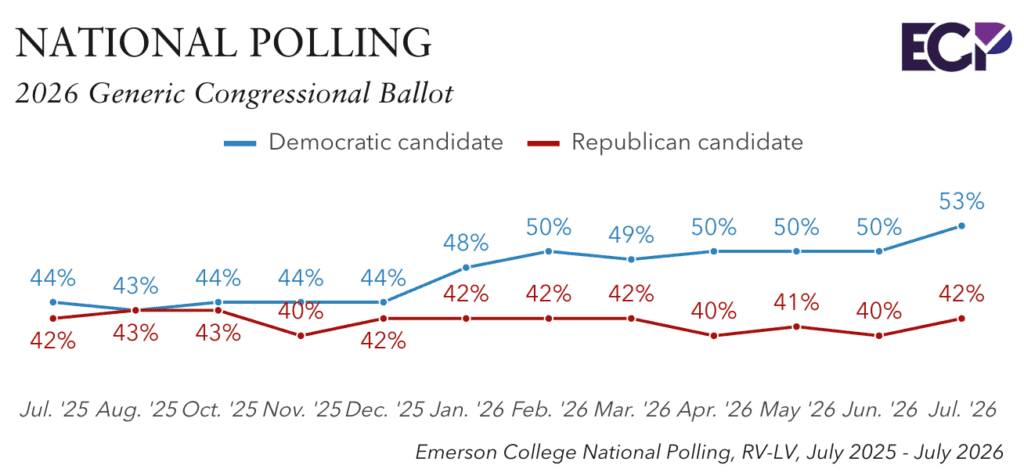
Democrats opened a 53% to 42% lead over Republicans on Emerson College Polling’s July national generic ballot, an 11-point margin among likely 2026 voters. The July 23 survey showed the Democratic share up 3 points from the prior month and the Republican share up 2 points, while Emerson College Polling executive director Spencer Kimball said women voters broke for the Democratic candidate by 27 points.
The new result widened the Democratic edge from Emerson’s April 29 national poll, which found Democrats ahead by 10 points. Taken together, the two polls show the July number is an escalation of an existing advantage rather than a sudden break, but it remains a national snapshot, not a district-by-district count of seats.

That distinction matters because the generic ballot is an early read on the political environment, not a map of who will win the House or Senate. Redistricting has already reshaped the battlefield, and an internal House Republican assessment said the new maps created 10 additional red-leaning seats. Cook Political Report’s 2026 House ratings also show how much district politics, candidate quality and state conditions still matter in all 435 House races.
Turnout history offers another caution against reading the poll as a straight line to November. The Census Bureau’s 2022 congressional election voting report and its registration data showed strong participation, with voter registration in 2022 the highest in 20 years for congressional elections. Pew Research later concluded that Republican gains in the 2022 midterms were driven mostly by a turnout advantage, a reminder that national polling can be overtaken by which voters actually show up.
Younger voters have also shown they can shift the terrain. CIRCLE at Tufts found Gen Z voted at a higher rate in 2022 than previous generations in their first midterm election, underscoring how turnout coalitions can change from cycle to cycle. That makes any generic-ballot lead less a forecast than a test of whether a party can convert enthusiasm into ballots in the right places.
The issue mix can move just as quickly. AP VoteCast found that in 2024 the economy and immigration were the top issues for voters, while democracy also drove many to the polls. Gallup likewise found the economy was the most important issue to the presidential vote, a sign that the national mood can swing sharply with headlines, prices and political trust. Emerson’s 11-point spread points to a favorable environment for Democrats, but the size of the lead does not tell us whether it will hold once district maps, turnout and issue salience take over.
This article was produced by Prism’s automated news system from verified source data, official records, and press releases, then run through automated quality and moderation checks before publishing. The system is built and supervised by the people who set the standards it runs under. Read our full AI policy.
Did this article answer your question?