Empty Moscow Mall Symbolizes Strain in Russia’s War Economy
A mostly empty Moscow mall exposes a quieter form of pressure inside Russia’s war economy. The shelves are not the only thing thinning out, even as official numbers still project stability.
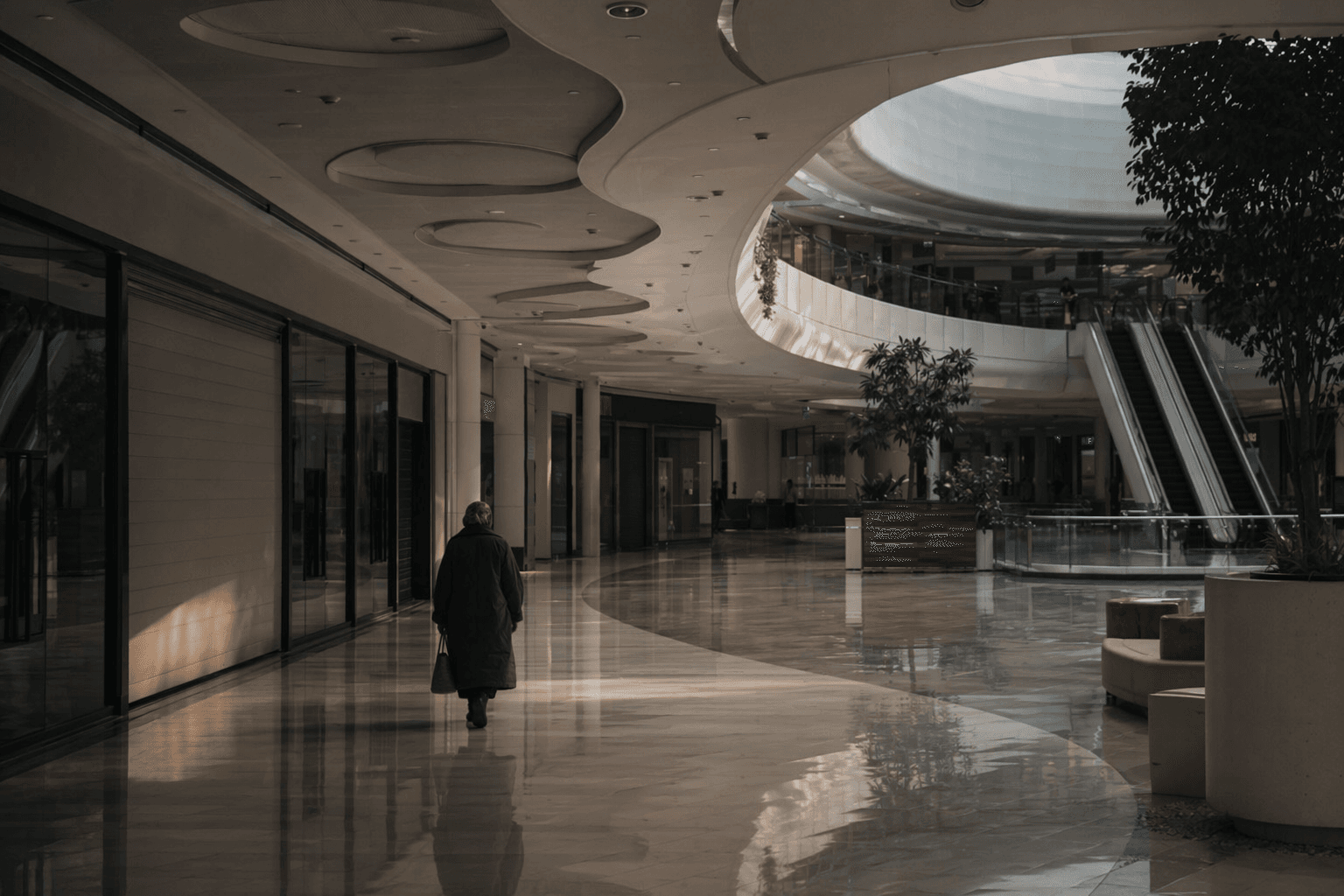
A retail space that now reads like an economic warning
Vacant storefronts, a darkened cinema foyer, and pop music drifting through nearly empty corridors have turned Goodzone mall into one of the clearest ground-level signs of strain in Moscow’s consumer economy. In CNN reporting by Zahra Ullah and Ana Archen, the southern suburban shopping center still opens every day, but its atmosphere now feels diminished, with many units boarded up or closed and foot traffic far below what the mall once promised.
Goodzone sits near Kashirskoye Shosse and the 4th Ring Highway in southern Moscow, a location chosen for convenience to local shoppers and travelers. When it opened in 2014, it was marketed as a modern retail destination with an eight-screen cinema and a broad retail gallery, the sort of place that suggested steady suburban consumption rather than contraction. The mall’s own site still says it is being “actively updated” and is undergoing phased re-concepting, but the public-facing language has not kept pace with the visible decline on the ground.
Why one mall matters in a wartime economy
The significance of Goodzone is not that it stands alone, but that it shows how pressure can appear first in ordinary consumer spaces before it becomes obvious in macroeconomic headlines. Russia initially appeared to adapt to sanctions and the costs of the full-scale invasion of Ukraine by channeling more resources into heavy military spending and by increasing oil exports to China and India. That strategy helped sustain activity, but it also redirected money, labor, and industrial capacity toward war priorities instead of civilian demand.
This is where the mall becomes useful as an economic signal. A retail center with boarded-up units and a shrinking crowd does not prove a nationwide collapse, and Moscow still has other malls that remain busy. But it does show how uneven the war economy can be, with military outlays supported while consumer-facing businesses absorb the strain from inflation, labor shortages, and cautious spending.
The macro data behind the silence
Russia’s official numbers still show a system that has not broken, but they also point to a clear cooling trend. President Vladimir Putin acknowledged on April 15, 2026 that GDP fell 1.8% in January and February and said the decline reflected negative trends in manufacturing, industrial production, and construction. At the same meeting, he asked why economic indicators were falling short of expectations, a notable public recognition that the slowdown had become difficult to ignore.
Sberbank followed with a sharper reassessment on April 29, cutting its 2026 GDP growth forecast to 0.5% to 1% after a weak first quarter. Earlier, the Bank of Russia had already moved to support conditions by cutting its key rate by 50 basis points to 14.50% on April 24, while later April releases pointed to declining money supply and credit growth. Those moves suggest monetary authorities are reading the same message that the mall’s empty hallways broadcast more quietly: the economy is cooling, and demand is softening.
A war budget that remains enormous
Even with that slowdown, Russia’s military spending remains exceptionally high. SIPRI said federal budget funding for the war and other military spending reached about 16 trillion roubles in 2025, equal to 7.5% of GDP. Growth in military spending slowed in 2025, but the level stayed extraordinarily large, which means the state still has strong incentives to protect defense priorities even as civilian commerce loses energy.
That imbalance matters for places like Goodzone because it shapes the flow of resources across the economy. When the state, defense sector, and wartime logistics command so much attention and funding, shopping centers, cinemas, and small retailers do not get the same lift. A mall can stay open and still lose its economic purpose, which is exactly what the emptiness at Goodzone suggests.
Political signals are turning sharper too
The slowdown is not only visible in markets and retail corridors. On April 22, 2026, Gennady Zyuganov, the Russian Communist Party leader, warned in the State Duma that the government’s economic course could fuel deeper failure if it is not corrected, even invoking the danger of unrest reminiscent of 1917. That was not a prediction of imminent upheaval, but it was a sign that the political system is starting to hear more criticism from inside the formal institutions that usually project unity.
The warning lands differently because the broader social picture remains stable on the surface. Russia’s unemployment rate stayed very low, at about 2.1% in February and 2.2% in March 2026, which indicates a still-tight labor market even as growth slows. Yet low unemployment does not erase the pressure on households if wages lag prices, borrowing gets harder, and consumer choices narrow.
What the empty corridors reveal
Goodzone’s decline is important because it captures what official statistics can miss. GDP, industrial output, and budget spending all tell part of the story, but they do not show whether people still fill cinemas, shop for routine purchases, or linger in commercial spaces that once symbolized normality. In this mall, the signs of strain are concrete: boarded-up units, a subdued retail hall, and a center that is still operating but visibly losing its pull.
That is why the mall matters as a test of Russia’s resilience narrative. The country has avoided the kind of sudden collapse many outsiders predicted after the invasion and sanctions, but resilience is not the same as health. If military outlays continue to dominate and civilian commerce keeps thinning out, the gap between official confidence and daily experience will only widen, and places like Goodzone will keep telling that story long before the numbers fully catch up.
This article was produced by Prism’s automated news system from verified source data, official records, and press releases, then run through automated quality and moderation checks before publishing. The system is built and supervised by the people who set the standards it runs under. Read our full AI policy.
Did this article answer your question?


