ESPN Analyst Dan Orlovsky Brings Son With Autism Onto NFL Live Set
Madden Orlovsky, 14, sang the Eagles fight song on ESPN's NFL Live set while dad Dan wept — a viral moment set against stubborn gaps in autism services nationwide.
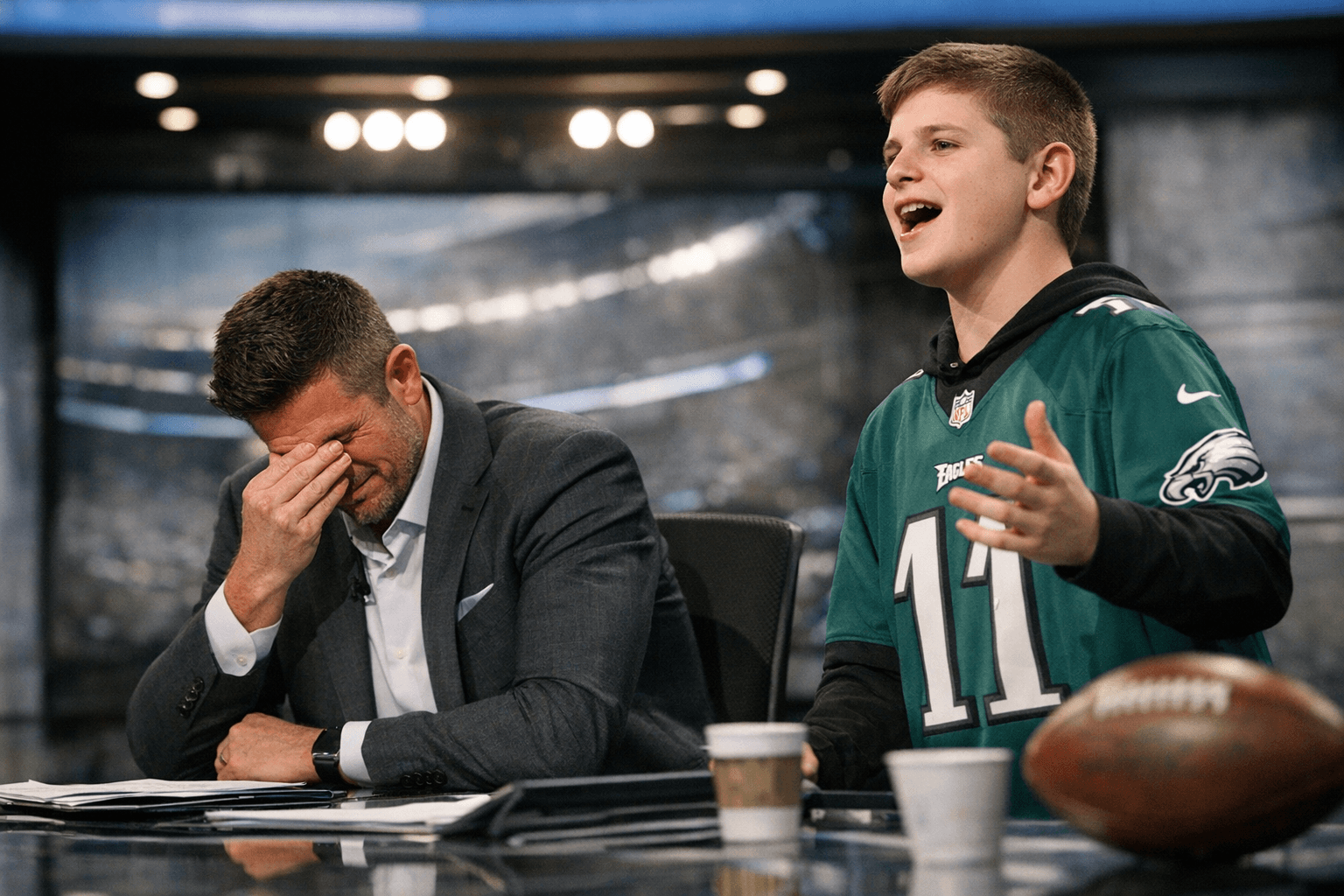
Fourteen-year-old Madden Orlovsky walked onto the set of ESPN's "NFL Live" on World Autism Awareness Day and did what he does best: he drew, he sang, and he made a roomful of television professionals cry.
Madden, the autistic son of former Detroit Lions quarterback and ESPN analyst Dan Orlovsky, had his drawings displayed across the "NFL Live" studio on Thursday afternoon. It was his second consecutive year appearing on the broadcast for the occasion. Just like the prior year, the studio was covered in Madden's drawings, but this year Madden sang the Philadelphia Eagles' "Fly Eagles Fly" fight song. Orlovsky cried again. When his father broke down, Madden asked, "Are you crying?" Orlovsky replied, "Yeah, because I love you."
Earlier in the program, Orlovsky received a swag bag of gifts from Eagles wide receiver DeVonta Smith alongside a video message. Madden's drawing of the Philadelphia Eagles logo was among the artwork featured on the broadcast. Madden wore a Kelly Green Eagles hoodie and shared a drawing of himself as an Eagles player wearing No. 3.
Before the broadcast, Dan Orlovsky signaled what the moment meant to him. "What I love about it, it's his, it's his thing. I'm so thankful that ESPN, and you guys, let me be a part of it before the show," Orlovsky said. "He's just a special, special human." Madden, for his part, thanked ESPN "for inviting me here. I think drawing is really great." He also turned to the camera to address his family directly: "Mom, I love you. Hunter, you're my favorite twin. Noah, I do like you. And Lennon, you're a good sister. Thank you all for supporting me."
The segment drew immediate national attention, but the applause carries a harder undertone. World Autism Awareness Day 2026 carries the theme "Autism and Humanity: Every Life Has Value," and advocates note that visibility, however moving, does not automatically translate into policy change. Families across the United States continue to experience long waitlists for autism services, often due to a shortage of qualified professionals. Increased awareness has led to higher demand, but access has not always kept pace.
Schools represent one of the most contested front lines. The Orlovskys chose to live in Westport, Connecticut specifically for the school district's services and approach, and Madden excels in school. That kind of geographic calculation is a luxury millions of families cannot afford. Adult autism coverage is still limited in most states, rural families often face therapy waitlists, and some services, like alternative therapies or respite care, are rarely covered.
The insurance picture is similarly uneven. Families might find limits on coverage for certain therapies, long waitlists for evaluations, and difficulties working with complicated insurance systems. Government programs like Medicaid waivers are crucial for filling these gaps, but more efforts are needed to make sure families have access to a range of affordable services. One measurable gain: since insurance mandates took effect, the number of board-certified behavioral analysts has grown by 16%, reducing provider shortages in many areas.
The most persistent gap sits at adulthood. Children who receive robust school-based services routinely age out of them at 22, entering an adult system far less equipped to support them. About 5.4 million U.S. adults, or 2.2 percent of the population, are on the spectrum, yet federally funded adult programming remains fractured and chronically underfunded.
Madden was officially diagnosed with autism between the ages of two and three. Initially, the diagnosis felt fearsome due to uncertainty and what Orlovsky described as "a lot of negatives attached to it." That fear, researchers and clinicians say, is itself a common barrier: stigma delays diagnosis, and delayed diagnosis delays intervention, compressing the window when early support is most effective.
After the cameras stopped rolling Thursday, Dan Orlovsky went home and told his wife: "Yo, that was unbelievable, and it doesn't happen without you." His acknowledgment points to something data consistently confirms: behind every autistic child who thrives in a public setting is a caregiver who has fought through a system designed with far less ambition than Madden Orlovsky demonstrated on live television.
This article was produced by Prism’s automated news system from verified source data, official records, and press releases, then run through automated quality and moderation checks before publishing. The system is built and supervised by the people who set the standards it runs under. Read our full AI policy.
Did this article answer your question?

.jpg&w=1920&q=75)
