EU and Mercosur to sign interim trade accord in Paraguay
After 25 years of talks the EU and Mercosur will sign an interim trade accord in Asunción; the European Parliament's consent and lengthy national ratifications will follow.
1. Signing ceremony planned
European and Mercosur officials moved to sign an Interim Trade Agreement (iTA) and the EU‑Mercosur Partnership Agreement (EMPA) political/cooperation package in Asunción, Paraguay, with multiple reports placing the ceremony on 17 January 2026 and some accounts noting activity on 16 January (Access Partnership; Consilium; Reuters).
2. Long negotiation history
Negotiations on an EU‑Mercosur association agreement began in 1999, meaning the process has spanned more than 25 years and reflects recurrent technical, political and sectoral sensitivities on both sides of the Atlantic.
3. Conclusion of talks
Negotiators formally concluded the talks on 6 December 2024, producing two legally distinct instruments, the EMPA and the interim Trade Agreement, after decades of intermittently intense diplomacy (Consilium).
4. Two‑instrument architecture
The package contains two separate instruments: the iTA focused on trade and investment liberalisation, and the broader EMPA covering political dialogue and cooperation; the iTA is deliberately designed to be a stand‑alone accord applied ahead of the full partnership (Think Ing; Consilium).
5. EMPA scope and replacement role
The EU‑Mercosur Partnership Agreement (EMPA) includes political dialogue, cooperation, investment and environmental provisions; when the EMPA enters into force it will supersede the interim Trade Agreement and provide the fuller legal framework (Think Ing; Consilium).
6. European leaders attending
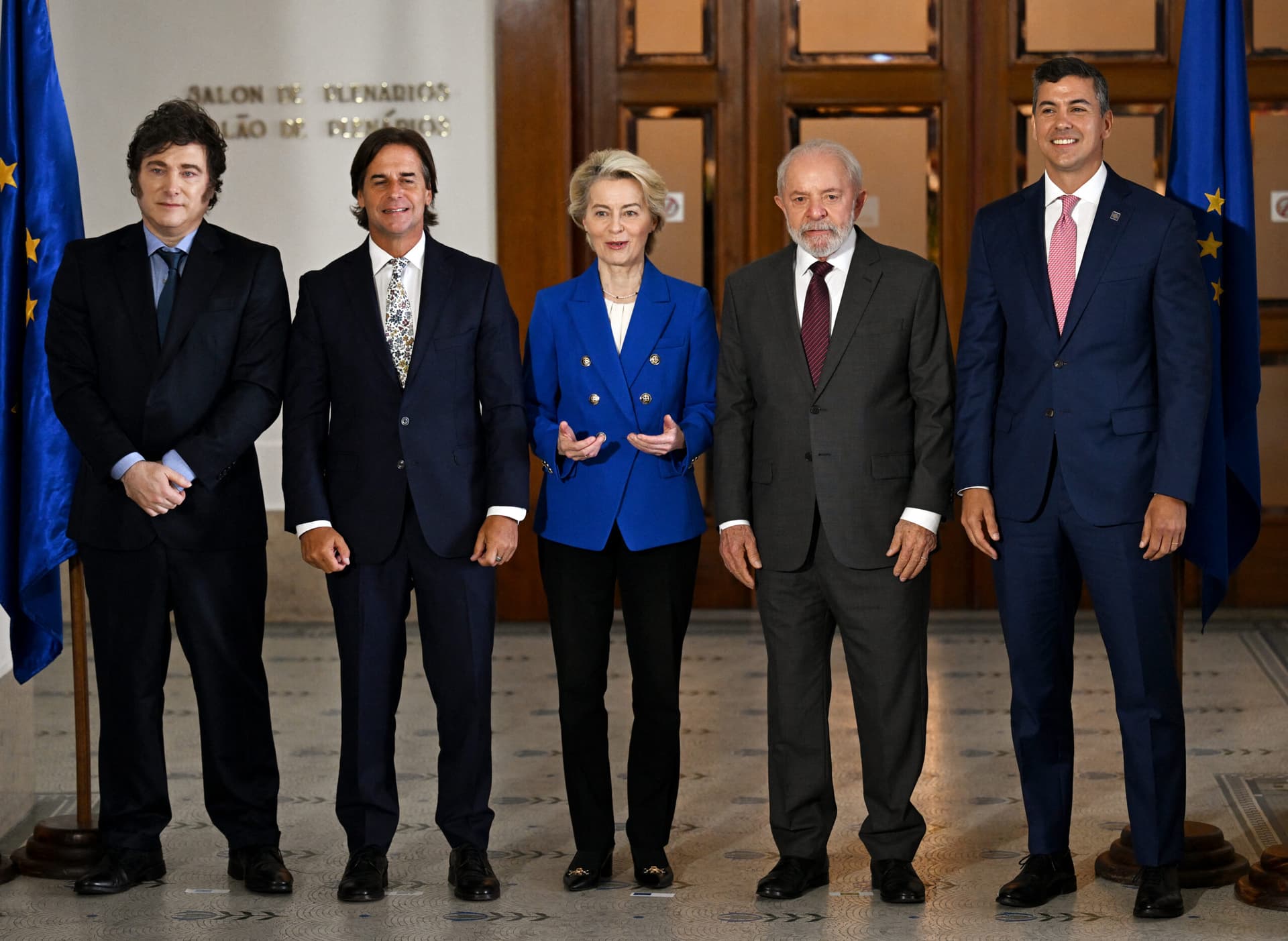
European Commission President Ursula von der Leyen and European Council President António Costa are reported to travel to Paraguay for the signing ceremony, signalling high political backing from EU institutions for the provisional stage of the deal.
7. Council approval step
The Council of the European Union approved the long‑awaited trade agreement on 9 January 2026, a necessary executive endorsement ahead of formal signature and parliamentary procedures (Latinoamerica21).
8. Provisional safeguards agreement
On 17 December 2025 the Council and European Parliament reached a provisional agreement on bilateral safeguards aimed at protecting EU agri‑food sectors; that regulation must be endorsed and adopted by both institutions before application (Consilium).
9. European Parliament role
The interim Trade Agreement requires the European Parliament’s consent before it can enter into effect; parliamentarians will therefore play a central gate‑keeping role and can shape political timelines through their ratification decision (Think Ing; AccessPartnership).
10. Council conclusion mechanics
After Parliament gives consent, the Council concludes the iTA by qualified majority; sources state the iTA can apply immediately upon Parliament consent, allowing tariff reductions and market access to begin while EMPA ratification continues (Think Ing; AccessPartnership).
11. EMPA ratification complexity
By contrast, the EMPA requires ratification by all 27 EU member states and by Mercosur parties according to their national procedures, a step that can stretch over years and is expected to continue into 2027 and beyond (Think Ing; AccessPartnership).
12. Immediate provisional application
Under the EU decision reported by Consilium, the EU will sign and apply large parts of the political and cooperation chapters provisionally pending completion of national ratification procedures, enabling some cooperation to begin early (Consilium).
13. Scale of the zone
The deal will create one of the world’s largest free‑trade zones, linking blocs covering roughly 700–718 million people and representing about USD 22–22.4 trillion in combined GDP, a strategic economic weight for global trade dynamics (Think Ing; Valor; AccessPartnership).

14. Mercosur tariff liberalisation (AP)
AccessPartnership reported that Mercosur will eliminate tariffs on 91% of EU exports over 15 years, while the EU will reciprocate by liberalising tariffs on about 92% of Mercosur exports, with reductions phased over that period.
15. EU figures and discrepancy (Valor)
Valor reported the EU would eliminate import tariffs on about 95% of goods while Mercosur would liberalise tariffs on 91% of goods, highlighting a published discrepancy between 92% and 95% EU liberalisation figures in source reporting.
16. Quotas and residual measures
Valor noted that products remaining subject to quotas or non‑tariff measures account for roughly 3% of goods and about 5% of the value imported by the EU, indicating targeted protections remain for sensitive items.
17. Agricultural safeguard tools
EU states unilaterally added stricter requirements including temporary safeguard mechanisms that can suspend tariff preferences on agricultural imports from Mercosur if imports demonstrably harm EU producers; these are designed to be emergency, temporary tools (Valor).
18. Political opposition dynamics
A coalition of European agricultural producers and environmental civil society organisations previously stalled ratification after an agreement in principle in June 2019, underlining persistent domestic political pressure in key EU capitals (Latinoamerica21).
19. Deforestation and 2023 adjustments
During resumed talks in 2023 negotiators added stricter requirements aimed at curbing deforestation, reflecting heightened European concern about environmental standards and supply‑chain impacts on biodiversity.
20. Mercosur reaction and dispute settlement
Mercosur officials, including Itamaraty advisers, have downplayed the short‑term likelihood of safeguards triggering and point to dispute‑settlement mechanisms, consultations and potential arbitration, embedded in the deal to manage conflicts (Valor).
21. Automotive sector gains
The agreement is expected to open prospects for European carmakers in a growth market by addressing Mercosur tariffs that historically reached up to 18% on auto parts and up to 35% on cars, reducing price barriers for exporters (Think Ing).
22. Digital and services provisions
The iTA and EMPA include provisions on e‑commerce and digital trade facilitating cross‑border cloud, financial services and software, though reporting notes limited detail on data localisation and data transfer rules that may require future negotiation (AccessPartnership).
23. Phased tariff transition
Tariff reductions are phased over up to 15 years, enabling gradual adjustment for sensitive sectors while creating predictability for businesses planning market entry and investment strategies across the Atlantic.
24. Implementation timeline expectations
With provisional application possible after Parliament consent but full EMPA ratification pending, practical trading and investment consequences will unfold incrementally: immediate gains for some sectors, full legal effects only once all ratifications are complete.
25. Strategic and geopolitical significance
Officials present the deal as a major boost for open markets and EU diversification of trade partners; however, environmental concerns, domestic politics and long national ratification procedures mean the full economic and legal implications will take years to materialise and will reshape transatlantic commercial and diplomatic ties.
This article was produced by Prism’s automated news system from verified source data, official records, and press releases, then run through automated quality and moderation checks before publishing. The system is built and supervised by the people who set the standards it runs under. Read our full AI policy.
Did this article answer your question?


