EU-Mercosur trade pact shows limits of U.S. leverage in Latin America
The EU and Mercosur have agreed a landmark trade pact, signaling Latin American shifts away from U.S. influence and toward diversified economic partnerships.
The European Union and the Mercosur trading bloc have reached a long-sought trade pact after decades of intermittent negotiations, a move analysts say underscores the waning leverage of the United States in Latin America. The accord, clinched on the final stretch of talks, brings together the EU and Mercosur members Argentina, Brazil, Paraguay and Uruguay, covering markets with a combined population of more than 700 million people.
Negotiators said the agreement clears the way for expanded South American access to the European market, greater EU investment and intensified commercial competition for Mercosur industries. Economic analysts expect the deal to boost exports of agricultural and industrial goods from South America while pressuring local producers to modernize, digitize and boost efficiency to remain competitive with European manufactured products.
Political analysts view the pact as part economic strategy and part geopolitical response. Officials and commentators link the move to a broader regional reaction against the transactional multilateral posture of the Trump administration, including tariffs and public skepticism toward multilateral agreements. Margaret Myers, director of the Asia & Latin America Program at the Inter‑American Dialogue, said, "At a time when the U.S. is breaking from the status quo, parts of Latin America appear to be upholding it. It’s a wake‑up call for the U.S."
Atlantic Council analysts framed the deal as diversification in the face of geopolitical uncertainty and trade pressure. Frances Burwell and Valentina Sader of the Atlantic Council cited growing domestic pressure inside Mercosur to open new markets after a period of punitive trade measures, and noted Brazil in particular has faced steep commercial headwinds, including an additional 40 percent U.S. tariff on some goods and deep trade ties with China.
The path to agreement was narrow. European ratification stumbled until the European Commission proposed safeguard measures to protect sensitive agricultural sectors from rapid import surges. Italy’s prime minister withheld a pivotal Italian endorsement until Brussels promised additional agricultural support in the next EU budget; once those concessions were outlined, member-state approval moved forward. EU officials also took note of strategic signals in the wider geopolitical environment, including messaging from the U.S. National Security Strategy that effectively elevated transatlantic trade ties with Latin America as a policy priority.
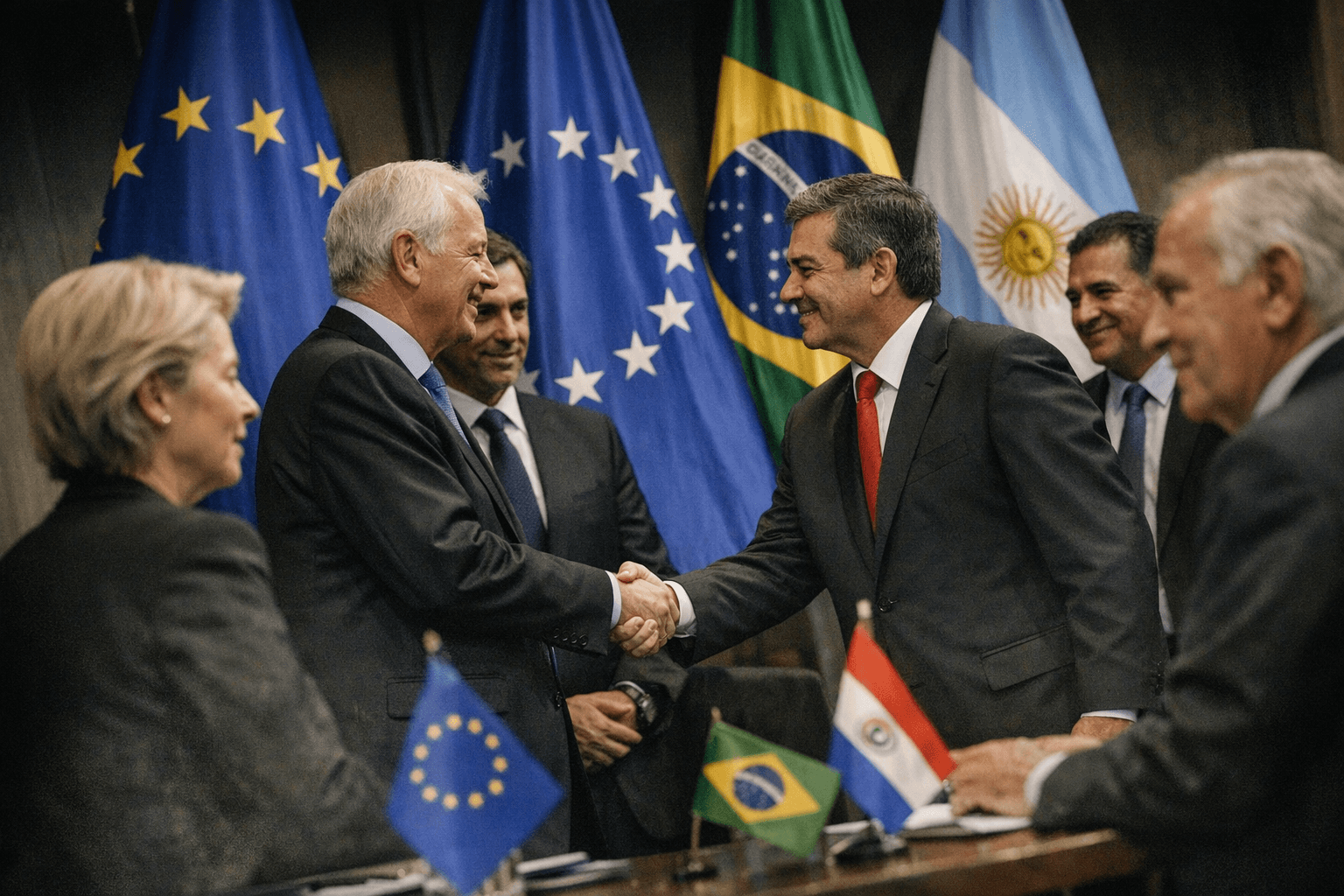
The deal reflects a larger pattern of states seeking alternatives amid rising U.S. tariffs and geopolitical friction. Observers point to recent EU accords with other Asian economies and renewed trade commitments among Japan, South Korea and China as signs that nations are hedging by broadening trade networks.
A European Parliamentary Research Service analysis emphasized an asymmetry in geopolitical exposure: Mercosur faces weaker direct geopolitical pressure than the EU, a factor that helps explain differing political reactions inside the bloc. That analysis also noted the agreement steers clear of explicit cooperation on normative issues such as sovereignty enforcement or conflict resolution, suggesting that such matters remain on a separate diplomatic track, likely centered on multilateral forums such as the United Nations.
For Mercosur governments, the pact offers a potential influx of investment and new markets, but also a political challenge: balancing domestic industry protections with the economic imperative to integrate into global value chains. For Washington, the deal is a reminder that economic influence can shift quickly when partners perceive a retreat from multilateralism.
This article was produced by Prism’s automated news system from verified source data, official records, and press releases, then run through automated quality and moderation checks before publishing. The system is built and supervised by the people who set the standards it runs under. Read our full AI policy.
Did this article answer your question?