EU tech sovereignty push signals ambition, not true independence
Brussels unveiled a sovereignty package for chips, AI and cloud, but Europe still lacks Nvidia-scale champions, TSMC-style fabs and the capital to catch up.
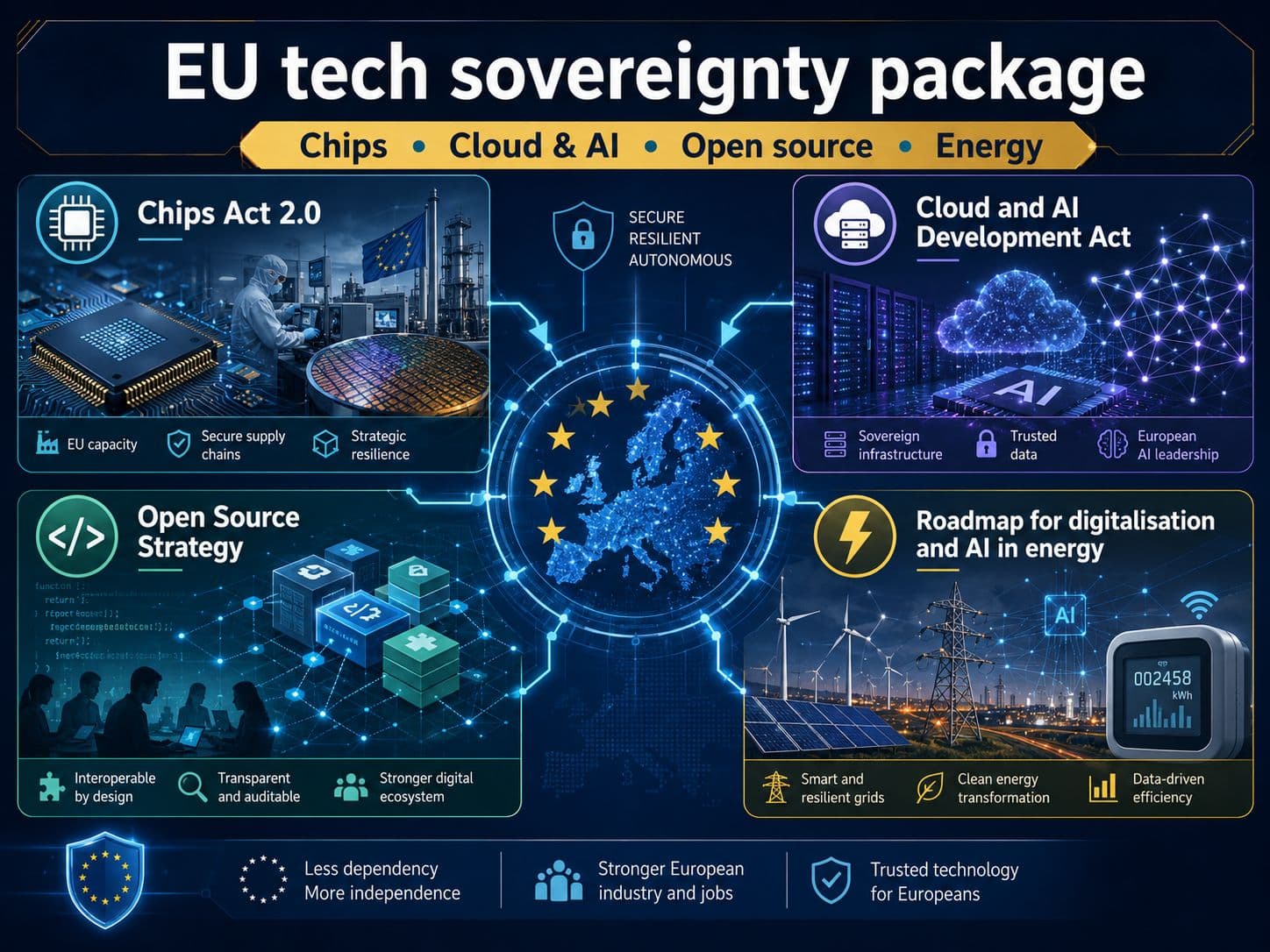
Brussels has put a political marker down on tech sovereignty, but the gap between ambition and industrial reality is still wide. The European Commission presented its European Technological Sovereignty Package on June 3, 2026, a plan covering semiconductors, artificial intelligence, cloud and open source as part of a push to make Europe an AI continent.
The package rests on four strands: a Chips Act 2.0 to build semiconductor capacity and support supply and demand, a Cloud and AI Development Act to back research and innovation and streamline data-center deployment, an open-source strategy to scale alternatives in priority areas, and a roadmap for digitalising Europe’s energy system so data centers can be integrated more sustainably into the grid. The Commission says the plan builds on the Competitiveness Compass and the Economic Security Strategy, and it is designed to strengthen the bloc’s digital independence.
Yet the hard limits are clear. Europe has no Nvidia equivalent in AI-chip design, no Taiwan Semiconductor Manufacturing Co. rival for manufacturing, and no software giants on the scale of the major U.S. cloud platforms that drive demand for the next generation of computing. The bloc remains dependent on Nvidia and AMD for graphics processors and will still need to work with international partners on some AI models.
That dependence is not just a matter of engineering pride. It is a question of capital, scale and industrial depth. The plan brings little new money compared with U.S. and Chinese state-backed support, leaving member states to shoulder more of the cost at a time when budgets are tight. High energy prices, labour shortages and fragmented capital markets continue to weigh on Europe’s ability to build the cloud and data-center infrastructure that would make sovereignty more than a slogan.
The package also shows how far Brussels is willing to go in trying to reshape the market. It is meant to give European firms more room against dominant American rivals, and Bloomberg reported that the measures could affect subsidies for chip-manufacturing plants and whether companies such as Microsoft and Amazon can handle sensitive government data in the cloud. The proposals still need debate and approval from the European Parliament and the Council of the European Union.
Industry reaction captures the same tension. Henna Virkkunen’s push is being cast as a step toward strategic autonomy, but business leaders and lobby groups say Europe cannot regulate its way into leadership. Ralf Wintergerst of Bitkom has called for concrete action and a better investment environment. Achim Weiß of Ionos says Europe will keep relying on Nvidia and AMD and on partners outside the bloc. Erik Rein of ESIA says leadership in semiconductors will not come from regulation alone, while CCIA Europe warns that the Cloud and AI Development Act could fragment the market instead of strengthening it.
The package is a meaningful political statement. Whether it becomes a real shift in capability will depend on whether Brussels can turn strategy into fabs, compute, cloud capacity and domestic champions at a scale Europe has not yet built.
This article was produced by Prism’s automated news system from verified source data, official records, and press releases, then run through automated quality and moderation checks before publishing. The system is built and supervised by the people who set the standards it runs under. Read our full AI policy.
Did this article answer your question?