Euro Zone Private Sector Contracts as Iran War Drives Inflation Higher
The euro zone slipped back into contraction as war-linked price pressures surged and services demand sank, leaving the ECB caught between inflation and growth.
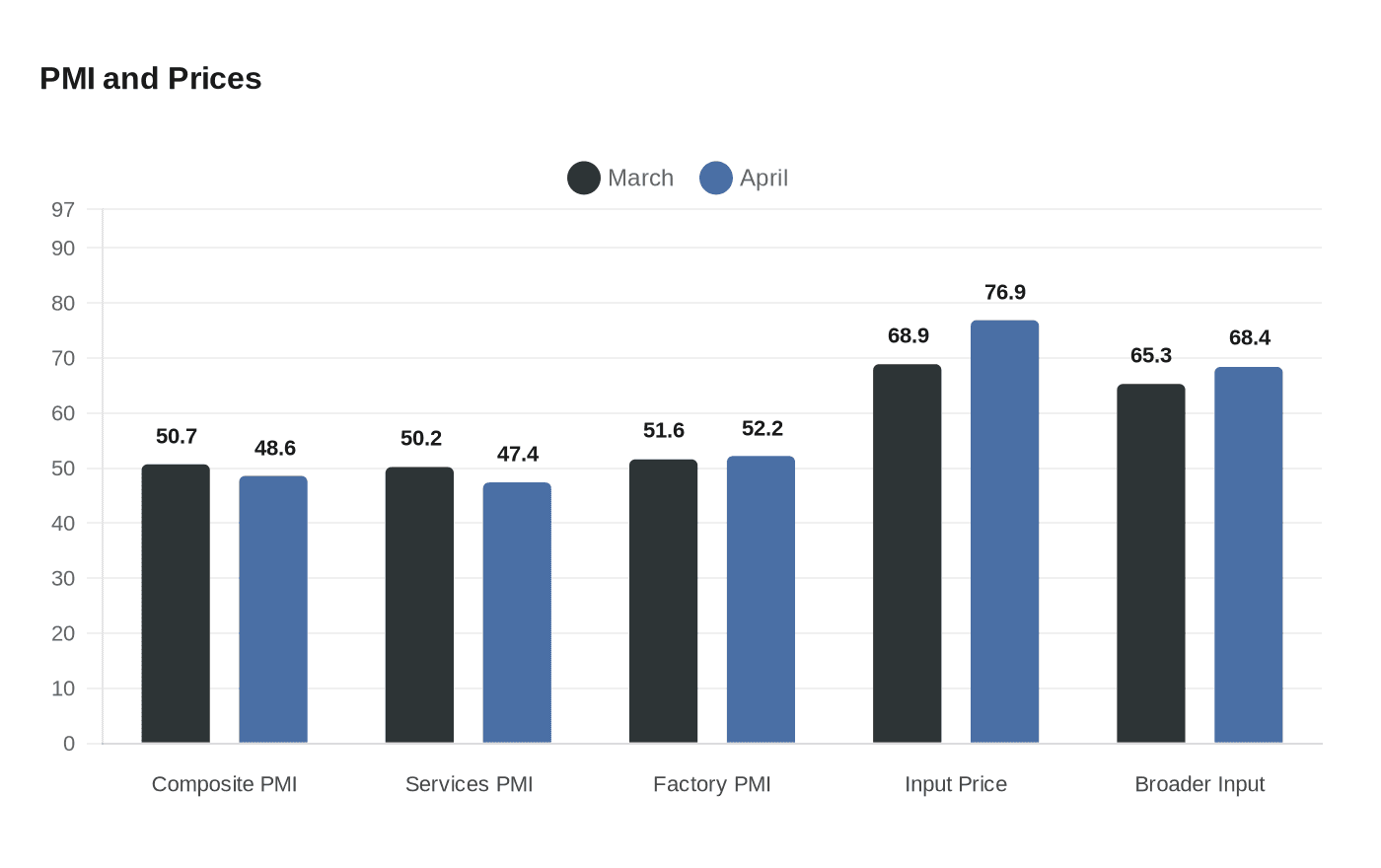
The euro zone’s private sector unexpectedly shrank in April, with the S&P Global Flash Eurozone Composite PMI falling to 48.6 from 50.7 in March, its first contraction since late 2024. The reading came in below the 50.1 expected in a Reuters poll and signaled a 0.1% quarterly GDP decline, a sharp reversal after a 0.2% gain had been indicated for the first quarter.
Services carried most of the damage. The services PMI dropped to 47.4 from 50.2, and S&P Global said demand in the sector fell at the sharpest rate since October 2023, with activity dropping at a pace not seen since the early-2021 pandemic lockdowns. The weakness showed how the war in the Middle East is hitting the euro zone through a second channel beyond energy: households and firms are pulling back on spending, especially in travel, leisure and other service businesses that depend on discretionary demand.
Manufacturing was more resilient, with the factory PMI rising to 52.2 from 51.6, but that did not mean relief for producers. S&P Global said manufacturers were increasing input buying at a pace not seen since early 2022, as companies tried to get ahead of shortages and further price increases. The manufacturing input-price gauge surged to 76.9 from 68.9, while the broader input price index jumped to 68.4 from 65.3, the highest since late 2022. Supplier delivery times lengthened to the greatest extent since July 2022, another sign that supply chains were tightening again.
The price data sharpened the policy dilemma. S&P Global said selling-price inflation reached a 37-month high and that the prices-charged index pointed to consumer price inflation running near 4%. Business sentiment also fell to its lowest level since late 2022. Chris Williamson, chief business economist at S&P Global, said, “The euro zone is facing deepening economic woes from the war in the Middle East,” and warned that widespread supply shortages threatened to slow growth further while adding pressure to prices.
The shock landed after 15 straight months of growth, and the weakness was not confined to one economy. Germany and France both posted private-sector contractions in April. That leaves the European Central Bank in an awkward position: financial markets are already weighing rate hikes in response to the inflation shock, even as Philip Lane said in Frankfurt on April 23 that no one really knew how long the situation would last and that the April 29-30 ECB meeting would be hard to judge without more clarity. For policymakers, the war has now made the trade-off stark: tighter policy to fight inflation risks deepening the downturn, while easier policy risks leaving prices even hotter.
This article was produced by Prism’s automated news system from verified source data, official records, and press releases, then run through automated quality and moderation checks before publishing. The system is built and supervised by the people who set the standards it runs under. Read our full AI policy.
Did this article answer your question?

