Europeans’ faith in U.S. as ally falls to historic low, survey finds
Only 11% of Europeans now call the U.S. an ally, a historic low that deepens pressure on NATO burden-sharing and Ukraine support.
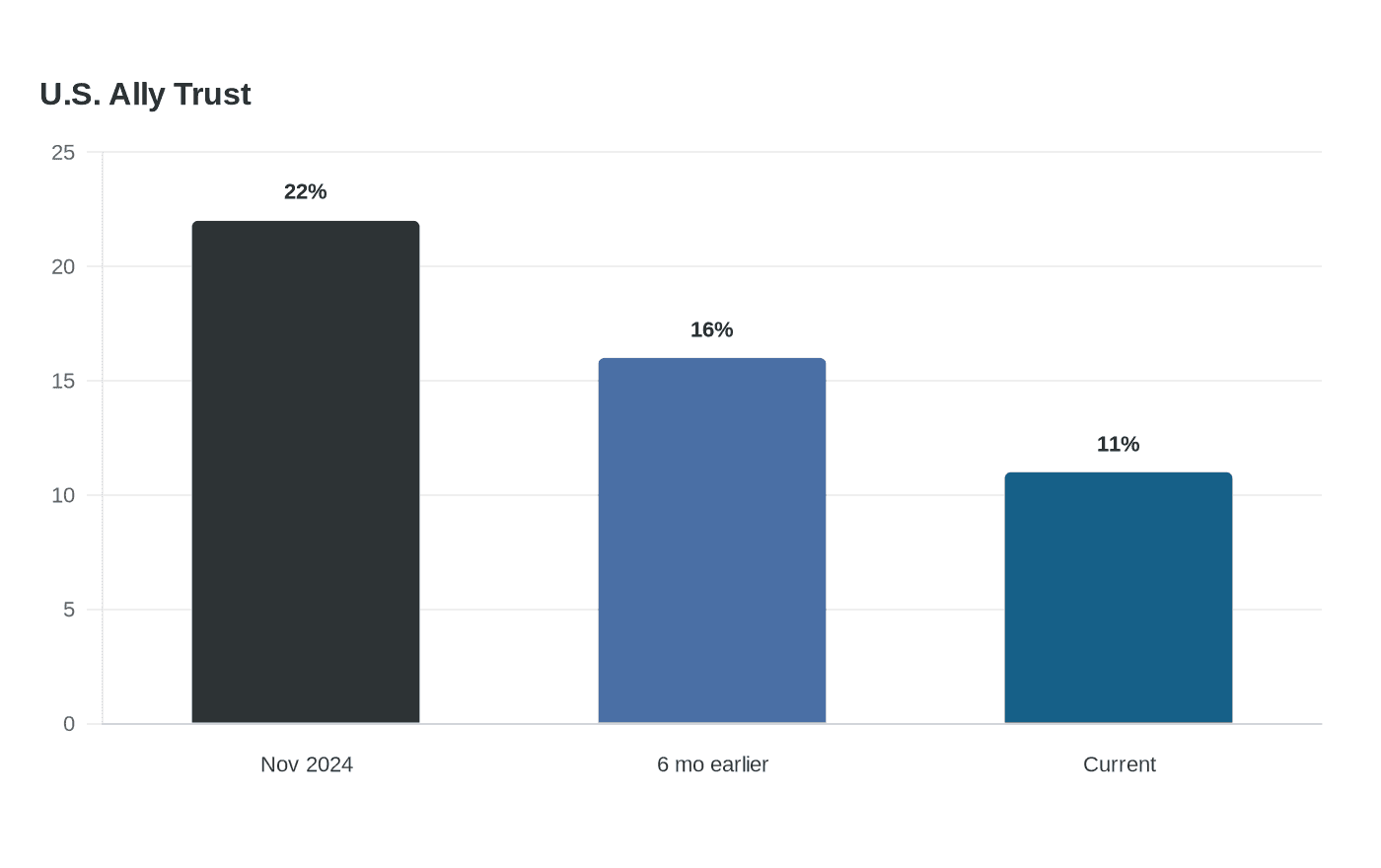
Europe’s faith in the United States as a security partner has fallen to a historic low, with just 11% of respondents across 15 countries calling America an ally. The collapse lands at a sensitive moment for Washington, as transatlantic unity is already strained by war, defense spending fights and the next round of NATO and G7 decisions.
The survey found that the ally figure had dropped from 16% six months earlier and 22% in November 2024. Majorities in every country polled said they were not confident the U.S. would come to their defense if they were attacked, a striking warning sign for American credibility in Europe at a time when the continent still depends heavily on U.S. power.
The political damage is broader than one question about alliance loyalty. About half of respondents described the U.S. as a necessary partner, while roughly a quarter saw it as a rival or adversary, with the sharpest negativity reported in Denmark, France, Spain and Switzerland. The fieldwork was conducted in May 2026 in Austria, Bulgaria, Denmark, Estonia, France, Germany, Hungary, Italy, the Netherlands, Poland, Portugal, Spain, Sweden, Switzerland and the United Kingdom, based on nearly 20,000 respondents.
For Washington, the significance goes beyond mood music. The European Council on Foreign Relations argues that Europe is being pushed toward a distinctly European way of defence, built around NATO command structures, European Union funding and closer minilateral cooperation. The same briefing says roughly 75,000 U.S. troops are still stationed across Europe, underscoring how much of the alliance’s operational strength still rests on American shoulders even as public trust erodes.
The survey also showed that Europeans are becoming somewhat more open to paying for their own defense. Forty-seven percent backed collective EU borrowing for defense initiatives, and most respondents supported buying more weapons from European countries and developing an alternative deterrent less dependent on the U.S. Poland stood out as the clearest exception, with a majority favoring more U.S. weapons, while Italy remained notably resistant to higher defense spending.
Ukraine remains another crucial test of that shifting public mood. The poll found broad support for Kyiv as an ally or strategic partner, but less enthusiasm for sending peacekeeping troops or for rapid eastward enlargement of the European Union. Forty-four percent opposed resuming Russian oil and gas imports even if energy costs stayed high, showing that strategic caution still outweighs the lure of cheaper fuel.
Perhaps most telling for U.S. policymakers, majorities in every country polled except Bulgaria expected relations to improve after President Donald Trump leaves office. That suggests European skepticism is being shaped not only by structural distrust, but by a belief that current U.S. policy has made lasting doubts about America’s reliability unavoidable.
This article was produced by Prism’s automated news system from verified source data, official records, and press releases, then run through automated quality and moderation checks before publishing. The system is built and supervised by the people who set the standards it runs under. Read our full AI policy.
Know something we missed? Have a correction or additional information?
Submit a Tip