Europe’s AI startup surge draws capital, policy support, new attention
Europe’s AI boom is no longer symbolic: capital is rising, policy is mobilizing, and Mistral AI is turning funding into serious compute.

Europe’s AI surge is becoming a strategic test
Europe is no longer just producing occasional breakout startups. Lovable and Mistral AI have become proof points for a broader shift: investors, policymakers, and industrial players are treating the continent’s AI and deep tech scene as a serious bet on whether Europe can compete with U.S. and Chinese dominance. That matters because this is not merely a startup story. It is a question of industrial capacity, technological sovereignty, and whether Europe can convert talent into scale.
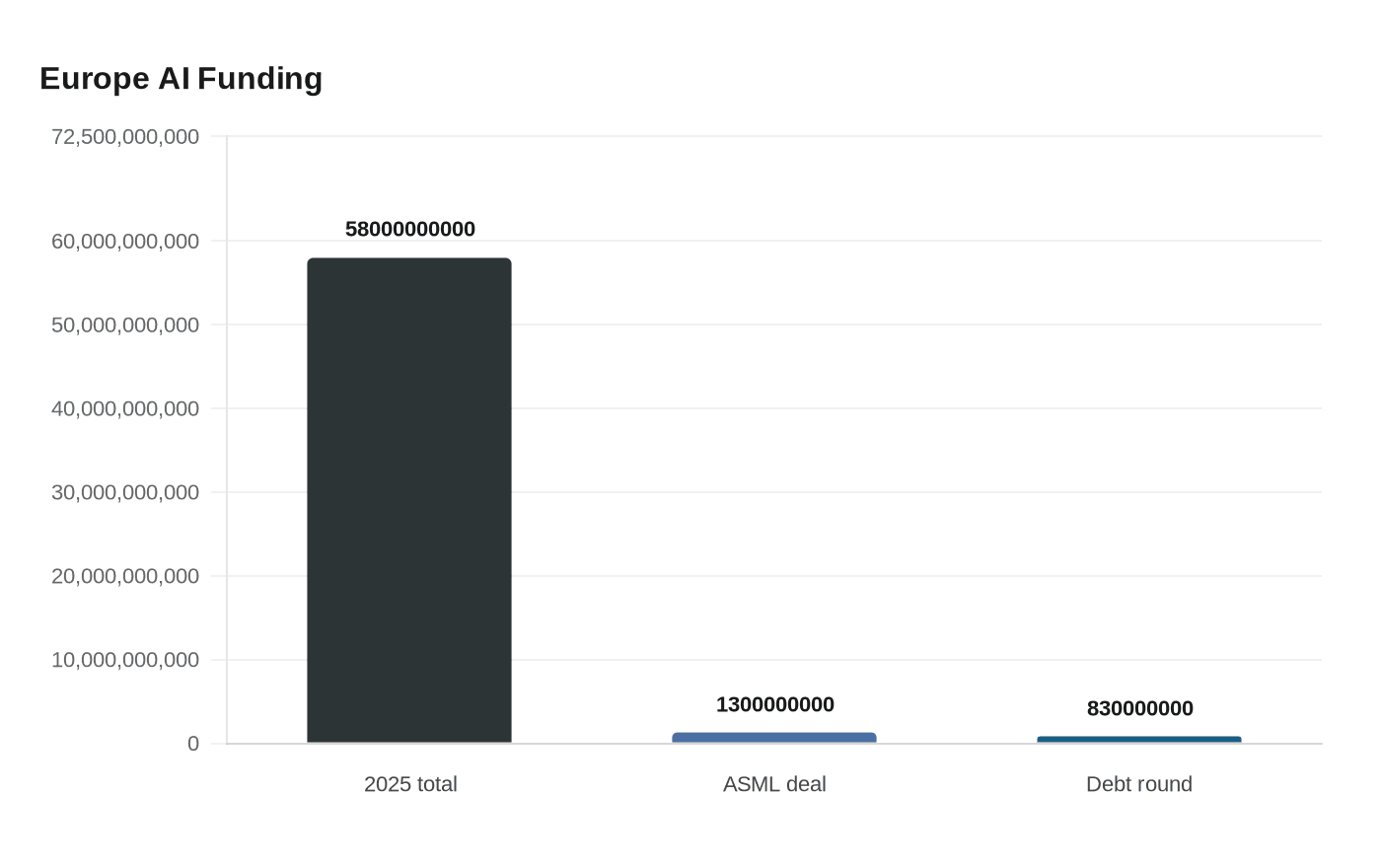
The numbers explain why attention has sharpened. Crunchbase said Europe-based startup funding rose about 9% year over year in 2025 to $58 billion, and AI became the region’s leading sector for startup investment for the first time. PitchBook went further, saying AI startups accounted for a record 39.1% of capital raised in Europe in 2025. In other words, the money is not just arriving, it is concentrating in the very category that will determine who sets the pace in the next generation of compute, models, and enterprise software.
Policy is trying to meet the market
The European Commission has started to act as if this shift matters. Its StepUp Startups initiative is designed to collect data and analysis on the startup landscape, with a particular focus on AI, which is a sign that Brussels wants to understand not just the headline companies but the conditions behind them. That matters because Europe’s challenge has never been a lack of promising founders. The harder problem has been turning promising firms into globally scaled companies without forcing them to leave the region to get the capital, customers, and infrastructure they need.
A November 2025 EU report reinforced that point. It said Europe’s AI investment landscape is expanding quickly and recommended strengthening the capital base, corporate participation, and ecosystem connectivity. Those three levers are revealing. Europe does not only need more venture checks. It needs more corporate buyers, more scale-up networks, and better links between labs, founders, banks, and industrial users. Without those, even successful companies can remain isolated successes instead of becoming a durable ecosystem.
Mistral AI has become the clearest bellwether
If one company now symbolizes Europe’s ambitions, it is Mistral AI. PitchBook identified its financing as the largest European VC deal in 2025, calling out ASML’s €1.3 billion investment in the French LLM developer at an €11.7 billion valuation. That deal alone showed something important: Europe’s industrial base is willing to back strategic AI assets, not just passively admire them. It also showed that deep-tech capital in Europe is beginning to behave more like strategic infrastructure investment than conventional startup finance.
The company’s next moves deepen that signal. A March 2026 report said Mistral AI raised $830 million in debt financing from seven European banks to fund 13,800 Nvidia GB300 GPUs for its first data centre outside Paris, in Bruyères-le-Châtel, France. Another March 2026 report said it plans to build 200 MW of AI computing capacity across Europe by the end of 2027. That is a major shift from model-building as software alone to model-building as industrial capacity, and it is exactly the kind of move that can determine whether Europe remains dependent on foreign compute or starts to own more of its AI stack.
Arthur Mensch put the company’s logic plainly: “Expanding our infrastructure in Europe is essential to empowering our customers and ensuring that innovation and autonomy in AI remain a priority in Europe.” The line captures the broader stakes. Europe is not just trying to host startups. It is trying to ensure that the hardware, financing, and data-center footprint for frontier AI do not all sit elsewhere.
Where Europe may have an edge
Europe’s strongest near-term advantages are not likely to come from outspending the United States or China. They are more likely to come from focused strengths in deep tech, industrial AI, and regulated sectors where trust, compliance, and cross-border policy alignment matter. Dealroom’s 2026 reporting highlighted Europe’s deep tech and AI momentum, and its 2026 calendar includes a State of AI in Europe report and a European Deep Tech report, signaling that these sectors remain central to how investors and policymakers read the region’s future.
That focus makes sense. Europe has dense industrial bases, advanced manufacturing networks, and a policy environment that can reward companies capable of navigating complex regulation. For AI startups, those conditions can be a barrier in consumer-facing markets, but they can also be an advantage in enterprise, industrial automation, defense-adjacent work, and infrastructure-heavy AI. The companies that can sell into these environments often build durable products, not just fast-growth narratives.
The capital and regulatory hurdles still matter
The surge should not obscure the structural problems. Europe still lacks the deep pools of late-stage capital that help companies stay independent through the most expensive years of growth. The EU report’s emphasis on strengthening the capital base is an admission that Europe’s market is not yet fully competitive with the U.S. at the level that matters most: scaling.
Corporate participation remains uneven as well. The policy language around ecosystem connectivity reflects a broader weakness, which is that too many promising firms still struggle to link up with large customers, research institutions, and financing networks early enough. Even when Europe produces a strong company, the default path has often been to seek global scale by leaning on non-European capital and infrastructure. That is exactly the pattern Brussels and national governments are now trying to interrupt.
Regulation is part of the debate too. Europe’s rules can help establish trust and define boundaries in AI, but they can also slow deployment if firms have to navigate fragmented national markets and compliance layers before they have real scale. The challenge is not simply lighter rules or harsher rules. It is creating a coherent environment where responsible deployment does not become a competitive handicap.
Why American readers should pay attention
Europe’s AI startup surge is not a side story for U.S. readers. If Europe succeeds in building competitive AI and deep tech champions, it will reshape where chips, cloud infrastructure, enterprise software, and industrial AI standards are developed and financed. That has implications for transatlantic competition, procurement, and the future bargaining power of U.S. firms operating in Europe.
There is also a broader geopolitical dimension. A more capable European tech base could give governments and companies more leverage in negotiations over data, infrastructure, and strategic autonomy. If Europe cannot make this transition, it will remain a market for imported AI. If it can, it becomes a producer of the technologies that govern productivity, security, and industrial strategy.
For now, the signal is clear: the continent is no longer waiting for permission to build. Capital is moving, public institutions are organizing, and companies like Mistral AI are translating ambition into hardware, debt financing, and compute capacity. Whether that adds up to a genuine counterweight will depend on how fast Europe can turn momentum into scale, and whether its policy response is strong enough to keep its best companies at home while they grow.
This article was produced by Prism’s automated news system from verified source data, official records, and press releases, then run through automated quality and moderation checks before publishing. The system is built and supervised by the people who set the standards it runs under. Read our full AI policy.
Did this article answer your question?


