Explosives Found Near Balkan Stream Pipeline Days Before Hungary's Elections
Two backpacks of explosives were found metres from a Russian gas pipeline feeding Hungary, one week before Orbán faces his toughest election in 16 years.

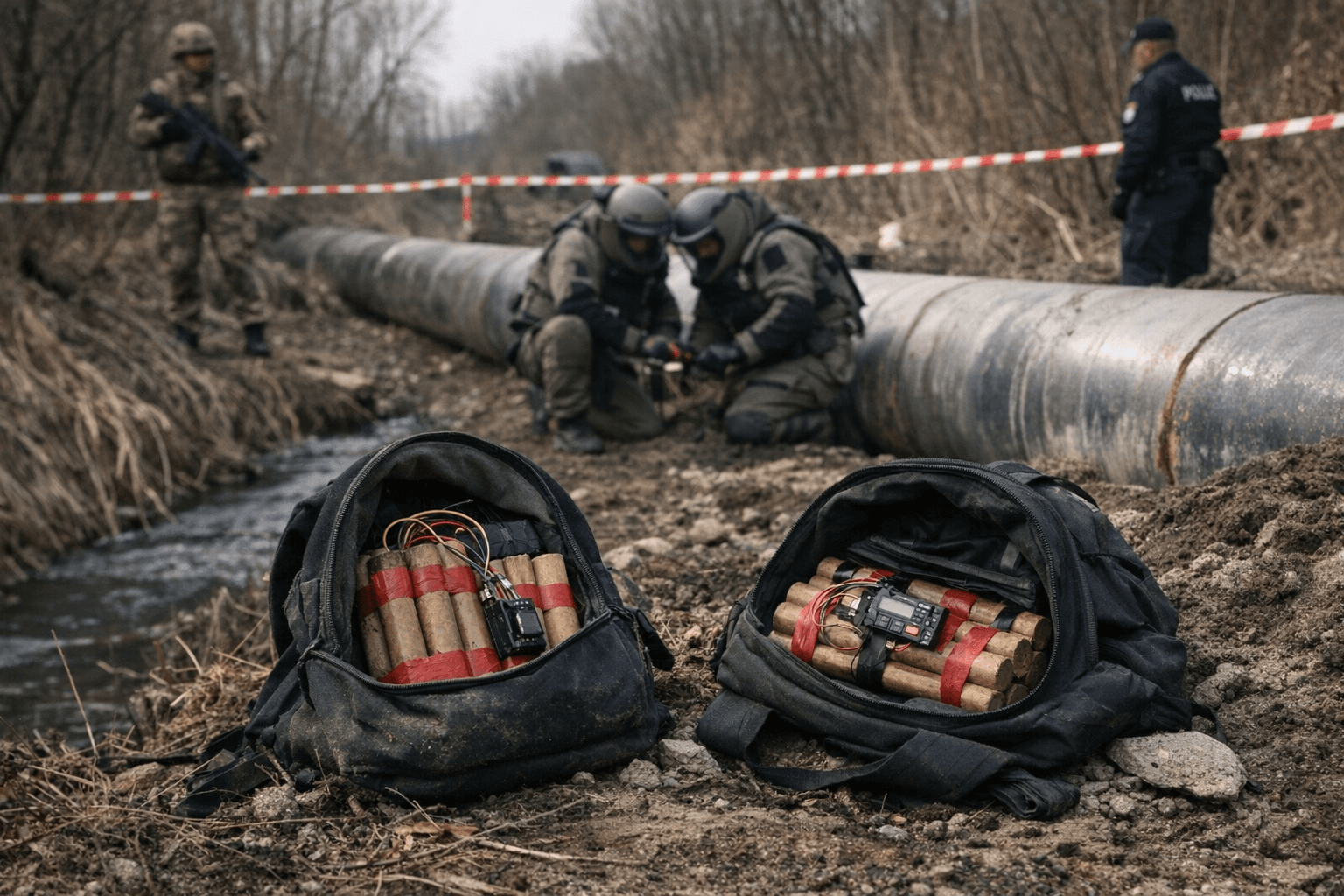
Serbian police and military units discovered two backpacks packed with high-powered explosives near the Balkan Stream gas pipeline in Kanjiza, northern Serbia on Sunday, triggering an immediate political crisis in Budapest exactly one week before Hungary's parliamentary elections.
Serbian President Aleksandar Vučić announced the find following a helicopter-assisted search operation near a local lake in Kanjiza, roughly 10 kilometres from the Hungarian border. The backpacks contained "two large packages of explosives with detonators," Vučić said, describing them as having "devastating power." Serbian Army units subsequently sealed roads near the border.
The Balkan Stream pipeline carries Russian natural gas from TurkStream, which traverses the Black Sea from Russia to Turkey, through the Balkans and into Serbia and Hungary. Had the explosives been detonated, Vučić warned, "Hungary would have no gas, and we in northern Serbia would not have gas either." He declined to publicly name suspects but said: "We think we know which group the individuals who were supposed to take that final step in activating the explosives belong to. The intention was to send a political message. We will severely punish anyone we catch."
In Budapest, Prime Minister Viktor Orbán convened an extraordinary Defence Council meeting on Sunday afternoon after Vučić called him to relay the news. Hungary announced the deployment of military units to guard its section of the pipeline. Foreign Minister Péter Szijjártó stated: "Energy security is a matter of sovereignty, and this is unacceptable to us."
Ukraine moved swiftly to reject any implication of involvement. Foreign Ministry spokesperson Heorhii Tykhyi rejected "attempts to falsely link Ukraine to the incident" and described it as "probably a Russian false-flag operation as part of Moscow's heavy interference in Hungarian elections." Hungarian opposition figures and independent analysts raised comparable concerns about the timing.
That timing is difficult to ignore. Orbán, who has governed Hungary for 16 consecutive years, faces the strongest electoral challenge of his tenure. The opposition Tisza party, led by former government insider Péter Magyar, holds a commanding lead in polling. A 21 Research Institute survey published on April 1 placed Tisza at 56% among decided voters against 37% for Fidesz, a 19-point gap; other polls show the margin ranging between 19 and 23 points. Orbán has framed the election as a choice between "war and peace."
The Kanjiza discovery arrives atop an already volatile energy backdrop. Since late January 2026, the Druzhba oil pipeline, which carries Russian crude via Ukraine to Hungary and Slovakia, has been idle following a Russian missile strike. Budapest has accused Kyiv of deliberately delaying repairs ahead of the vote. Orbán raised security around energy infrastructure in February, and on Saturday posted a video warning that "a severe energy crisis is approaching, accelerating day by day."
Vučić and Orbán are close political allies with well-documented ties to Moscow. Serbia imports approximately 6 million cubic metres of Russian gas daily at roughly half the prevailing market price, and Vučić extended Belgrade's supply deal with Russian President Vladimir Putin by three months as recently as March. Serbia is an EU candidate country but has not yet joined the bloc.
Whether the Kanjiza incident reflects a genuine thwarted attack or something more orchestrated, its proximity to April 12 makes it nearly impossible to assess independently of the political contest it precedes.
This article was produced by Prism’s automated news system from verified source data, official records, and press releases, then run through automated quality and moderation checks before publishing. The system is built and supervised by the people who set the standards it runs under. Read our full AI policy.
Did this article answer your question?