Pakistan, Türkiye to Sign Judicial Cooperation MoU During High-Level Court Visit
Pakistan's Supreme Court will host Türkiye's Constitutional Court president Kadir Özkaya on April 6 to sign a judicial cooperation MoU, as both nations face mounting questions about judicial independence.
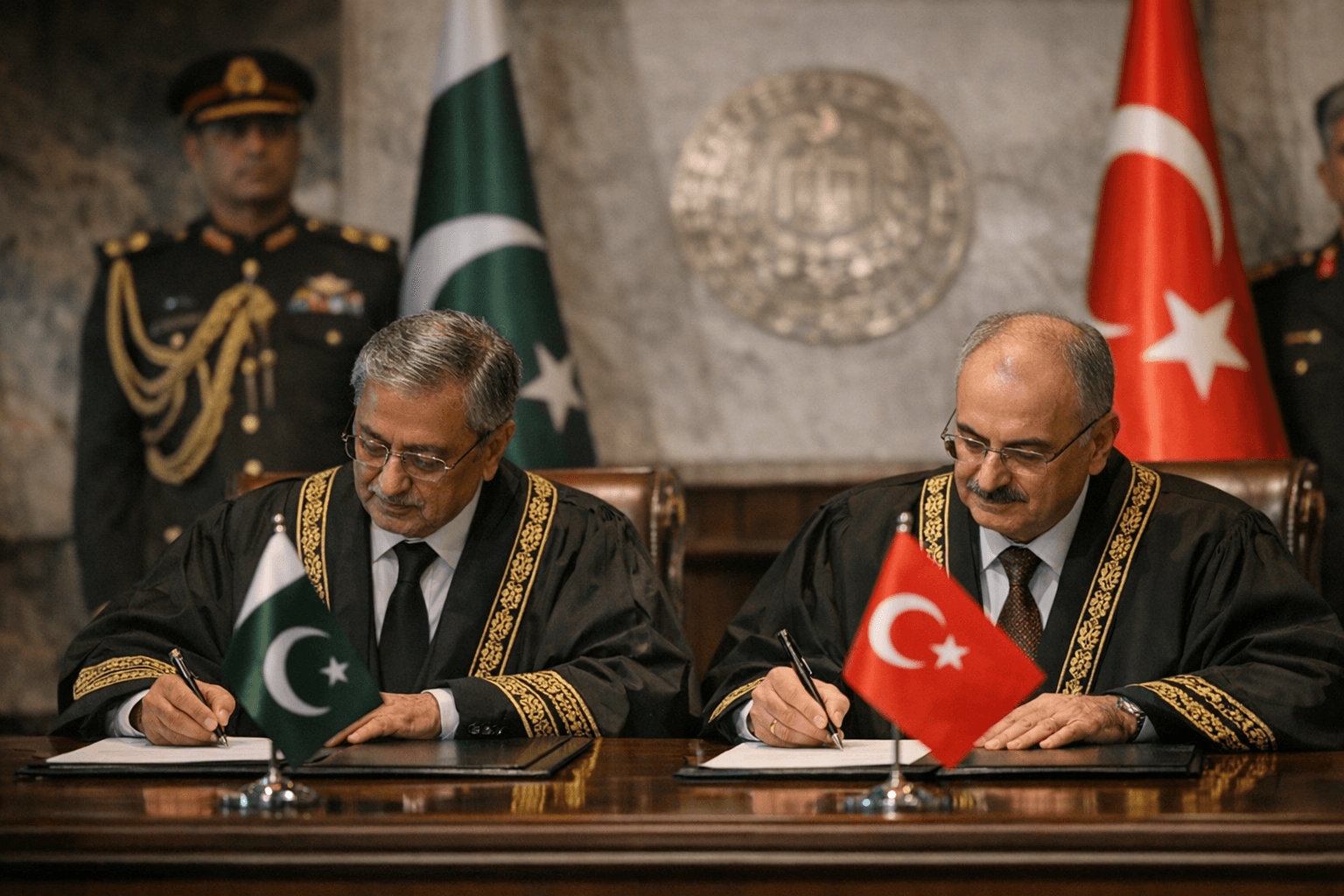
Pakistan's Supreme Court and Türkiye's Constitutional Court will sign a memorandum of understanding on judicial cooperation when a high-level Turkish delegation arrives in Islamabad on April 6, a formal step that formalizes institutional ties between two countries whose domestic judicial records sit uneasily alongside the deal's stated ambitions.
The delegation will be led by Kadir Özkaya, president of Türkiye's Constitutional Court, accompanied by judges and senior judicial officials. Pakistan's side will include Supreme Court justices, the chief justices of the provincial high courts, and Law Minister Azam Nazeer Tarar. The MoU's stated architecture covers a joint working group to oversee implementation, formalized academic and training exchanges, and a drive to embed modern technologies, including e-filing, virtual hearings, and case-management platforms, into judicial administration. Such agreements also typically allow courts to share comparative legal experience on constitutional interpretation, trial procedure, and judicial ethics, giving one country's bench access to another's institutional design without adopting binding legal commitments.
Pakistan and Türkiye have steadily expanded bilateral ties across economic, defense, and cultural lines, and judicial cooperation fits that pattern. For Pakistan, the practical pull is significant: the Supreme Court alone reported 56,169 pending cases in October 2025, and technology transfers and administrative reforms modeled on foreign systems are presented as tools to improve access to justice at district and appellate levels. For Türkiye, bilateral MoUs serve diplomatic as well as legal interests. Özkaya has led an active international outreach effort since taking the court's presidency, signing cooperation agreements with other nations in late 2025 as part of a broader strategy to position the Constitutional Court as a regional institutional anchor.
Both governments come to the table, however, carrying domestic credibility problems on the very principles the MoU invokes. Pakistan passed its 27th Constitutional Amendment in November 2025 in less than a week of legislative deliberation, creating a Federal Constitutional Court that stripped the Supreme Court of its exclusive jurisdiction over constitutional interpretation and expanded executive control over judicial appointments. The International Bar Association's Human Rights Institute condemned the measure as a structural assault on the independence of the judiciary, with long-term consequences for constitutional governance and the protection of fundamental rights. Türkiye, meanwhile, has faced European Commission assessments citing serious backsliding on democratic standards and judicial independence, and repeated episodes of lower courts openly defying Constitutional Court rulings have drawn sustained criticism from legal observers, raising questions about how much institutional weight Özkaya's court actually carries at home.
The MoU will ultimately be measured not by the signing ceremony or the delegation's scheduled visits to the archaeological site of Taxila and Lahore's Walled City, but by whether the follow-up working groups produce enforceable timelines, whether digital court projects penetrate Pakistan's district judiciary, and whether either bench grows more insulated from executive pressure rather than less. Those outcomes will require years to assess, and neither country's recent record suggests the political will to let courts operate at arm's length from governments that have worked methodically to reduce that distance.
This article was produced by Prism’s automated news system from verified source data, official records, and press releases, then run through automated quality and moderation checks before publishing. The system is built and supervised by the people who set the standards it runs under. Read our full AI policy.
Did this article answer your question?