Federal Judge Halts White House Ballroom Construction, Citing Congressional Authority
A federal judge shut down Trump's $400 million White House ballroom project, ruling no existing statute comes close to giving the president authority to build without Congress.
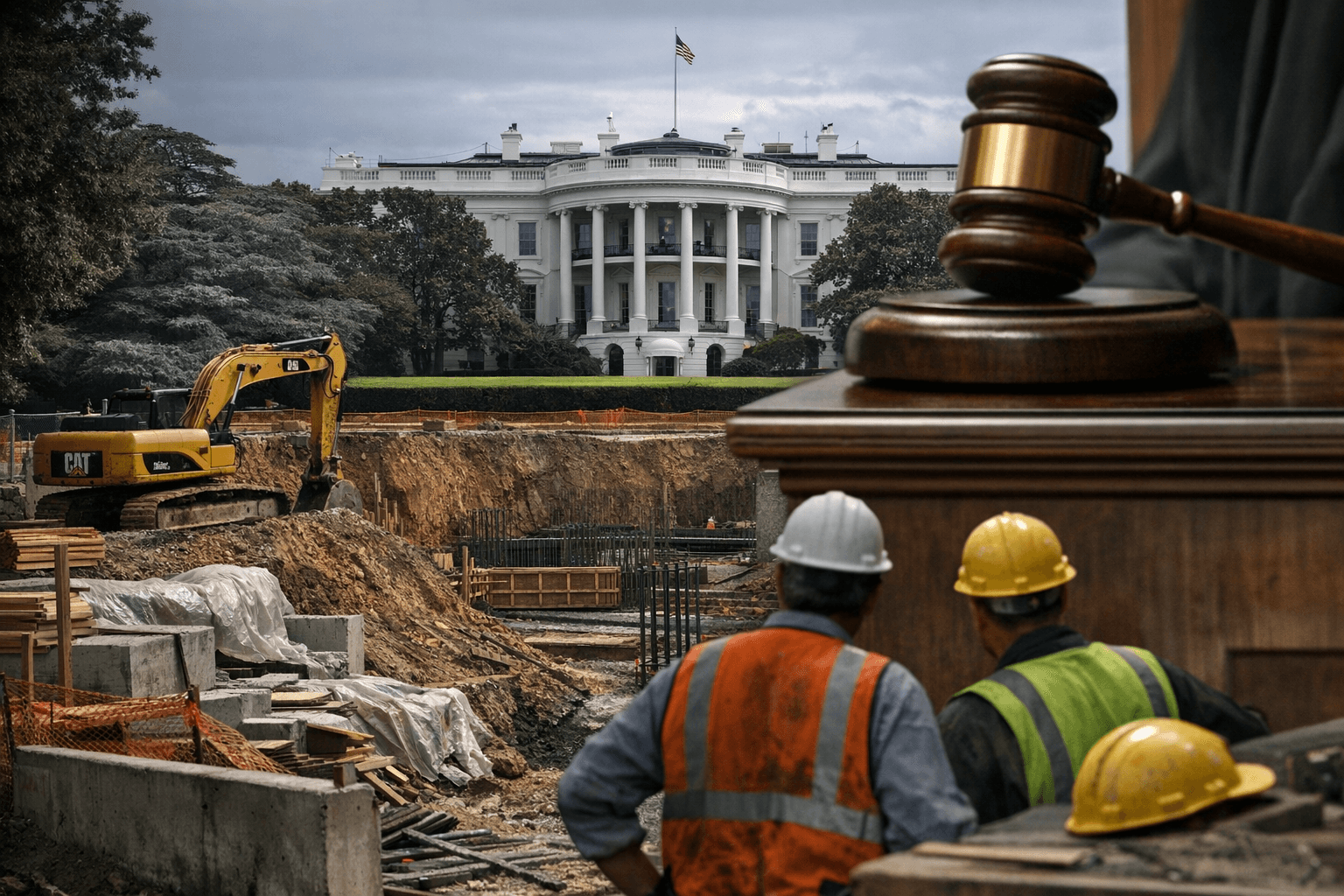
A federal judge issued a sharp rebuke to the Trump administration Tuesday, ordering an immediate halt to construction of a $400 million ballroom on the former site of the White House East Wing and ruling that no statute in existence gives the president authority to proceed without congressional approval.
U.S. District Court Judge Richard Leon, a George W. Bush appointee, stated his conclusion plainly: "Unfortunately for Defendants, unless and until Congress blesses this project through statutory authorization, construction has to stop!" The preliminary injunction bars workers from any demolition, excavation, foundation work, or other physical development beyond what is strictly necessary to ensure safety and security at the complex.
The decision lands at the intersection of three constitutional doctrines Leon cited: Congress's power to control public lands, the Appropriations Clause granting lawmakers control over federal spending, and the District Clause giving Congress authority over the nation's capital. The administration had argued that existing statutes provided the president broad authority to build on federal property in Washington regardless of the funding source, a position Leon dismissed as historically unprecedented. "This clearly is not how Congress and former Presidents have managed the White House for centuries," he wrote.
Trump began demolishing the East Wing in October 2025 to make room for the ballroom, a nearly 90,000-square-foot structure intended to host state dinners, galas, and other events, with completion slated for 2028. The administration said the $400 million price tag would be covered entirely by private donors, including Amazon, Meta, Altria, NextEra Energy, and Lockheed Martin. Officials also cast the project in national security terms, citing planned bomb shelters and a drone-proof roof.
Leon was unmoved by the security framing and dismissive of comparisons to earlier White House renovation projects. "This is an iconic symbol of this nation," he said from the bench, adding in his written opinion: "The President of the United States is the steward of the White House for future generations of First Families. He is not, however, the owner!"
The ruling does not permanently kill the project. Leon offered a direct path forward, writing that the president could seek congressional authorization at any time, and that Congress could choose to appropriate public funds, greenlight private financing, or devise an alternative funding scheme. "Either way, Congress will thereby retain its authority over the nation's property and its oversight over the Government's spending," he wrote.
Leon paused enforcement of the injunction for 14 days to allow for an appeal, warning that above-ground construction completed during that window "is at risk of being taken down depending on the outcome of this case." The Justice Department filed a notice of appeal roughly 90 minutes after the ruling.
The lawsuit was brought by the National Trust for Historic Preservation, which sued in December after the administration moved ahead without congressional sign-off. Carol Quillen, the organization's president and CEO, called the ruling "a win for the American people on a project that forever impacts one of the most beloved and iconic" federal landmarks. Trump dismissed the organization as unappreciative of his efforts at "sprucing up" Washington's buildings.
The constitutional stakes extend well beyond this project. By anchoring his ruling in the Appropriations Clause and Congress's authority over federal lands, Leon established a framework that could apply to any future administration, regardless of party, seeking to finance significant construction on federal property through unconventional private funding. Who decides what qualifies as an "improvement" to a national landmark, and who authorizes the money, now sits with the appellate courts and, if Leon's logic holds, ultimately with Congress.
Sources:
Know something we missed? Have a correction or additional information?
Submit a Tip