Four Dead in Haifa After Iranian Strike Bypasses Israeli Air Defenses
Iranian missile kills four members of a Haifa family after Israeli air defenses failed to intercept the ballistic projectile, exposing gaps in Israel's multi-layered defense shield.
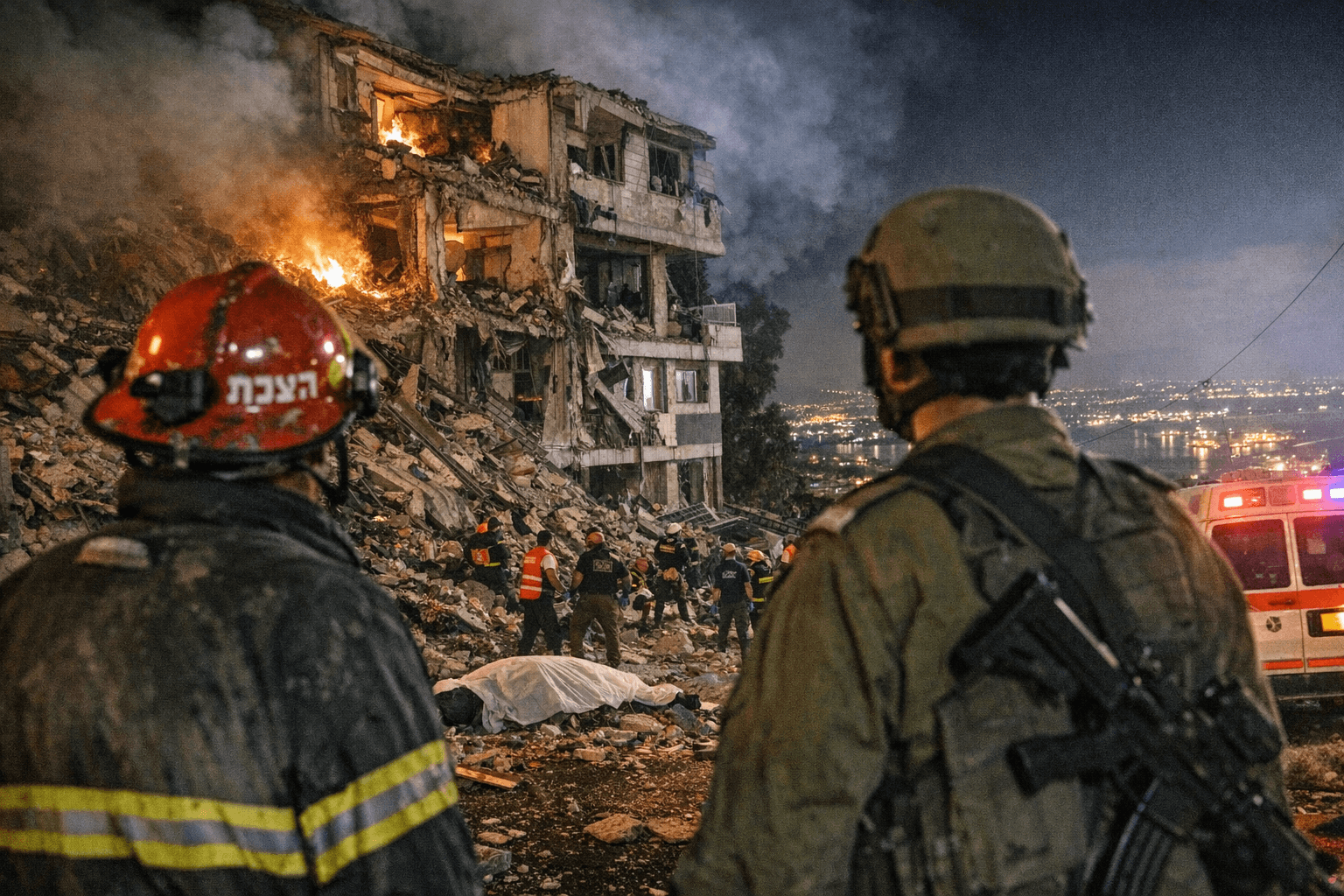
Rescue workers pulled four bodies from the rubble of a six-story residential building in Haifa on Monday after an Iranian ballistic missile tore through the structure the previous evening, igniting a fire and triggering a partial collapse of the building's upper three floors. The dead were identified as Lena Ostrovsky, 68, her husband Vladimir Gershovich, 73, their son Dima, 42, and his wife Lucille Jean, approximately 25, a Filipino national. Investigators determined the four were caught in the building's stairwell and had not reached the internal shelter before the missile struck.
The Israeli Air Force confirmed that interception was attempted and failed, and the service announced it had opened a formal investigation into how the projectile penetrated the country's defenses. The missile carried a conventional warhead, the military said, ruling out the cluster munition variant that struck a separate target the following day. Israel operates a three-tier air defense architecture: the Arrow system, designed specifically to engage long-range ballistic missiles launched from Iran and Yemen; David's Sling, which covers medium-range threats; and Iron Dome, built for shorter-range rockets. All three tiers were designed to be interlocking, with real-time data sharing across platforms. That layered architecture failed Sunday for reasons the IDF had not publicly detailed by Monday morning.
The failure was not the first. In the weeks prior, missiles reached Dimona and Arad in southern Israel, prompting IDF air defense commanders to acknowledge publicly that no system achieves perfect intercept rates. "There are mistakes, there are malfunctions," one senior official said in the aftermath of those strikes. "No matter how advanced they are, they have limitations."
At the scene in Haifa, the Magen David Adom evacuated an 82-year-old man with serious injuries, along with a 78-year-old woman with moderate wounds, a 38-year-old woman and a 10-month-old infant, both lightly hurt. Six additional people wounded in a separate Iranian strike on a vehicle in northern Israel were taken to Galilee Medical Center in Nahariya. Israel's Home Front Command deployed rescue teams using advanced detection equipment throughout the night as the building remained at serious risk of collapse.
The strike landed on the fifth week of a conflict that began February 28, 2026, when the United States and Israel launched coordinated strikes against Iranian nuclear and military infrastructure following the collapse of diplomatic talks. Iran has since conducted dozens of retaliatory missile barrages against Israeli cities. On Sunday night, Israeli Air Force jets hit dozens of Iranian military aircraft and helicopters at three airports in Tehran, a significant escalation in target selection. Iran simultaneously rejected a U.S. proposal for a temporary ceasefire, and President Trump responded by threatening to "take out Iran in one night."
Intelligence and military analysts monitoring the conflict's trajectory described escalation as the most probable near-term scenario. For the families of Ostrovsky, Gershovich, Dima, and Lucille Jean, the trajectory of the war converged in a stairwell on a Sunday evening. The investigation into why the missile was not stopped before it reached them will shape every phase of the conflict that follows.
This article was produced by Prism’s automated news system from verified source data, official records, and press releases, then run through automated quality and moderation checks before publishing. The system is built and supervised by the people who set the standards it runs under. Read our full AI policy.
Did this article answer your question?


