France records hottest day ever as Europe faces severe heatwave
France set a new heat record at 29.8 C as 54 departments faced red alerts and schools, trains and landmarks were forced to adapt.
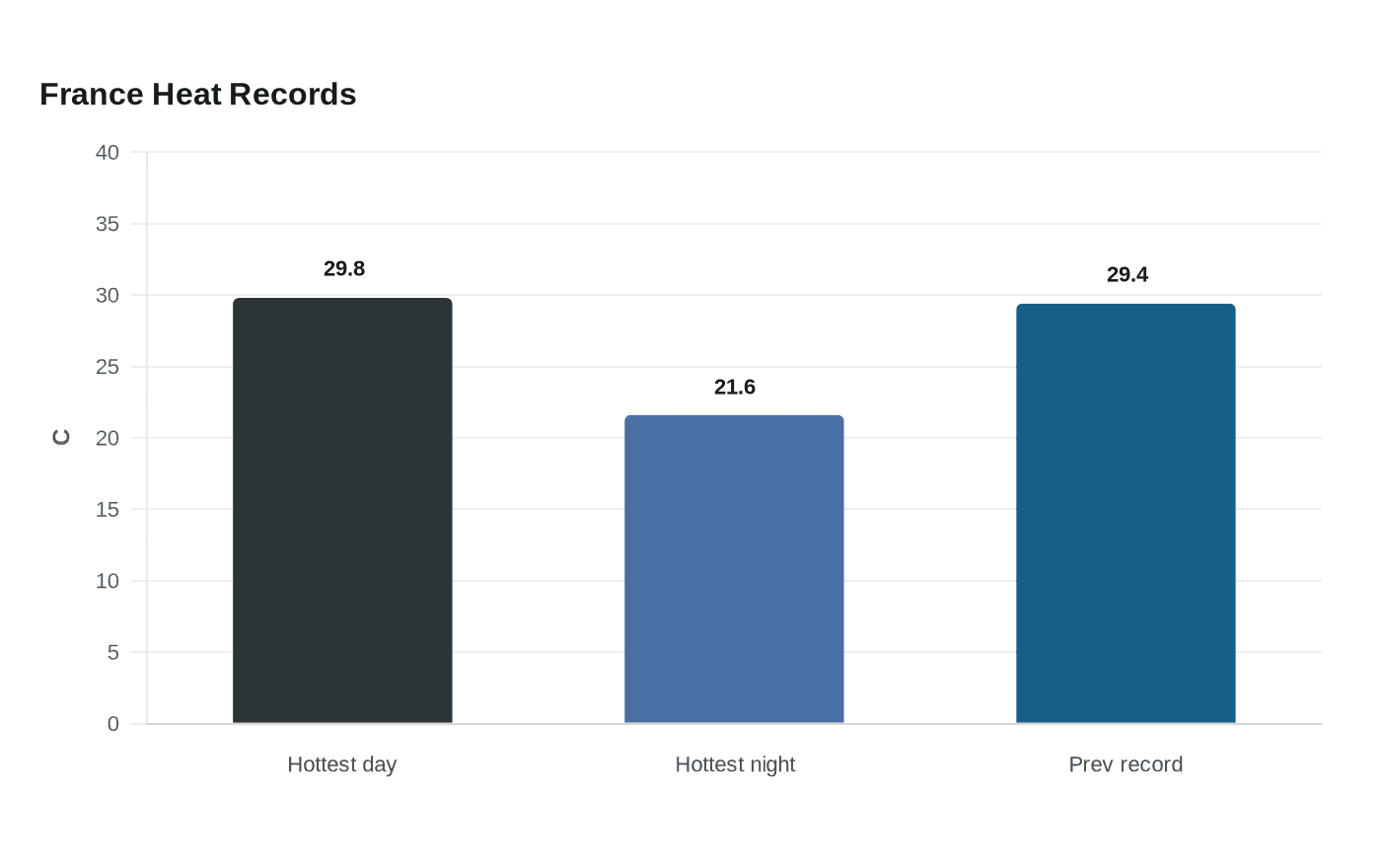
France’s heat wave pushed the country into uncharted territory on Tuesday, with the national thermal indicator hitting 29.8 C, the hottest average ever recorded across 30 weather stations. Météo-France placed 54 departments, about half the country, under a red heatwave alert as temperatures above 40 C were expected to linger through the end of the week.
The overnight heat was nearly as punishing. France also logged its hottest night on record Monday into Tuesday, when the average across 30 stations reached 21.6 C, underscoring how little relief the country had after sunset. The previous national record, 29.4 C, had been set during the August 2003 and July 2019 heat waves, and the speed at which this event surpassed it reinforced how far the current episode has pushed the system.

The strain was visible well beyond the weather maps. Hundreds of schools were ordered to close, trains and sporting events were disrupted, and major Paris landmarks including the Eiffel Tower and the Louvre museum adjusted their hours. Authorities said at least 40 people drowned in France since June 18 as many people sought relief from the heat, including many young people. In a country where public life is built around dense cities, commuter rail and school schedules, the heat wave became a test of basic infrastructure as much as a climate event.
The pressure was not confined to France. Britain, Spain and Italy also issued red alerts, while Germany and Switzerland faced similar warnings as the hottest conditions spread across the continent. The United Kingdom’s Met Office said June heat records were very likely to be broken, a sign of how early and how broadly the extreme temperatures had arrived. Europe has warmed about twice as fast as the global average since the 1980s, according to the European Union Copernicus Climate Change Service, and the current episode has revived memories of August 2003, when an extreme heat wave was linked to an estimated 15,000 deaths in France.
That history still shapes the response today. France created its heat-watch warning system after the 2003 disaster, and this week’s red alerts, school closures and service changes showed how much depends on speed, coordination and public compliance when temperatures climb this high. For U.S. cities, the lesson is blunt: heat waves are no longer just weather disturbances, but stress tests for transportation, schools, emergency planning and public health systems that have to function before the heat becomes deadly.
This article was produced by Prism’s automated news system from verified source data, official records, and press releases, then run through automated quality and moderation checks before publishing. The system is built and supervised by the people who set the standards it runs under. Read our full AI policy.
Know something we missed? Have a correction or additional information?
Submit a Tip