German Automaker Scales Back Electric Vehicle Plans, Prioritizes Gasoline Models
Volkswagen is ending ID.4 electric SUV production at its Chattanooga, Tennessee plant this month, pivoting to the gas-powered Atlas as EV demand falters.

Volkswagen announced Thursday it would halt production of the ID.4 electric SUV at its Chattanooga, Tennessee assembly plant in mid-April, redirecting the facility's capacity toward the gasoline-powered 2027 Atlas and Atlas Cross Sport. The decision makes VW the latest major European automaker to retreat from an ambitious electrification commitment it had staked to a specific American factory and a specific American workforce.
The Chattanooga plant employs roughly 3,200 hourly workers, who in February ratified their first contract with the United Auto Workers by a 96 percent margin. That agreement, with sizable raises and bonuses, took effect February 23, just weeks before management delivered the production pivot. Workers currently assigned to ID.4 assembly will be transferred to other plant positions based on seniority, VW said, with a special early retirement program offered to eligible employees. No direct layoffs were announced.
The reversal underscores how thoroughly the economics of EV manufacturing have shifted since VW made a $800 million investment to electrify the Chattanooga plant in 2022. Production of the U.S.-market ID.4 moved from Zwickau, Germany, to Tennessee that July with the promise of reaching 7,000 units per month. Four years later, the model is being phased out of American production entirely, a casualty of demand that never matched that trajectory.
Sales figures illuminate the gap. The Atlas moved more than 71,000 units in the U.S. in 2025, even as that figure slid from 75,500 the prior year, while the Atlas Cross Sport sold approximately 31,600. By contrast, the ID.4 had received a brief boost when buyers rushed to claim Inflation Reduction Act EV tax credits before they expired September 30, 2025, but that surge masked rather than resolved the underlying weakness. Without that federal incentive propping up demand, the case for continuing domestic EV production deteriorated quickly.
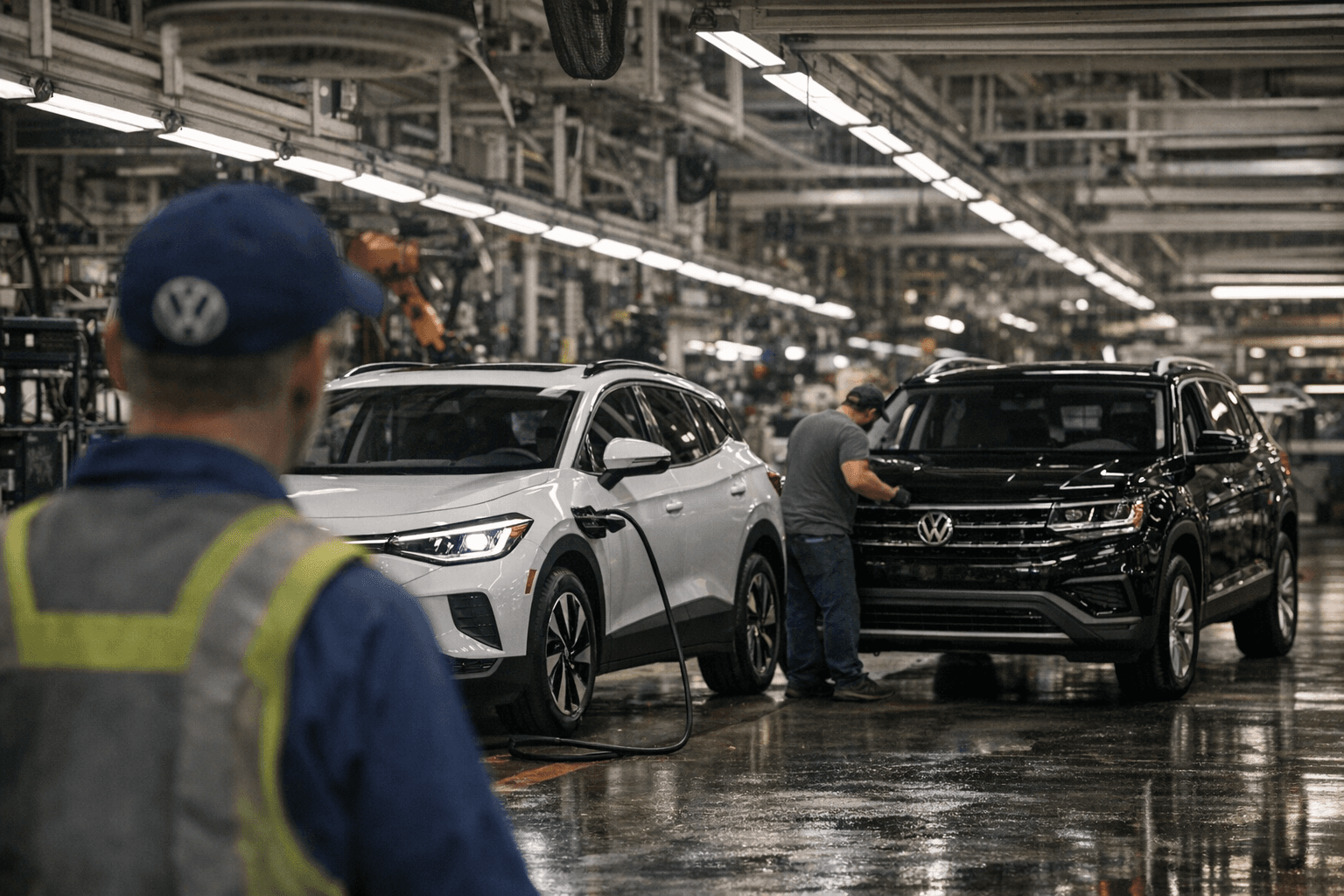
The 2026 model year ID.4 will remain on sale through existing dealer inventory, which VW expects will carry into 2027. The ID. Buzz electric van, meanwhile, will skip the 2026 model year altogether due to excess unsold stock from 2025. VW said it is planning a future version of the ID.4 for the North American market but offered no timeline or pricing details.
The new-generation Atlas begins rolling off the Chattanooga line this summer, with dealer availability expected in the fall. The current 2026 Atlas carries a base manufacturer suggested retail price of $39,310. VW's spokesman noted the plant's production line can sequence multiple models dynamically, but going forward, the Atlas family will be the facility's sole product, at least for now.
For Tennessee's broader economic planning, the shift carries real weight. State and local governments used the prospect of EV manufacturing to justify infrastructure investments and attract component suppliers to the region. A Chattanooga plant producing only gasoline SUVs narrows the footprint of that bet considerably, and the timeline for any next-generation electric model arriving from VW remains unresolved. For U.S. emissions targets, which depend heavily on passenger vehicle electrification rates, one fewer domestically built EV option at scale is a measurable setback, not an abstraction.
This article was produced by Prism’s automated news system from verified source data, official records, and press releases, then run through automated quality and moderation checks before publishing. The system is built and supervised by the people who set the standards it runs under. Read our full AI policy.
Did this article answer your question?

