Global debt hits record $353 trillion as investors eye Treasury alternatives
Global debt neared $353 trillion as investors shifted toward European and Japanese bonds, a hint that Treasury demand is no longer the automatic default.
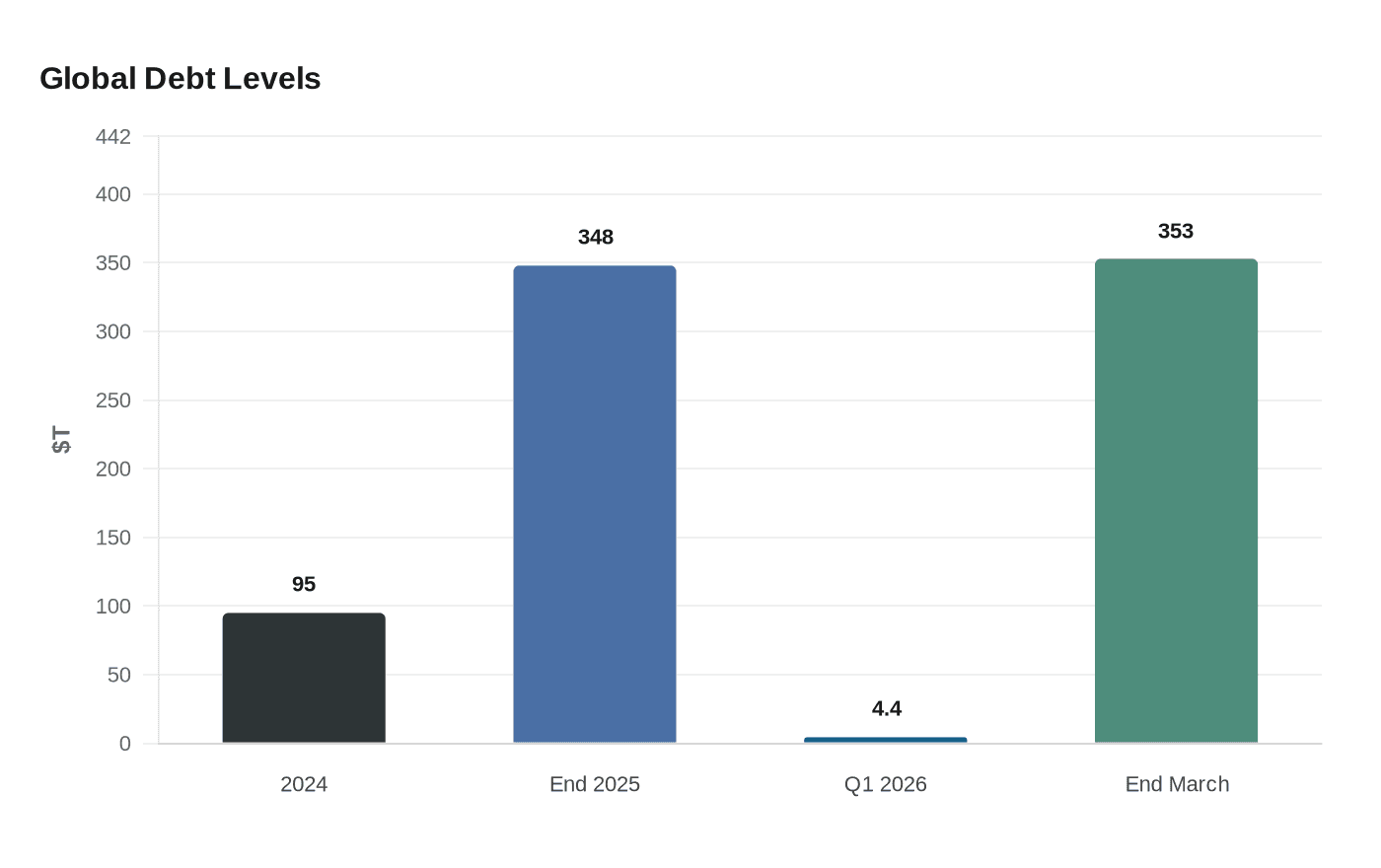
The world’s debt stockpile climbed to a record near $353 trillion by the end of March, and investors are showing early signs of looking beyond U.S. Treasuries for safety.
The Institute of International Finance said its May Global Debt Monitor showed global debt rose by more than $4.4 trillion in the first quarter of 2026, after reaching $348 trillion at the end of 2025. The group said nearly $29 trillion was added in 2025 alone, the fastest annual increase since the pandemic-era surge, with the latest buildout concentrated in China and the United States and driven largely by government borrowing.
For U.S. markets, the key signal is not panic but positioning. The IIF said cross-border investors have shown some diversification away from Treasuries in favor of European Union and Japanese government bonds. That matters because demand for Treasuries is a barometer for confidence in the U.S. fiscal outlook, the dollar and the country’s role at the center of global capital markets. If that shift deepens, Washington could face higher borrowing costs, and those costs tend to filter through to mortgage rates, auto loans and the federal deficit over time.
The report also pointed to a split in credit markets. U.S. corporate bond markets continue to boom, supported by artificial intelligence-related issuance and strong overseas inflows, even as government bond markets look less settled. The IIF said that disconnect is unfolding against a backdrop of geopolitical fragmentation, armed conflict and market volatility.
The longer arc is sobering. Global government debt exceeded $95 trillion in 2024 and rose further in 2025, while the world’s debt load has stayed broadly stable at about 305% of global GDP since early 2023. That stability, however, hides sharp regional differences. Debt ratios have been declining in mature markets but rising in emerging economies, where refinancing needs top $9 trillion in 2026.
Emerging-market debt excluding China rose to a record $36.8 trillion in early 2026. The IIF said supportive funding conditions, a softer dollar and carry-trade demand have helped keep spreads near record lows, but the financing burden remains heavy. It also reclassified Czechia, Hong Kong, Israel, Singapore and South Korea as mature markets in the new monitor, underscoring how quickly the map of global borrowing is changing.
For now, the Treasury shift looks more like a market signal than a crisis. But as record debt meets a more selective investor base, the United States may find that the world no longer treats its bonds as the unquestioned destination for surplus capital.
This article was produced by Prism’s automated news system from verified source data, official records, and press releases, then run through automated quality and moderation checks before publishing. The system is built and supervised by the people who set the standards it runs under. Read our full AI policy.
Did this article answer your question?