Greece signals new Aegean territorial waters expansion despite Turkish warnings
Greece says it will extend territorial waters in the Aegean, prompting Ankara’s objections and raising diplomatic and security stakes for NATO and regional energy disputes.
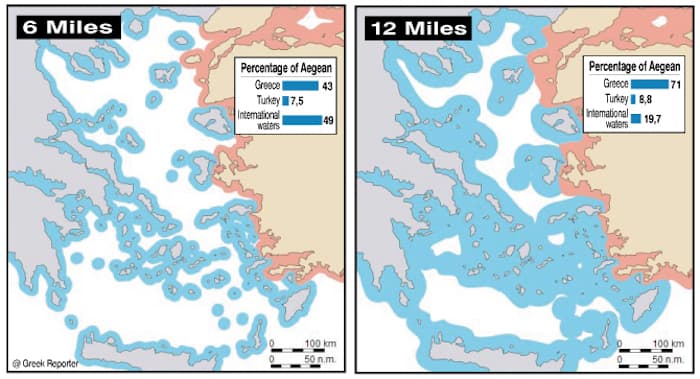
Greek Foreign Minister George Gerapetritis told parliament that Athens intends to press ahead with further extensions of its territorial waters, potentially including parts of the Aegean Sea, despite long-standing Turkish warnings that such moves could provoke confrontation. He affirmed that “Today, our sovereignty in the Aegean Sea extends to six nautical miles,” and said expansion was planned without pinpointing which maritime zones would be affected.
Gerapetritis sought to frame the step as part of a steady legal and spatial policy. “As there was an agreement with Egypt, as there was an agreement with Italy, there will also be (a further) extension of the territorial waters,” he told lawmakers, suggesting future moves would follow bilateral delimitation practice. Other parliamentary remarks tied the decision to environmental and planning initiatives: “Extension of territorial waters [in the Aegean Sea] will come, as marine parks and spatial planning,” he was reported to have said.
The announcement reiterates a recent pattern in Athens’s maritime strategy. Greece extended parts of its territorial waters in the Ionian Sea from six to 12 nautical miles following an agreement with Italy, a step implemented in January 2021. Athens has also concluded a maritime delimitation accord with Egypt covering sections of the eastern Mediterranean, and last summer unveiled boundaries for planned marine parks in the Ionian and Aegean seas. Official maps presented an Aegean marine park covering roughly 9,500 square kilometres around the southern Cyclades, a move that drew objections from Ankara.
The dispute between two NATO allies traces to contested interpretations of international maritime law and the Aegean’s complex geography of islands, narrow seas and overlapping continental shelves. Control over maritime zones carries implications for exclusive economic zones, the right to exploit seabed resources and management of airspace and overflights. Turkey has historically reacted strongly to unilateral Greek extensions; in 1995 the Turkish parliament declared a casus belli if Greece increased its territorial waters in the Aegean beyond six nautical miles.

Ankara did not immediately issue an official response to the foreign minister’s remarks. Turkish officials have repeatedly accused Greece of militarising some Aegean islands since the 1960s and of violating postwar arrangements, a narrative that Ankara uses to justify its objections. Athens rejects those claims and presents its moves as consistent with international law and with bilateral agreements reached in other parts of the Mediterranean.
Domestically, the government has linked maritime policy to a broader posture of what it calls principled strength and to military modernisation. Officials have highlighted the arrival of the Hellenic Navy’s first FDI-class Belharra frigate, Kimon (F-601), as part of a stepped-up defence profile. Observers warn, however, that signalling military capability while simultaneously altering maritime claims can harden positions on both sides and reduce diplomatic space.
The unfolding episode places strain on NATO cohesion at a time when alliance unity is prized for deterrence and regional stability. Legal channels for resolving maritime disputes exist, but both Athens and Ankara face domestic political incentives that complicate compromise. The coming weeks will test whether Athens will specify the areas and timing of any extension, and whether regional and European partners can help mediate a solution that reduces the risk of escalation while clarifying maritime rights in a strategically sensitive sea.
This article was produced by Prism’s automated news system from verified source data, official records, and press releases, then run through automated quality and moderation checks before publishing. The system is built and supervised by the people who set the standards it runs under. Read our full AI policy.
Did this article answer your question?


