Haitian forces reported to bomb three houses linked to gang leader Barbecue
Local outlet Gazette Haiti reported security forces struck residences tied to gang leader Jimmy "Barbecue" Chérizier in Port-au-Prince, raising questions about verification and economic fallout.
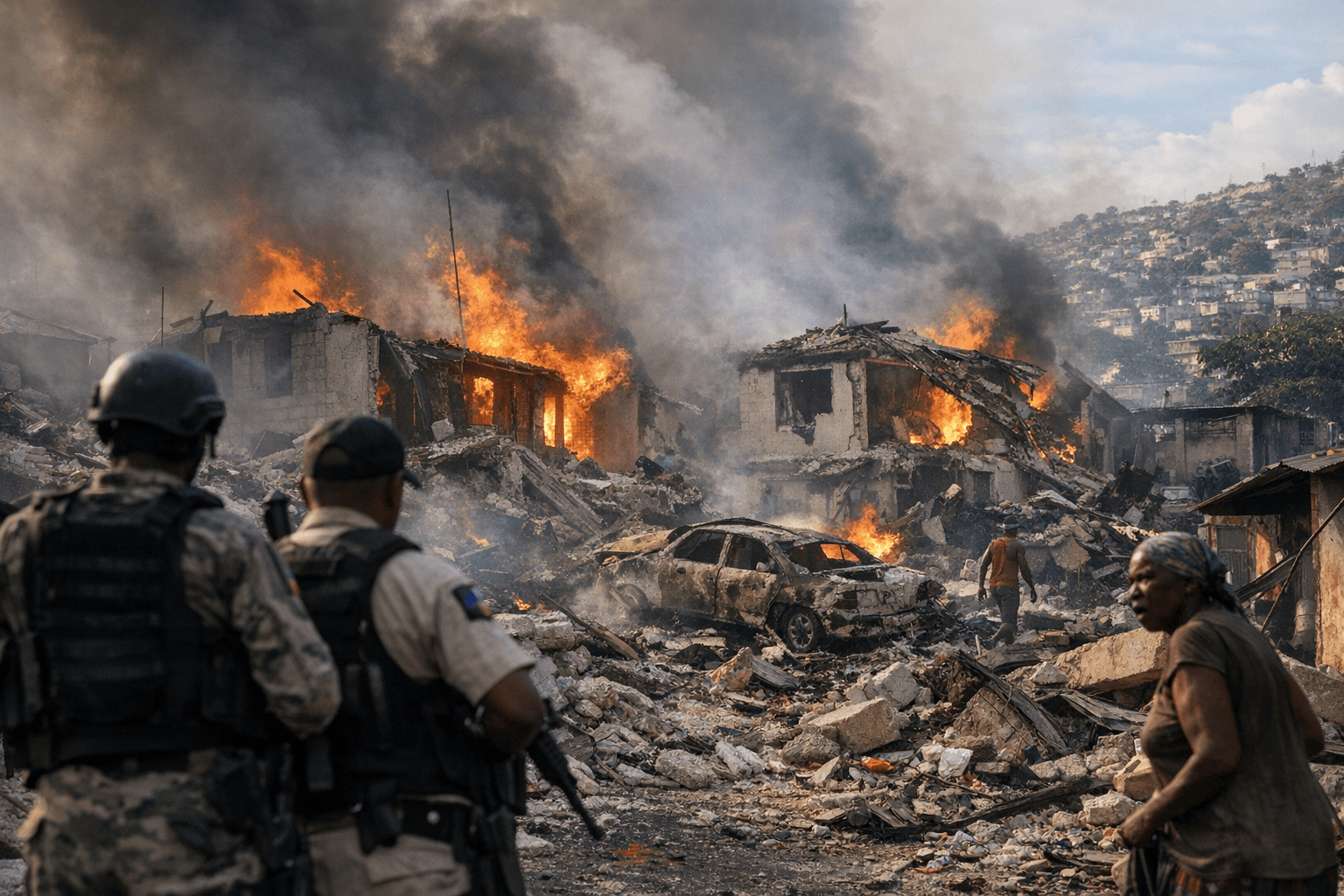
Haitian security forces carried out bombing strikes on residences linked to Jimmy "Barbecue" Chérizier in Port-au-Prince, local outlet Gazette Haiti reported, saying three houses were hit. The account was relayed by international wire services and news aggregators, and footage circulating online showed a large explosion that destroyed buildings, though that video has not been independently verified.
The operation, reported Jan. 14, has not been confirmed by any government ministry, the national police, or named military units, and no official statement explaining the rationale was available at the time of reporting. There is no independently verified information on casualties, the timing of the strikes beyond the reported date, or any subsequent arrests or legal actions. The absence of named actors and casualty figures leaves the core claims as unverified allegations pending confirmation from Haitian authorities or on-the-ground verification.
The reported strikes carry immediate security and economic implications in a country where state capacity is limited and gang influence is pervasive. Jimmy Chérizier is widely described as a top gang leader in Port-au-Prince; targeting properties linked to him could signal a heightened willingness by security actors to use heavy force in urban neighborhoods long contested by armed groups. Such operations risk civilian harm and further displacement in densely populated districts, aggravating humanitarian needs.
Economically, renewed or escalated violence could deepen an already fragile situation. Haiti’s formal economy is small and informal activity dominates; remittances from the diaspora account for roughly one-third of national income, acting as a crucial safety net for households. Heightened insecurity tends to disrupt remittance channels, raise transaction costs, and push more activity underground. Local currency volatility and disrupted supply chains can amplify food and fuel price pressures for consumers who already face constrained purchasing power.
Financial markets and aid flows are also sensitive to security shocks. International donors and lenders typically condition or calibrate assistance on governance and human rights considerations. An operation of this nature, particularly if followed by civilian casualties or a lack of transparency, could prompt donors to suspend program disbursements or demand stricter oversight, reducing liquidity available for public services. Private investors, already scarce, are likely to retreat further, widening financing gaps for reconstruction and basic services.
Policy responses should prioritize verification and civilian protection while addressing the root drivers of gang power. Independent confirmation of the strikes, including geolocation of the circulating footage and local witness reporting, is essential for accountability. If verified, operations should be accompanied by transparent legal procedures, humanitarian access to affected neighborhoods, and measures to safeguard noncombatants. In the medium term, stabilizing Haiti requires rebuilding policing capacity, restoring judicial processes, and expanding economic opportunities that reduce communities’ reliance on armed actors.
The reported strikes underscore a dangerous feedback loop between security operations and economic decline. Without rapid, transparent action to verify events and to shield civilians and critical economic lifelines, short-term tactical gains risk producing longer-term instability that will further erode living standards and constrain Haiti’s fragile recovery.
This article was produced by Prism’s automated news system from verified source data, official records, and press releases, then run through automated quality and moderation checks before publishing. The system is built and supervised by the people who set the standards it runs under. Read our full AI policy.
Did this article answer your question?


