HELOC rates may hold near 7% as Fed, inflation weigh on outlook
HELOC rates are near 7% now, but only Fed cuts, sticky inflation or a geopolitical shock are likely to move them much by late 2026.
Why HELOC rates are sitting in a narrow band
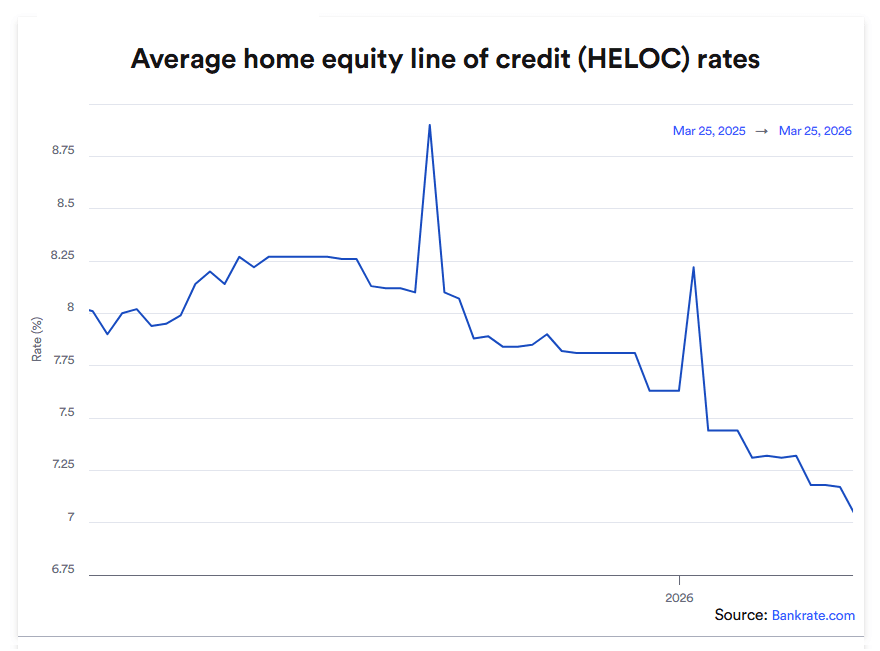
HELOC borrowers are starting from a better place than they were 18 months ago. The national average HELOC rate stood at 7.02% on April 8, 2026, after sliding from about 9% over the past year and a half and falling nearly half a percentage point in the first quarter alone. That kind of move is meaningful for homeowners weighing whether to tap equity now or wait, but it also leaves rates in a range where the next move depends heavily on the Fed, inflation and broader market shocks.
The key point is stability, not drama. Bankrate says home-equity borrowing costs are driven primarily by Federal Reserve policy and long-term inflation expectations, and the Fed’s own recent posture reinforces that view. The central bank held the federal funds target range at 3.5% to 3.75% on January 28, 2026, after cutting the range by a quarter point on December 10, 2025. With the Fed paused and inflation still a live question, the most likely near-term outcome is that HELOC pricing stays close to where it is now.
What would actually move HELOC rates by late 2026
The biggest lever is a change in Fed policy. Bankrate’s 2026 rate outlook says the Fed is projected to cut interest rates by three-quarters of a percentage point this year, and that path would normally give HELOCs room to ease further. If that forecast plays out and inflation cools in a durable way, homeowners could see HELOC pricing drift below the low-7% range by late 2026, though not necessarily in a straight line.
The opposite is also true. If inflation proves sticky, the Fed can stay on the sidelines longer, and HELOCs would likely remain near today’s level. That is why the range of outcomes matters more than the headline average: a policy pause is not bad news for borrowers who need cash now, but it does mean the savings from waiting could be modest.
Geopolitical shocks add a second layer of risk. Recent conflicts have already been part of the backdrop for the rate decline, and fresh turmoil can quickly affect market pricing, funding costs and lender behavior. In practice, that can show up as temporary rate bumps or wider pricing spreads even if the Fed has not changed course. For homeowners, that means a sudden event can matter almost as much as a formal policy move.
Why the current 7% range matters for borrowers
A HELOC at roughly 7% is still cheaper than it was when rates were near 9%, but it is not cheap enough to borrow casually. The product remains attractive for people who want flexibility, are not sure how much they need, or plan to draw funds over time rather than all at once. It is less attractive if the plan is to lock in a known, one-time expense and keep the payment unchanged for years.
The long view helps explain why lenders and borrowers keep circling back to this product. FRED tracks HELOC-related data back decades, including commercial-bank revolving home equity loans and total HELOC assets, underscoring how important home equity has been as a borrowing channel for U.S. households. This is not a niche corner of the market. It is a core consumer-credit option that rises and falls with broader borrowing conditions.
When a HELOC still makes sense
A HELOC can still be the right call if you value flexibility more than certainty. That is especially true for home improvements, tuition bills, irregular medical expenses or emergency reserves, where the final borrowing amount is uncertain and you may not need every dollar right away. If the current rate is around 7.02%, and the Fed stays on hold, you are not likely to miss a dramatic bargain by waiting a few months.

A HELOC also makes sense when you expect to repay quickly. Because it is a revolving line, you can borrow, repay and borrow again during the draw period, which can be useful if the expense arrives in stages. That structure is hard to match with a fixed lump-sum loan.
When a fixed-rate home equity loan is the cleaner choice
If you know exactly how much you need and want the payment to stay put, a fixed-rate home equity loan is often the better fit. Bankrate’s Rossman forecasts home equity loan rates to average 7.75% in 2026, compared with 7.3% for HELOCs. That slight premium buys certainty, which can be worth it if you are worried that rates may rise later or if your monthly budget cannot absorb a variable payment.
This is the classic tradeoff: HELOCs usually start cheaper and adjust with the market, while fixed-rate home equity loans cost a bit more but remove interest-rate uncertainty. If your project is large, your timeline is fixed and your comfort level with risk is low, the fixed option is easier to live with.
When refinancing may beat both options
Refinancing becomes part of the discussion when the equity need is large enough that replacing the first mortgage is worth the hassle and closing costs. Fannie Mae projects mortgage rates will end 2026 at 5.9%, which gives homeowners a useful benchmark for comparing a mortgage-based option with a stand-alone HELOC. If you can refinance into a rate that fits your overall housing plan, a cash-out refinance can sometimes provide one bundled loan instead of two separate debts.
That said, refinancing is a bigger reset than a HELOC or a home equity loan. It makes the most sense when you want to change the whole mortgage, not just unlock a portion of equity. If the goal is a smaller, temporary borrowing need, the lighter touch of a HELOC may be easier to justify.
What to do if you can wait
Waiting only helps if your timeline is flexible. The case for patience depends on two things happening together: the Fed delivering the quarter-point cuts that Bankrate expects across 2026, and inflation continuing to ease rather than reaccelerating. If both happen, HELOC rates could edge lower by late 2026. If either one stalls, today’s near-7% borrowing costs may look a lot like tomorrow’s.
For most homeowners, the choice is less about predicting a perfect bottom and more about matching the loan to the expense. HELOCs still offer a workable middle ground at roughly 7%, but the best move depends on whether you need flexibility, payment certainty or a full mortgage reset.
This article was produced by Prism’s automated news system from verified source data, official records, and press releases, then run through automated quality and moderation checks before publishing. The system is built and supervised by the people who set the standards it runs under. Read our full AI policy.
Did this article answer your question?

