Hezbollah uses fibre-optic drones to evade Israeli defenses
Hezbollah’s fibre-optic FPV drones are slipping past jammers and forcing Israel into an expensive race to adapt.
A low-cost drone is changing the cost of war
A thin fibre-optic cable, no wider than dental floss, is helping Hezbollah send first-person-view drones through one of the strongest assumptions in modern air defence: that electronic jamming will stop them. BBC Verify examined dozens of attack videos showing small FPV drones guided by fibre-optic lines, a tactic that makes them far harder to jam, and much harder for radar or infrared sensors to spot.
That matters because the battlefield is no longer defined only by who has the biggest missiles or the most advanced aircraft. It is also defined by who can field the cheapest weapon that still gets through. In southern Lebanon and along the Israel-Lebanon border, Hezbollah’s drones have hit tanks, artillery positions, cargo carriers and troop concentrations, turning a relatively improvised tool into a serious tactical problem for Israel’s multibillion-dollar air-defence and electronic-warfare systems.
How the fibre-optic method works
The shift is simple in concept and disruptive in practice. Instead of relying on radio links that can be jammed, the drone is physically tethered to its operator by a fibre-optic cable. That cable carries the control signal directly, which means electronic warfare systems have far less to disrupt. Because the drone is small and low-flying, it is also difficult to track with conventional detection tools.
That combination has made the weapon attractive well beyond this conflict. Reporting has linked the technique to lessons from Ukraine, where fibre-optic FPV drones became known as a way to defeat jamming. The appeal is obvious: a cheap airframe, a small explosive payload and a control method that bypasses the kind of countermeasures militaries spend years and billions of dollars building.
Israeli officials and analysts have said the military has struggled to develop an effective defence against these drones because they do not depend on radio signals. The result is a grim asymmetry. A low-cost attack can force expensive defensive responses, or hit before those responses activate at all.
What Hezbollah has been hitting
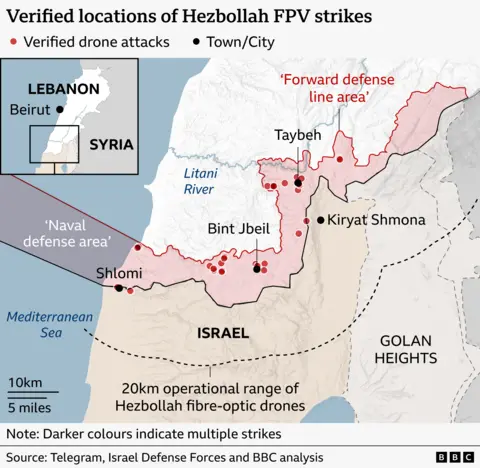
The recent campaign has not been abstract. Hezbollah-released footage and other reporting show strikes on Israeli military vehicles, tanks and artillery positions, as well as attacks on troop concentrations. One of the most closely watched incidents was a strike near Shomera, where an IDF cargo carrier at an artillery site was hit and 12 soldiers were wounded, according to the Israel Defense Forces.
Videos have also shown attacks in and around Qantara, Bint Jbeil and Mays al-Jabal in southern Lebanon, underlining that the group is using the border zone itself as a launch and propaganda theater. A Hezbollah video of a drone attack on an Israeli military vehicle in Qantara, dated April 26, was highlighted in recent coverage as part of the new pattern. The public release of strike footage is doing double duty: it documents the tactic and advertises it.
Reuters has described the drone warfare in southern Lebanon as an evolving battlefield challenge for Israel. That description fits the pattern on the ground. These are not isolated one-off launches. They are part of a campaign that appears designed to probe defences, study responses and normalize a tactic that is harder to intercept than the drones and rockets that came before it.
Why this is a strategic shift, not just a new weapon
Hezbollah has used drones before, but the current wave looks more mature and more battlefield-hardened. In October 2012, the group said it had sent a drone into Israeli airspace, and Israel shot it down. That earlier episode showed intent. The current campaign shows adaptation.
The difference is not just technical. It is strategic. Hezbollah has paired drones with rockets and missiles in the fighting that intensified after Hamas’s October 7, 2023 attack and the subsequent Israel-Hezbollah cross-border war. The drone arm now appears to be woven into a broader pressure campaign aimed at keeping Israeli forces off balance while testing the limits of Israel’s layered defences.
The numbers help explain why this is more than spectacle. AP reported that an earlier pager attack across Lebanon killed 12 people, including two children, and wounded more than 3,000. That scale of injury, combined with the current drone threat, shows how quickly this front has become a laboratory for mixed tactics, where cheap devices and high-impact attacks coexist with far more destructive systems.
The Ukraine lesson and the limits of traditional defence
The connection to Ukraine is hard to ignore. Fibre-optic FPV drones became widely known there as a way to bypass jamming, and the same logic now appears to be reshaping the Lebanon front. Al Jazeera has described the drones as immune to jamming and invisible to radar, which is exactly why they are so difficult for sophisticated defence networks to stop in time.
This is the larger economic and military lesson. Defences built around detecting radio emissions, tracking signatures and reacting fast can be overwhelmed by a weapon that sidesteps those assumptions. That creates a procurement problem as much as a battlefield problem. Israel is not only facing a new threat; it is facing a new spending race, in which the attacker’s unit cost can remain low while the defender’s response grows more expensive.
What comes next along the border
The tactical change is likely to outlast this particular round of fighting. Hezbollah’s use of fibre-optic FPV drones suggests that improvised drone warfare is evolving faster than many traditional counter-drone systems. If the method spreads, other armed groups may copy it, especially where electronic warfare has become the backbone of defence planning.
That is why the current campaign matters beyond Lebanon and Israel. It shows that the next phase of drone warfare may belong to small, hard-to-detect platforms that do not need sophisticated guidance to be lethal. Hezbollah’s videos are not just battlefield propaganda. They are evidence of a wider shift in modern conflict, where a cheap cable can expose a costly defence architecture and force militaries to rethink what protection really looks like.
This article was produced by Prism’s automated news system from verified source data, official records, and press releases, then run through automated quality and moderation checks before publishing. The system is built and supervised by the people who set the standards it runs under. Read our full AI policy.
Did this article answer your question?


