How much sitting is too much, and why it raises health risks
The danger is not one long meeting, but hours that stack up day after day. Five minutes of walking every half hour is a realistic way to blunt some of the harm.

Why sitting becomes a health problem
The chair itself is not the enemy. The problem is long, uninterrupted sedentary time that adds up day after day until movement becomes rare and muscles spend too much of the day switched off. A Washington Post health explainer published May 7 takes aim at the familiar slogan that sitting is the new smoking and asks the more useful question: how much sitting is too much, and what can people do when their jobs make sitting unavoidable?
The answer is not that every seated hour is dangerous. It is that prolonged sitting, repeated over years, is linked to real health risks, including shorter lifespans, higher heart-disease mortality, cancer risk, type 2 diabetes, osteoporosis, depression, and cognitive impairment. Keith Diaz, a Columbia behavioral medicine researcher who has studied sedentary behavior for a decade, has helped make clear that the harm comes from accumulation, not from one bad afternoon.
Where the risk starts
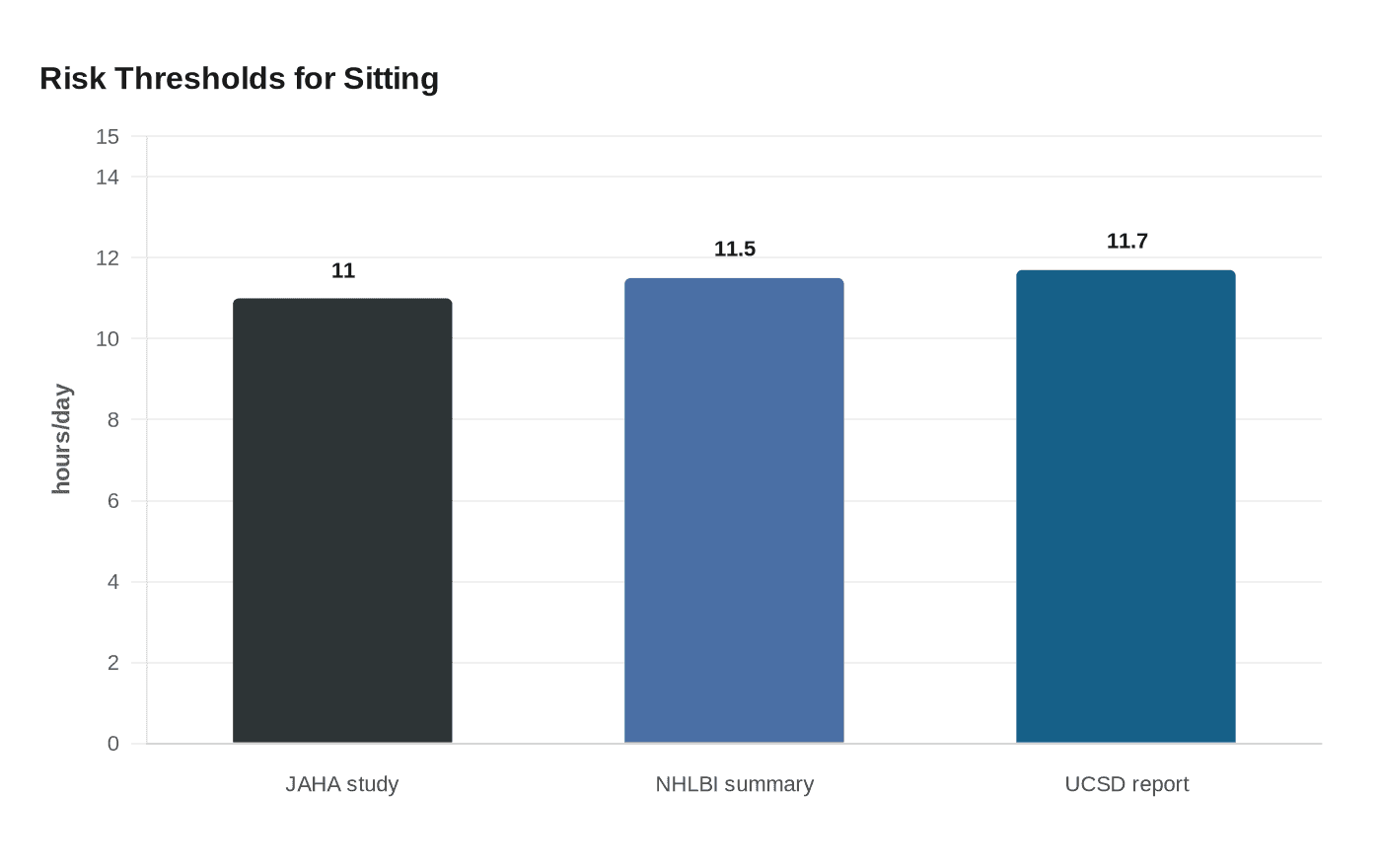
The clearest number in the research is not a universal cutoff, but it is close enough to matter: more than 11 hours of sitting per day was associated with significantly higher death risk in a February 2024 Journal of the American Heart Association study of nearly 6,000 older women. The study population was women in their 70s and 80s, which makes the findings especially important for understanding risk in later life.
The National Heart, Lung, and Blood Institute’s summary of that same research sharpened the point further. It found that women who spent less than about 9 hours sitting each day were less likely to die prematurely or experience a fatal heart attack or stroke than women who spent more than 11.5 hours idle. A separate University of California, San Diego report on the same line of research said older women who sat for 11.7 hours or more a day raised their risk of death by 30 percent, regardless of whether they exercised vigorously.
What sitting is doing inside the body
Sitting is more than a posture problem. When muscles stay inactive for long periods, they stop doing one of their main jobs, helping regulate glucose and blood fats. That is why the issue shows up in cardiovascular disease and diabetes research, not just in complaints about stiff backs and tight hips.

This is also why “I work out later” is only a partial answer. Exercise matters, but it does not erase every hour spent motionless. The body responds to both movement and stillness, and long stretches of sedentary time can push metabolism in the wrong direction even when a person is otherwise active.
Who should pay attention most closely
The evidence in the notes is strongest for older women, especially those in their 70s and 80s, but the practical warning reaches far beyond that group. Office workers, drivers, remote employees, and anyone whose day is shaped by screens and desks face the same pattern: too many hours in one position and not enough muscular activity to offset them.
That makes the question less about whether you sit at all and more about how much sitting your day accumulates. A commute, a desk job, long video calls, and an evening on the couch can add up fast. The risk does not require a dramatic mistake; it can come from ordinary routines that never break.
What actually helps
The most actionable finding in the research is also the simplest. Columbia University reported that just five minutes of walking every half hour can offset some harmful effects of prolonged sitting. That gives the science a practical rhythm: interrupt the seated block before it becomes a long, uninterrupted stretch.
The World Health Organization’s 2020 guidelines on physical activity and sedentary behaviour point in the same direction. They recommend that adults and older adults reduce sedentary time and replace it with physical activity of any intensity, because the overall accumulation of movement matters. The message is not to chase a perfect workout schedule, but to keep the body from going still for too long.
- Walk for five minutes every 30 minutes when possible.
- Break up long sitting spells instead of waiting until the end of the day.
- Treat movement as part of the workday, not something that begins after it.
A realistic day can therefore look less like a fitness plan and more like a series of small interruptions:
Those are modest changes, but the science suggests modest changes repeated consistently can matter more than a single hard workout later.
Exercise helps, but it is not the whole answer
The American College of Cardiology highlighted a 2024 Journal of the American College of Cardiology study showing that about 10 hours or more of sedentary behavior per day was linked to higher heart-failure and cardiovascular-death risk even among people who regularly exercised. That finding matters because it cuts through a common assumption: a workout does not grant immunity from a day spent mostly seated.
The broader public-health lesson is straightforward. Sitting and exercise are related, but they are not interchangeable. A person can meet exercise goals and still spend most of the day in a way that raises risk. The stronger protection comes from combining movement with a lower total dose of sedentary time.
The chair is not the villain, but it should never get the whole day. The safest routine is not perfection, just interruption, and the data show that even small, repeated walks can move the day back toward health.
This article was produced by Prism’s automated news system from verified source data, official records, and press releases, then run through automated quality and moderation checks before publishing. The system is built and supervised by the people who set the standards it runs under. Read our full AI policy.
Did this article answer your question?