How One Costume Maker Transformed Hersheypark Into a Candy-Branded Destination
A costume maker's handmade Reese's Cup suit convinced Hershey executives to "chocolatize" the park, turning a workers' picnic ground into an IP-driven American landmark.
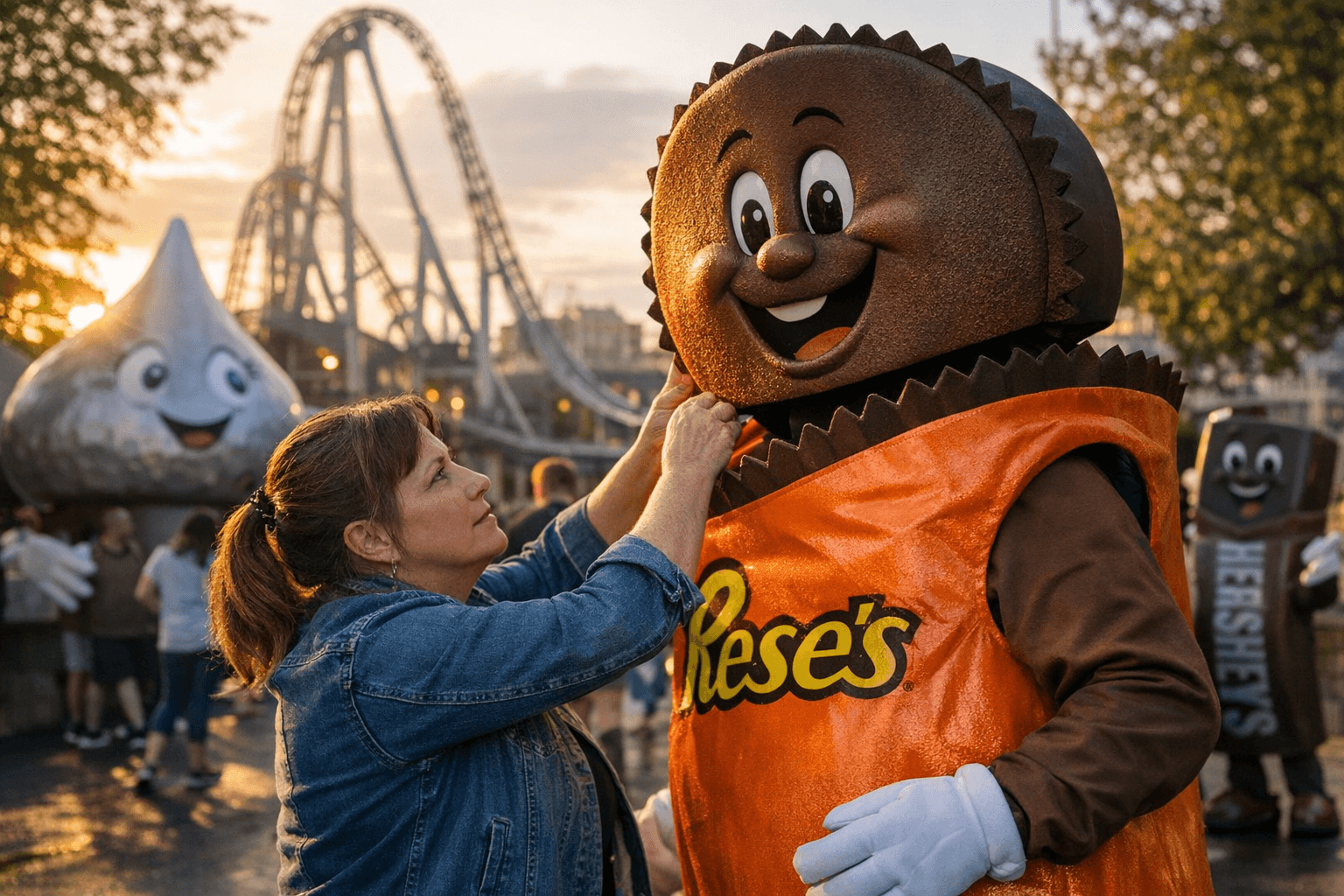
Bill Scollon had a hunch, and he decided to act on it with foam and fabric. The costume fabricator had been hired to build woodland animal suits for Hersheypark's new character lineup in 1974, but one conversation with a Hershey executive convinced him there was a bigger opportunity hiding in plain sight. What followed was a pivot so complete that it reshaped not just a single amusement park in central Pennsylvania, but the commercial logic of themed entertainment across the country.
A Workers' Playground, Repurposed
Hershey Park opened on Memorial Day, May 30, 1906, built by Milton S. Hershey as a recreational venue for the workers at his chocolate factory and their families. The idea was paternalistic by design: Hershey wanted his employees to have a more pleasant environment than any typical factory town of the time offered. He built not just a park, but an entire community around it, complete with schools, shops, utilities, and eventually a grand hotel. For the better part of half a century, the park thrived in that spirit. On summer days in the 1940s and 1950s, residents of Hershey and nearby towns would stream in for picnics and rides, and the wooden roller coaster Comet, which debuted in 1946, became the park's signature thrill.
By the late 1960s, however, that model was aging. Attendance softened, attractions felt dated, and the amusement park industry was entering a period of dramatic reinvention. In 1971, Hersheypark embarked on a five-phase redevelopment plan orchestrated by planner Randall Duell, formally dropping the space in its name to become "Hersheypark" in 1973 and switching to a one-price admission model. The vision at that point was historical rather than commercial: themed zones recreated Tudor England, the German Rhineland of the 18th century, the agrarian culture of the Pennsylvania Dutch, small-town American life, and Pennsylvania's coal mining past. Local visitors could see their own heritage dramatized; tourists from Philadelphia, New York, Washington, and Baltimore could escape urban life by stepping into a curated version of simpler times.
The Pitch That Changed Everything
Matching the Disney playbook, the park introduced mascots in 1974: the Furry Tales, a trio of woodland animals named Dutch the bear, Chip the chipmunk, and Violet the skunk. They were Hersheypark's answer to Mickey, Minnie, and Donald, and the costume fabricator hired to build their suits was Bill Scollon. During one of his visits, Scollon asked Bruce McKinney, a Hershey executive who served as assistant general manager of the park, whether leadership had ever considered candy-themed characters tied directly to Hershey's product lines. McKinney explained the roadblock: the chocolate company, Hershey Foods, had resisted the idea. Scollon had a different theory about why.
He suspected that Hershey Foods executives had simply never been able to see and touch what such a character could be. So Scollon built one. He constructed a Reese's Peanut Butter Cup costume and presented it to McKinney, who was impressed enough to escort Scollon, fully suited up, to locations where Hershey Foods executives would be. The executives were delighted, and their resistance promptly disappeared. The proof of concept was confirmed in a particularly vivid way at a Hershey Rotary Club meeting, where the Reese's character greeted members as they left. Robert "Bob" Reese, the son of Reese's Peanut Butter Cups founder H.B. Reese, encountered the costumed figure and was, according to McKinney, "all smiles and ecstatic."
Scollon's firm, Scollon Productions, then brought in newspaper editorial artist Ed Fresca to help develop the full roster of candy characters. Once the product characters strolled into the park in 1974, the floodgates opened. "We started to chocolatize Hersheypark," McKinney recalled. "We Hersheyized everything."
The $3 Million Gamble on Thrills
Mascots alone were not enough. Randall Duell's planning philosophy had actively discouraged parks from investing in large roller coasters, arguing they appealed to teenagers but alienated other demographics. Hersheypark reversed course in 1976, again with McKinney at the center. Flipping through an industry trade journal, he came across a photograph of the Revolution, the first looping roller coaster of the modern era, under construction in West Germany. When the Revolution opened at Six Flags Magic Mountain in California, it attracted massive crowds. "I harbored all of these feelings," McKinney recalled, "of what it would be like to have that thing in Hershey."
The price tag was steep: $3 million, a staggering investment at the time. McKinney secured it anyway. Hersheypark commissioned its own looping coaster, the SooperDooperLooper, which opened on July 4, 1977, and became the first complete-circuit, modern-day looping steel roller coaster on the East Coast of the United States. The success was spectacular enough to permanently reorient the park's investment strategy toward thrill rides. Today, the Hershey skyline is dominated by roller coasters, including the Storm Runner hydraulic launch coaster, which debuted in 2004 and takes riders from 0 to 72 mph in two seconds, and Candymonium, the park's 15th coaster, described as its tallest, fastest, and longest.
Branding as Place-Making
The candy characters and the coasters were two sides of the same commercial logic. Together they created an experience that extended far beyond the rides themselves: character meet-and-greets, themed parades, branded food, and a merchandising apparatus that turned every visit into a transaction with the Hershey product universe. In 2020, the park opened Hershey's Chocolatetown, an entirely reimagined arrival zone with 15 new experiences designed so guests can play, eat, shop, and gather year-round. The adjacency to Hershey's Chocolate World, a separate visitors' center with a chocolate factory-themed tour ride, restaurants, and shops, created a campus-scale brand environment rather than a single attraction.
The Furry Tales, the woodland animal mascots that had prompted Scollon's original question, coexisted with the candy characters for roughly a decade before quietly disappearing in the 1980s. Their exit was a quiet signal of which identity had won: not the regional historical themes or the generic animal mascots, but the proprietary candy iconography that could not be replicated anywhere else. A giant Hershey bar or Reese's Cup character was inherently a product promotion and a park attraction simultaneously.
What Gets Remembered, What Gets Replaced
A professor of American studies at Penn State Harrisburg who has written a book on Hersheypark, drawing on archival research and interviews, frames the "chocolatization" as both a business strategy and a cultural phenomenon with unresolved tensions. The historical themed zones that once represented Tudor England or Pennsylvania's mining past were effectively sidelined by the ride expansion, even as the park has made conscious efforts to preserve remnants of its earlier identity. Visitors who look carefully while walking through the park can still find traces of that bygone era, but they exist in the margins of an attraction built around branded spectacle.
The question the park's transformation raises is one that applies well beyond Hershey, Pennsylvania: when a corporate identity becomes the organizing logic of a public leisure space, what happens to the local history it displaces? Milton Hershey's original park was built for his workers. The park that replaced it is built for a national audience drawn by IP, sugar, and steel. That shift, engineered in crucial part by a costume maker with a foam Reese's Cup suit and a persuasive pitch, mirrors a transformation that played out across the American amusement park industry, a moment when regional attraction became national brand and the experience of a place became inseparable from the products sold within it.
This article was produced by Prism’s automated news system from verified source data, official records, and press releases, then run through automated quality and moderation checks before publishing. The system is built and supervised by the people who set the standards it runs under. Read our full AI policy.
Did this article answer your question?