How protest images shape public opinion, and endanger journalists
Protest images can mobilize a nation or distort a movement. The people behind the camera now face growing danger as they document public unrest.
Who defines a protest in the public mind
A protest image can do more than record a moment. It can decide who looks like a witness, who looks like a threat, and whose pain becomes legible to the public. That is why the camera has never been a neutral bystander in American protest politics, from the murder of 14-year-old Emmett Till in August 1955 to the flood of smartphone video that now travels the world in seconds.
The stakes are civic, medical, and moral at once. Images can legitimize a movement, flatten its complexity, or mislead viewers by isolating a single scene from the larger conditions that produced it. They can also expose how power operates in public, showing whether the state meets dissent with restraint or force, and whether communities are allowed to define themselves before someone else does it for them.
From Emmett Till to Birmingham, the camera changed the argument
The visual record of Emmett Till’s killing helped mobilize the civil rights movement because it made racial terror impossible to dismiss as abstraction. The Library of Congress says the publication of images of Till’s brutalized body brought nationwide attention to the racial violence and injustice prevalent in Mississippi. Mamie Till Mobley’s decision to insist that the public see what had been done to her son changed the emotional and political frame of the case.
That same principle appeared again in Birmingham, Alabama, in 1963. The Library of Congress says nationwide and international media coverage of police violence, including fire hoses and attack dogs used against child protesters, precipitated a crisis the Kennedy administration could not ignore. The images did not merely document events already understood by everyone present. They created pressure, widened the audience, and forced federal attention.
This is why protest photography has such enduring force. It preserves evidence, shapes public perception, and documents social movements in ways that text alone often cannot. The Associated Press and PBS have both emphasized that photographs from civil rights marches became part of the public archive of accountability, helping later generations understand what was at stake when people took to the streets.
The smartphone era has multiplied witnesses and multiplied distortion
Today, nearly every protester, bystander, and officer carries a camera. PBS noted in 2020 that smartphones and social media let protest images be disseminated instantly to the world, and that ubiquity means anyone can become a photographer. In one sense, that has expanded the democratic record. In another, it has made the public mind easier to shape with selective clips, cropped frames, and viral posts stripped of context.
This is where the lens becomes both reporting tool and source of distortion. A single image can show injured bodies, peaceful crowds, or police lines advancing, and each can be true while still failing to explain the whole scene. A movement seen only through its most dramatic photograph can be reduced to chaos or heroism, while the ordinary, organized work of community members, medics, clergy, legal observers, and family members disappears from view.
That tension is why iconic protest imagery still matters. Photographers and photojournalists preserved the visual memory of civil rights marches and, more recently, the 2020 demonstrations after George Floyd’s killing. Those images became evidence in debates over policing and civil unrest, but they also became shorthand, sometimes too shorthand, for much larger struggles over race, power, and state violence.
When documenting protest becomes dangerous work
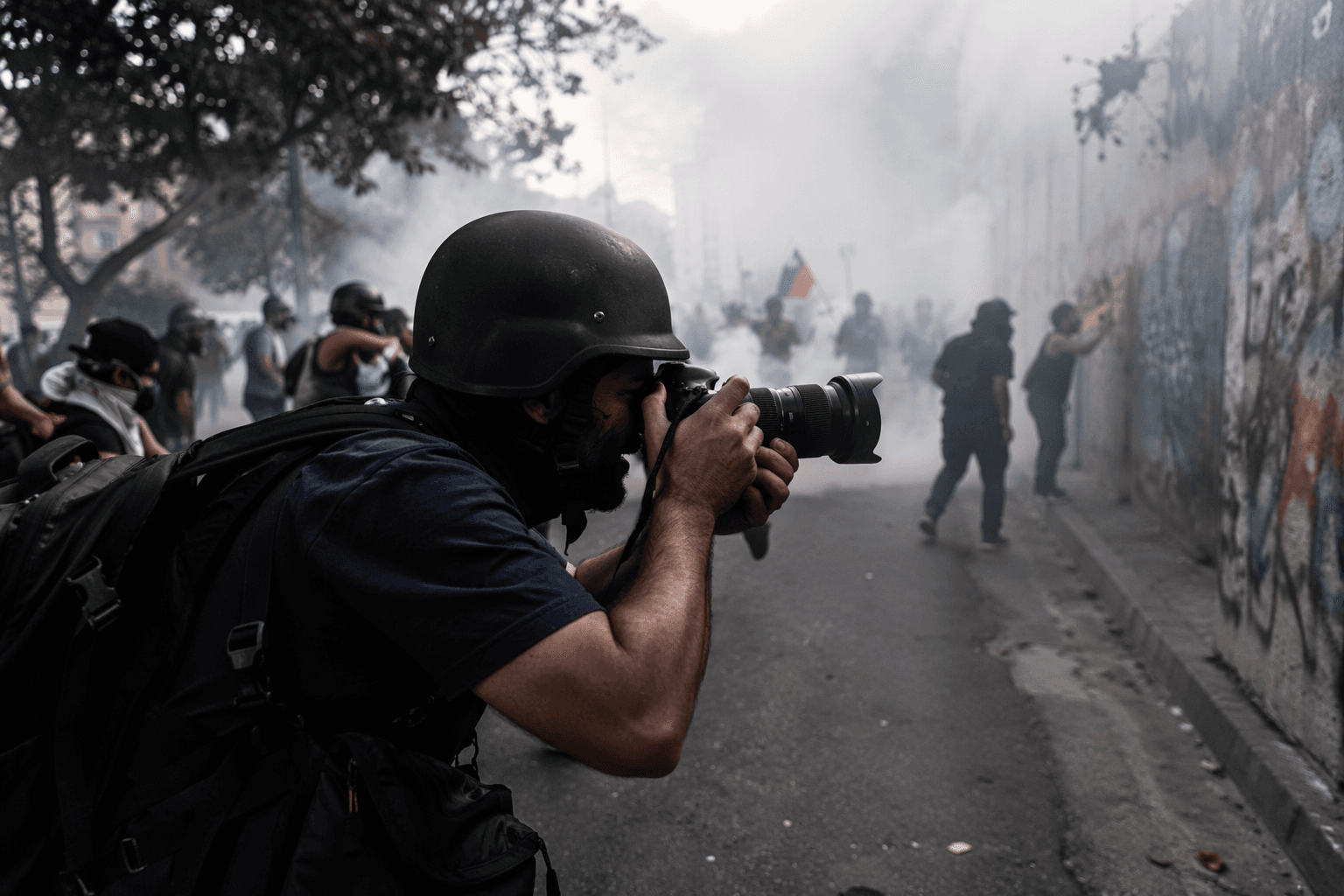
The people making this record increasingly face the same force they are trying to document. In Los Angeles, California, during protests in June 2025, the Committee to Protect Journalists said more than 20 journalists were assaulted or obstructed while covering the demonstrations. Reporters Without Borders said it verified at least 27 attacks on journalists between June 6 and June 8, and that the violence came from both law enforcement and protesters.
Those numbers matter because they show that press freedom is not only a First Amendment issue; it is a public accountability issue. CPJ said authorities should respect the media’s role in documenting issues of public interest, a reminder that the camera helps protect democratic oversight even when the footage is inconvenient to people in power. When journalists are pushed back, detained, pepper-balled, or struck, the public loses not just a messenger but a record.
The danger also has a community impact. Protest coverage often becomes the first draft of local memory, especially in neighborhoods already carrying mistrust from prior encounters with police. If journalists are blocked or attacked, the most visible images may come from whoever is most aggressive, most organized, or most willing to distort the scene. That can leave residents with a narrative built less on evidence than on whoever controlled the frame.
Why protest imagery is a public health and equity issue
Protests are political events, but they are also public health events. When tear gas, pepper balls, detentions, and physical assaults enter the scene, the effects extend beyond headlines to injuries, fear, mobility limits, and access to care. The burden is rarely shared evenly. Communities that already live with overpolicing, racialized surveillance, and barriers to healthcare are often the ones most exposed when protest turns into crowd control.
That is why the image matters so much for social equity. A photograph can help a marginalized community prove what it lived through, but it can also be used to justify harsher policing if it is selected or framed to emphasize disorder over harm. The public rarely sees the full chain: the grievance that sparked the march, the emergency response that followed, the bystanders caught in the middle, and the health consequences that linger after the cameras move on.
Deborah Willis, whose work has helped shape how Americans think about photography and Black visual culture, stands within this larger tradition of seeing images as both memory and evidence. The lesson from Till, Birmingham, George Floyd, and Los Angeles is the same: protest images are never just pictures. They are instruments of public power, and the struggle over who gets to define them is part of the struggle over democracy itself.
In the smartphone age, that struggle is faster, wider, and more vulnerable to manipulation than ever. But it is also more visible. The camera still has the power to clarify injustice, and the duty to document it remains one of the most important forms of witness in public life.
This article was produced by Prism’s automated news system from verified source data, official records, and press releases, then run through automated quality and moderation checks before publishing. The system is built and supervised by the people who set the standards it runs under. Read our full AI policy.
Know something we missed? Have a correction or additional information?
Submit a Tip