How the F-15E Crew Likely Ejected After Being Shot Down Over Iran
When an IRGC missile brought down a U.S. F-15E over Iran on April 3, two crew members had milliseconds to trigger a sequence that unfolds faster than human thought.

A missile fired by Iran's Islamic Revolutionary Guard Corps destroyed a U.S. Air Force F-15E Strike Eagle on April 3, 2026, making it the first U.S. fighter jet downed by enemy fire in decades and the first manned American aircraft lost to enemy action during Operation Epic Fury. Both crew members ejected. The pilot was recovered by two U.S. military Black Hawk helicopters shortly after the shoot-down. The Weapons System Officer remained unaccounted for the following day, with Iranian state television offering a bounty for any crew member captured alive and regional merchants in southwestern Iran reportedly pledging the equivalent of $60,000 for the same.
Iran published a photograph of what it claimed was the aircraft's ejection seat, an ACES II unit, confirming that at least one crew member had made it out of the stricken jet. What that seat did in the seconds after being triggered is a story of decades of engineering compressed into a 3-to-4-second automated sequence.
The Aircraft: Two Seats, Two Lives
The F-15E Strike Eagle is a two-seat multirole fighter. The pilot occupies the front seat; the Weapons System Officer sits behind. In a combat loss scenario, both depend on the same technology: the Advanced Concept Ejection Seat II, or ACES II, manufactured by Collins Aerospace (formerly UTC Aerospace, formerly McDonnell Douglas). The seat has been the standard ejection system for most American military aircraft since the 1970s, serving the F-15, F-16, A-10 Thunderbolt II, B-1 Lancer, and B-2 Spirit, among others.
Retired U.S. Air Force Colonel Jeffrey Fischer noted the vulnerability inherent to the flight profile at the time: "That was some pretty low and pretty slow flying, which reduces any kind of reactive or defensive maneuvers in the event an aircraft is engaged by air defense." That observation matters technically, because the ACES II's response depends heavily on airspeed and altitude at the moment of ejection.
The ACES II: A Third-Generation Life-Saver
The ACES II is a third-generation ejection seat with what engineers call "zero-zero" capability: it can safely launch a crew member from a stationary aircraft at zero altitude and zero airspeed on a runway. At the other extreme, it can handle airspeeds up to 600 knots equivalent airspeed. The minimum safe ejection altitude in inverted flight is approximately 140 feet (43 meters) at 150 knots.
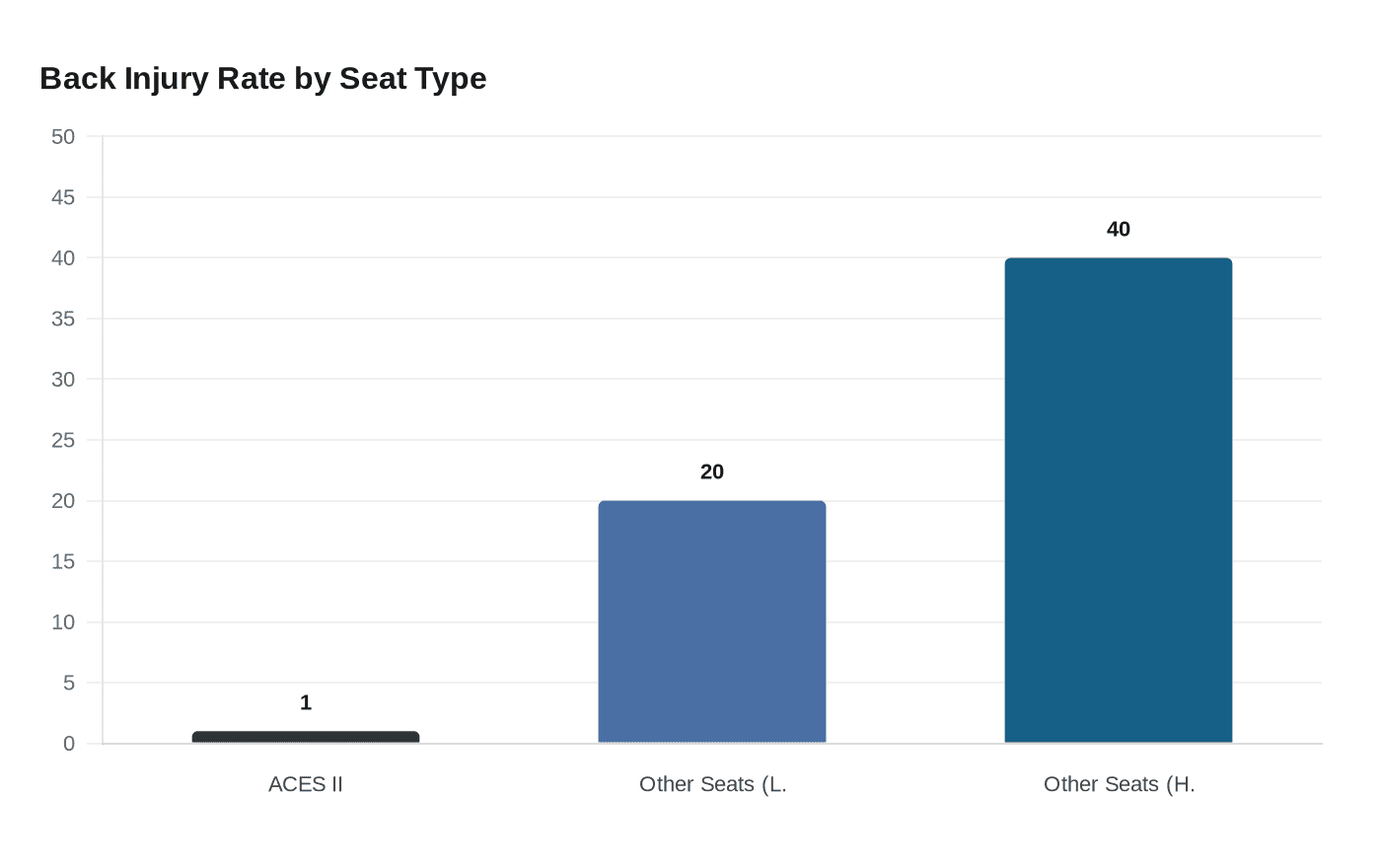
Those parameters reflect six decades of hard-won data. Since rocket-powered ejection seats first entered service in the late 1940s, they have saved more than 12,000 lives globally. The ACES II alone has recorded over 600 live ejections with one of the lowest injury rates in the world. Back injuries, historically the most common ejection trauma, occur in only 1% of ACES II ejections, compared to 20 to 40 percent in most other seat types. The seat's propulsion system is also calibrated to body weight, ensuring that a 103-pound crew member receives a similar acceleration profile to a 245-pound pilot.
The Ejection Sequence, Step by Step
The sequence begins the moment a crew member grasps the ejection handle, located on the sides of the seat bucket in the F-15. Pulling with approximately 40 to 50 pounds of force activates a pair of initiators through mechanical linkages. The side-pull handles are mechanically linked, so lifting one raises the other. From that instant, everything is automatic.
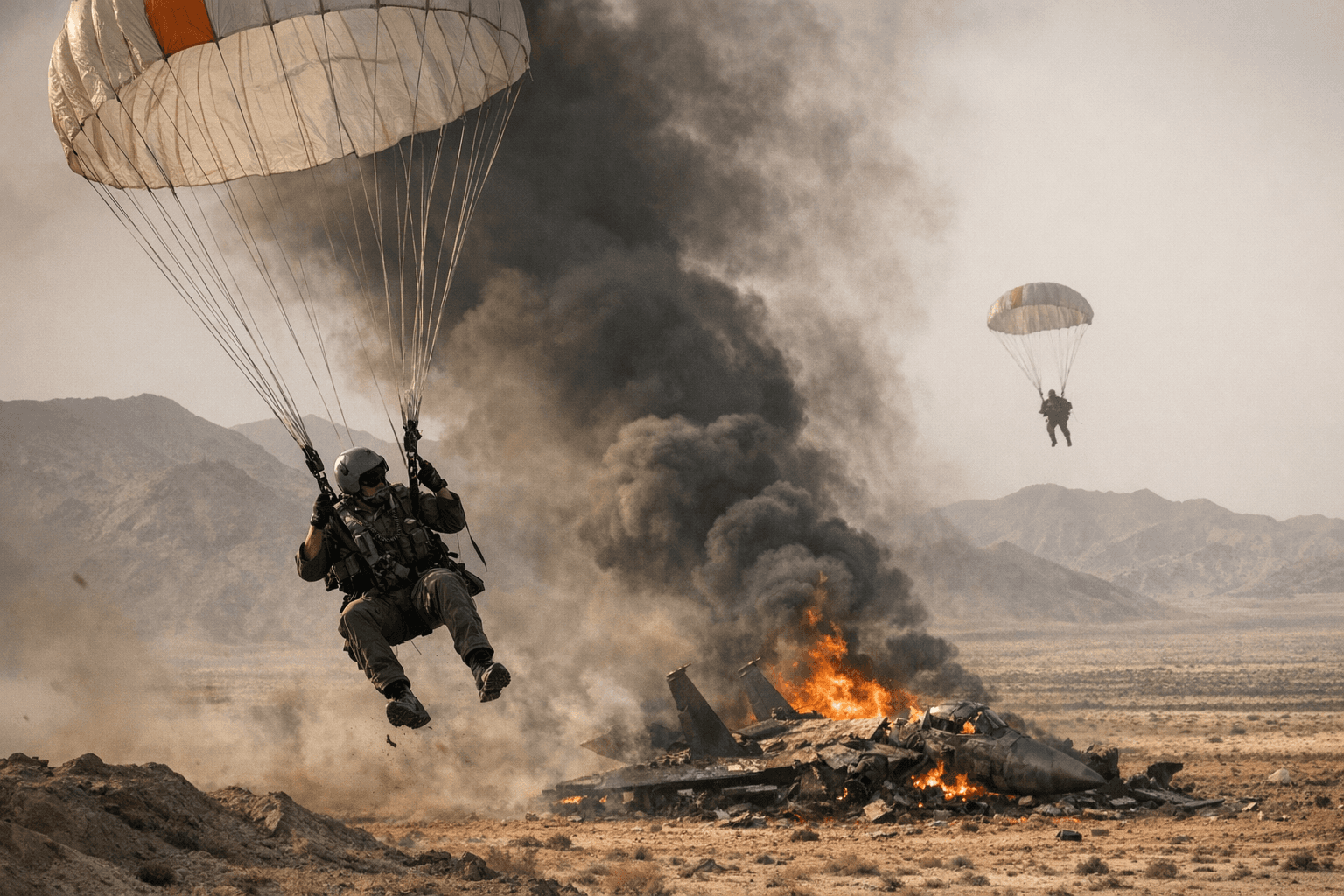
Within 0.1 seconds, explosive charges jettison the F-15E's canopy to clear an escape path. The ACES II also features headrest canopy breakers that can physically shatter the canopy if jettison fails, a modification introduced after a mishap demonstrated that fractions of a second can determine survival.
Because the F-15E carries two crew members, an automated sequencer fires the WSO's seat first. This is not optional protocol; it is a hard-wired safety feature that prevents a catastrophic mid-air collision between two human bodies and two metal seats traveling upward simultaneously in close proximity.
Once the WSO's seat clears the cockpit, the solid-propellant CKU-5 rocket catapult fires beneath the pilot's seat, propelling the 127-pound seat directly upward. Peak catapult acceleration is approximately 12 Gz, and crew members experience up to 20 Gs during the full ejection event. The underseat rocket then lifts the seat-man package an additional 100 to 200 feet (30.5 to 61 meters), depending on body weight, to clear the aircraft's tail. A unique component called the STAPAC, a vernier rocket motor mounted on a tilt system controlled by a pitch-rate gyro, fires corrective counter-force to prevent extreme pitching when the center of gravity shifts.
Three Modes, One Decision Made Automatically
The ACES II's most sophisticated feature is its three-mode parachute deployment system. Built-in environmental sensors continuously calculate dynamic airspeed and altitude and automatically select the appropriate mode:
- Mode 1 (below 250 knots): The main parachute deploys immediately after seat exit, inflating in under two seconds. This covers the zero-zero envelope.
- Mode 2 (250 to 450 knots): A five-foot drogue parachute deploys first to decelerate the seat before the main canopy inflates in under six seconds. The harness inflation system triggers within 40 milliseconds to position the crew member optimally.
- Mode 3 (above 450 knots, up to 600 KEAS): The drogue provides extended deceleration before main parachute deployment. At these speeds, windblast forces can exceed 8,000 pounds per square foot. Automated restraints pull the crew member's legs flush against the seat; the helmet shields the face.
In Mode 3, the sequencer delays main parachute deployment until conditions drop into Mode 2 or Mode 1 range. Below 10,000 feet, explosive bolts physically separate the seat from the crew member so the recovery canopy can inflate without entanglement. The sequencer also contains a crash data recorder that logs ejection dynamics and loads for post-incident investigation.
The entire sequence, from handle pull to parachute open, takes no more than 3 to 4 seconds, faster than a human being could consciously execute any single step within it.
After the Parachute Opens
Surviving the ejection is not the same as surviving the mission. Retired Brigadier General Houston Cantwell, who logged 400 combat hours, described the immediate disorientation: "You're like, Oh my God… a missile just exploded, literally 15 feet from your head." He emphasized that tactical thinking must begin before landing: "Your best view of where you may want to go… is while you're coming down in your parachute."
Landing under a parachute in a hostile environment carries its own serious risks. "There are many stories… of severe injuries, compound fractures," Cantwell noted. Crew members draw on SERE (Survival, Evasion, Resistance, and Escape) training for everything that follows. Retired pararescueman Scott Fales confirmed that Combat Search and Rescue teams deploy immediately after any ejection. In the April 3 incident, the rescue operation escalated quickly into a second engagement: an A-10 Thunderbolt II sent to support the search took Iranian fire, and its pilot ejected safely over the Persian Gulf in Kuwaiti airspace. Two additional Black Hawks involved in the rescue were struck by Iranian fire, and one helicopter carrying the recovered F-15E pilot was hit by small arms fire, wounding crew members aboard before landing safely.
A Loss in Context
The April 3 shoot-down occurred within a broader campaign in which the U.S. military has struck more than 12,300 targets inside Iran, with 13 American service members killed in combat actions against Iran to date. It is not the first aircraft struck during Operation Epic Fury: a U.S. F-35 reportedly took enemy fire on March 19 before making a safe emergency landing. On March 2, three USAF F-15Es were destroyed in a friendly-fire incident involving Kuwaiti F/A-18 aircraft, with all six crew members ejecting safely. As of January 2024, 131 USAF F-15 aircraft had been destroyed in mishaps across the jet's service life, with 59 fatalities recorded.
Retired Lt. Gen. David A. Deptula, dean of AFA's Mitchell Institute for Aerospace Studies, framed the loss with precision: "High-end combat against a capable, integrated air defense system is never risk-free. What distinguishes modern Western airpower is not invulnerability, but the ability to survive, penetrate, and sustain operations while keeping losses exceptionally low."
The ACES II, in that context, is exactly that calculus in hardware form: a system built not to prevent the worst from happening, but to give crew members the best possible chance when it does. For the pilot already recovered, it worked. The search for the WSO continues.
This article was produced by Prism’s automated news system from verified source data, official records, and press releases, then run through automated quality and moderation checks before publishing. The system is built and supervised by the people who set the standards it runs under. Read our full AI policy.
Know something we missed? Have a correction or additional information?
Submit a Tip