Germany inaugurates first permanent postwar brigade in Lithuania
Germany’s first permanent postwar brigade in Lithuania marked a sharp reversal: troops once feared as occupiers were welcomed as a NATO shield against Russia.

German soldiers marched into Vilnius under a very different national memory than the one that has shadowed the Baltic state for generations. On May 22, 2025, Germany officially inaugurated its 45th Armoured Brigade in Lithuania, a deployment meant to stiffen NATO’s eastern flank against Russia and to signal that Berlin is prepared to keep forces forward in the region for the long term.
The brigade’s first advance party arrived in Lithuania in April 2024, and about 400 personnel were already in the country as the unit moved toward full operational capability, which is scheduled for the end of 2027. When complete, the formation is expected to include about 4,800 military personnel and around 200 civilian staff. A new main base is being built in Rūdninkai, roughly 30 kilometers south of Vilnius, while troops continue operating from temporary sites. Germany has said the brigade will be built around two combat battalions from Bavaria and North Rhine-Westphalia, plus a third multinational NATO battalion.
The political meaning of the deployment reaches far beyond military planning. Germany’s brigade is its first permanent foreign troop deployment since World War II, and in Lithuania that fact carries unusual emotional force. Nazi Germany occupied Lithuania from June 22, 1941, to January 28, 1945, a period that began with some Lithuanians greeting German forces as liberators from Soviet rule before the occupation hardened. Against that background, the sight of German troops arriving as protectors rather than occupiers marked a historic reversal shaped by today’s fear of Russian aggression.
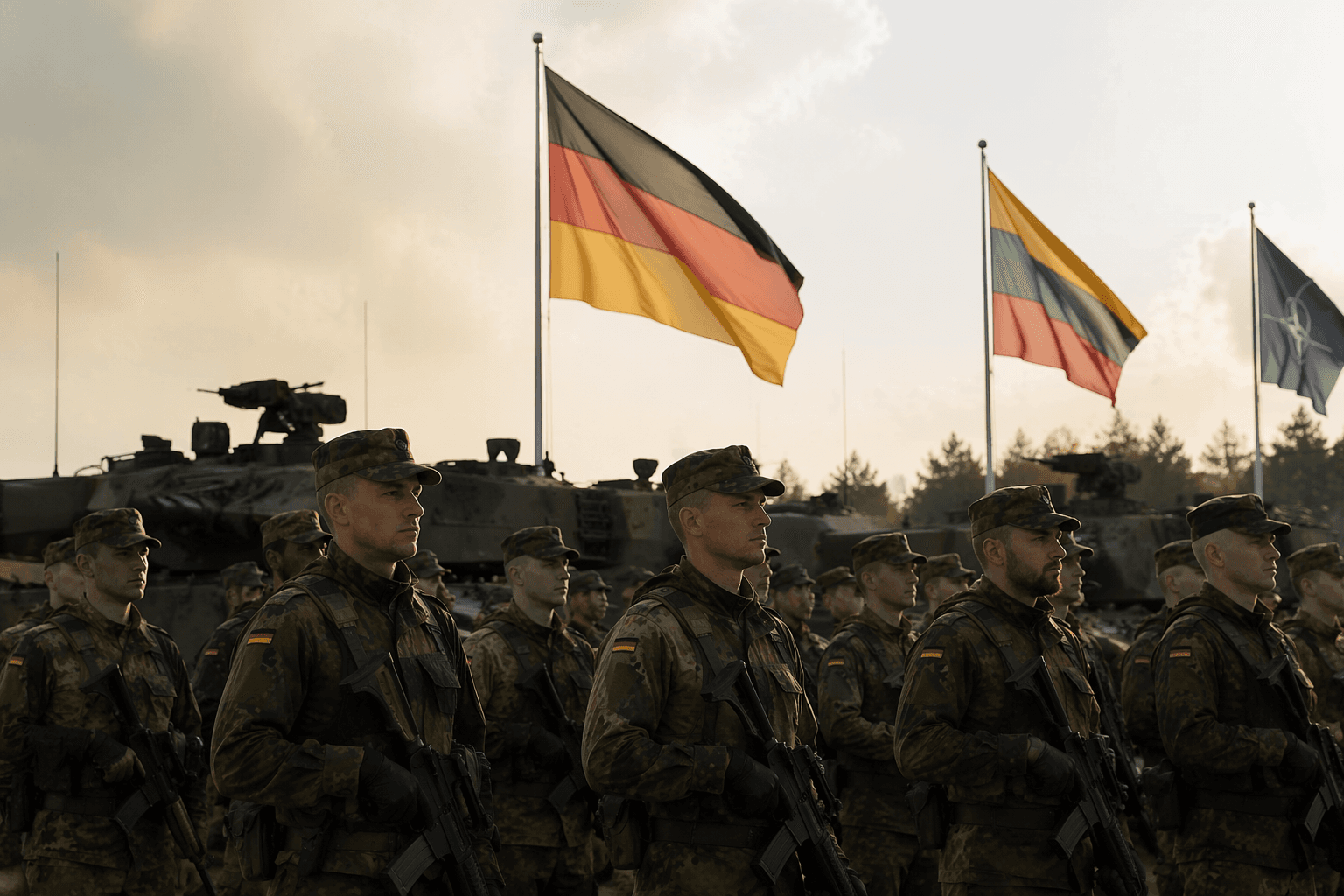
Lithuanian President Gitanas Nausėda called the brigade’s arrival “an exceptional event in our country’s history,” casting it as proof of the strategic partnership between Lithuania and Germany. German officials, including Chancellor Friedrich Merz and Defence Minister Boris Pistorius, have framed the deployment as evidence that Germany is taking greater responsibility for European security and standing by its allies. NATO, for its part, says the brigade improves deterrence by permanently forward-positioning combat-ready forces, cutting response time in any crisis on the alliance’s eastern edge.
The deployment was accelerated by Russia’s full-scale invasion of Ukraine, which forced a wider reassessment of security across Europe. In Lithuania, that recalculation has turned old taboos into policy, and once-unthinkable German uniforms into a visible guarantee of defense.
This article was produced by Prism’s automated news system from verified source data, official records, and press releases, then run through automated quality and moderation checks before publishing. The system is built and supervised by the people who set the standards it runs under. Read our full AI policy.
Know something we missed? Have a correction or additional information?
Submit a Tip