How to Repair, Launder and Extend the Life of Workwear
Learn to treat workwear by fiber, follow industrial standards when you can, and pick fabrics and services that actually make garments last—because good workwear earns its keep.
You buy a work jacket to do a job, not to be babied—so treat it like the tool it is. A workwear jacket “works hard every shift. It keeps tools and heats out, holds heat in when you need it, and presents a clean, professional image.” With that in mind, the single best rule is simple: read labels and treat by fiber—because the way you wash cotton is not how you babysit waxed cotton or wool trousers.
Fabric-by-fabric first aid The original brief nails the essentials: “cotton and canvas tolerate cold-water washing with mild detergent.” That’s your daily baseline—soft knits and cotton as champion fabrics for frequent washing, exactly as the Evergreen method prefers: “Cotton and soft knits mostly” and “Movement‑friendly and stain‑resistant items.” For canvas, think gentle cycles, cold water, and a mild detergent that won’t strip natural oils; you’re preserving texture and strength, not trying to make the jacket look new on day one.
Waxed cotton is its own animal: “waxed cotton should never be machine-washed—spot-clean and re-proof with recommended wax.” Hear that? No spin cycle. Spot-clean dried grime with a soft brush and reproof with the wax the maker recommends—this is maintenance, not cosmetology. If you skip reproofing, the fabric loses its purpose: water repellency and that lived-in patina that makes waxed cotton worth owning.
Wool and blends live in a grey area. The source fragment says “Wool suiting and blended trousers should be steamed or dry-” (the sentence cuts off), so pause before you declare a rule. Evergreen’s personal playbook explicitly states “No dry cleaning,” showing a lifestyle preference that conflicts with the truncated wool advice. Until you confirm the full instruction for wool, the safest move is: steam to remove creases and odors, spot-treat when possible, and follow the garment’s care label for anything beyond that.
Industrial laundering and standards that matter If you’re running a fleet of jackets or managing uniforms, don’t guess—standardize. “For high‑volume plants, industrial laundering is usually the most reliable route.” When you specify a wash, “use processes aligned to ISO 15797.” That standard “sets out industrial washing and finishing procedures that simulate real‑life conditions and helps you evaluate workwear compatibility with detergents, temperature, mechanical action, and drying.” In practice that means testing garments against a documented process so you know whether your jacket survives the shift after 50, 100, 200 cycles—not just after a single home wash.
Hygiene and compliance belong in this conversation, too. “If your site needs to control microbiological quality uniforms, ask about a risk‑based system for biocontamination control. The EN 14065 RABC framework is used in many sectors, including food and healthcare, to keep textiles hygienic from wash to handover.” That’s not corporate fluff—if your workwear crosses into regulated contexts, laundering choices are part of safety certifications and audits: “A garments compliance audit can further ensure that your uniforms meet safety, hygiene, and durability requirements for certification.”
Protecting special features “Not all workwear uniforms are the same. Match the care method to fabric technology.” Zips, reflective trims, printed logos, and waterproof membranes all need bespoke attention. If a jacket has taped seams or a laminated membrane, don’t assume a home washer will respect it. Use manufacturer guidance, and when in doubt, pull the garment out of rotation for specialist cleaning rather than turning a small problem into a costly failure.
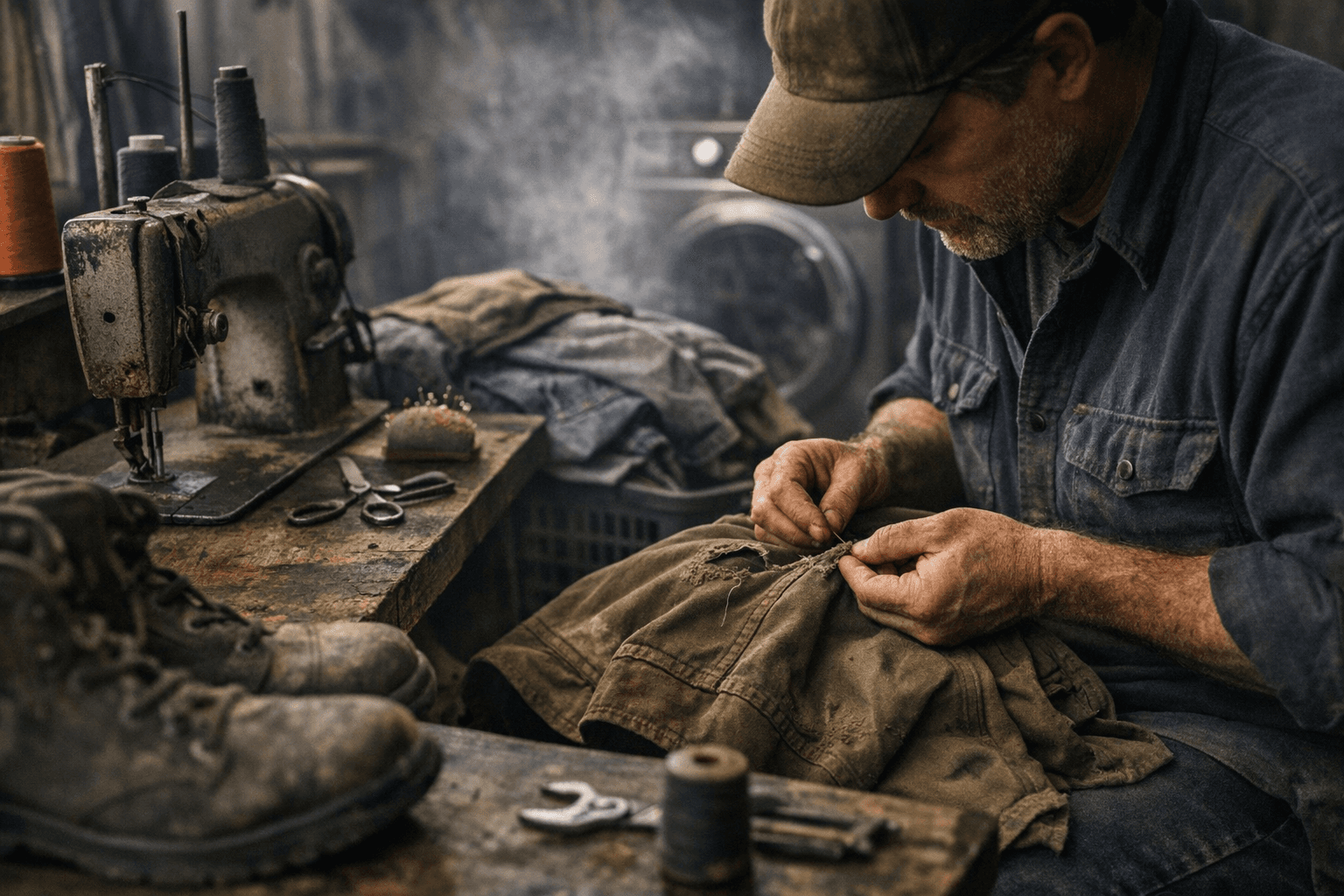
Practical repair habits that actually work Repairs are maintenance economy. The Lindstrom model lists maintenance and repairs as core services—“With our workwear rental and laundry model, you get the garment, hygienic washing, maintenance, repairs, replacements, delivery, storage and lockers in one contract.” For individuals: learn two basic fixes—re-stitch torn seams and apply patches to high‑wear canvas areas. For teams: catalog failure points (cuff fray, hem wear, pocket stress) and either set up a repair kit or lock in a vendor who will do it for you. The cost math is honest: “With the right care, it will last longer, protect better, and cost less over its lifetime.”
Drying, finishing and the gaps you should notice Lindstrom’s outline includes “### Step 4: drying and finishing: [… ]” but the detailed step is missing in the notes—so don’t accept boilerplate. Finishing choices change a jacket’s function: tumble heat can kill waterproofing; pressing can flatten technical textures; over-aggressive drying can shrink cotton and stress seams. Until you have vendor-specific finishing advice, err on conservative settings and use air-dry or low-heat finishing where the label or supplier permits.
Designing a wardrobe that minimizes laundering pain The Evergreen Method is practical: map how you live and buy to that rhythm. They map a typical 28-day period: Work 35%; Rest/Everyday 35%; Athletic/Movement 15%; Elevated/Social 10%; Play/Creative 5%. “These numbers guide how much space each capsule gets in my closet and help me avoid over-buying for things I rarely do.” Use that scale—if work is 35% of your month, invest in durable, wash-friendly pieces for that quarter of your wear-time. Keep dressier fabrics minimal (“Dressier fabrics kept minimal”) and prioritize “No dry cleaning” where your lifestyle allows.
When to outsource: rental and managed services If inventory is mission-critical, the rental pitch is practical: “With our workwear rental and laundry model, you get the garment, hygienic washing, maintenance, repairs, replacements, delivery, storage and lockers in one contract. That keeps availability high and takes hidden work off your team.” That package is worth considering for crews and hospitality teams where downtime is costly. Pricing and SLA details weren’t provided, so treat the vendor promise as a starting point—ask for turnaround times, replacement thresholds, and proof of ISO/EN compliance.
- Read the label and treat by fiber—start with cotton/canvas in cold water and a mild detergent.
- Never machine-wash waxed cotton; spot-clean and re-proof with the recommended wax.
- If you manage many garments, specify processes aligned to ISO 15797 and ask about EN 14065 for hygiene control.
- Track wear percentages like Evergreen—buy more of what you live in and less of what you don’t.
- Have a repair plan—either your own kit or a vendor that includes maintenance and replacements.
Quick checklist (carry this in your head)
Bottom line: workwear is a tool, and tools deserve a plan. Start by matching fabrics to care rules—“cotton and canvas tolerate cold-water washing with mild detergent,” waxed cotton needs reproofing, and wool care deserves clarification—then choose whether you’ll manage washing and repairs in-house or hand them off to a specialist who follows ISO 15797 and EN 14065. Do that, and your jacket will keep working long after the trend has moved on.
Know something we missed? Have a correction or additional information?
Submit a Tip