How White Label Services Help Agencies Expand Without Internal Development
White label services let agencies sell more without hiring more; 73% of agencies already use them to scale faster and retain clients longer.
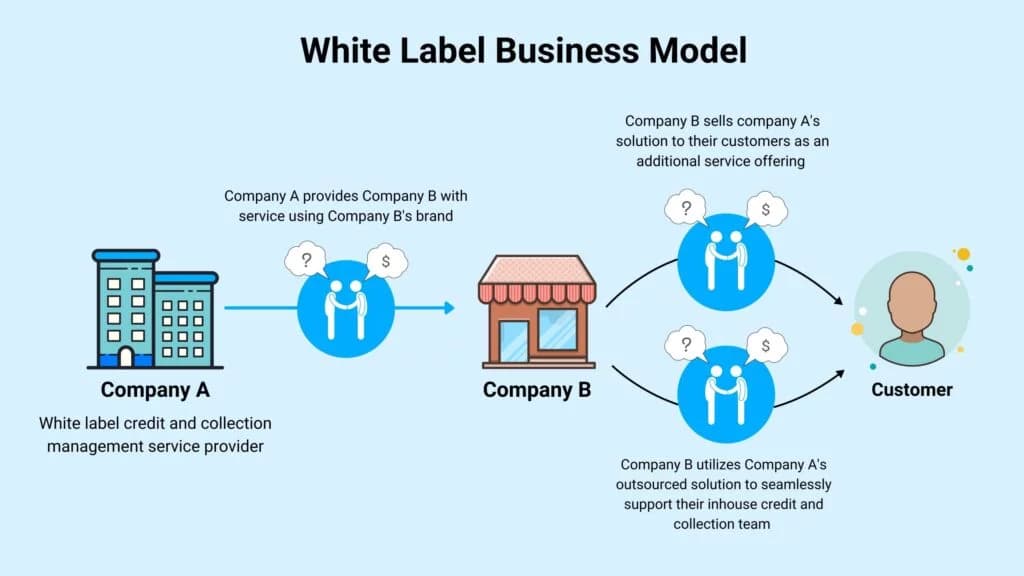
White label services are products or services produced by one company and rebranded by another for resale. For digital agencies, they are the fastest route to scaling revenue without scaling headcount. The model is now mainstream: industry surveys show 73% of agencies have already integrated white label services into their offerings.
What Is a White Label Service Agreement?
A white label service agreement is a contractual arrangement where one company produces the deliverable and another rebrands and resells it to end clients. The contract defines the scope of services, sets responsibilities for each party, and establishes confidentiality provisions that keep the fulfillment partner invisible throughout the client relationship.
This legal layer separates white label from informal outsourcing. Agencies like Symphonic Digital formalize these arrangements so that quality standards, revision workflows, and client-facing communication protocols are locked in before the first deliverable ships. Without a written agreement, agencies are exposed to inconsistent quality, intellectual property disputes, and the risk of clients discovering who actually built their deliverables.
The confidentiality clause is the most operationally important element. Clients see one brand throughout; the white label partner's name never appears in reports, invoices, or communications.
What Is the White-Label Services Market Size in 2026?
The white label market is projected to reach $99.19 billion by 2026, driven by agency demand for scalable service delivery without proportional overhead growth. That figure spans sectors from digital marketing to fintech. The white label payment gateway segment alone is expected to grow from $3.02 billion in 2026 to $8.19 billion by 2035, at a compound annual growth rate of 14.5%.
For digital agencies, the adoption numbers are striking. Agencies using white label services see 42% higher client retention compared to those delivering everything in-house, and they retain clients 42% longer on average. That retention advantage compounds: higher lifetime value per account funds further growth without new business development costs.
Uplers, one of the larger white label fulfillment networks, reports working with 500+ agencies across 52 countries, reflecting how globalized this model has become.
What Types of White-Label Services Exist Beyond SEO?
White label fulfillment now covers nearly every digital service category. The most commonly outsourced services include:
- Search engine optimization (SEO): Keyword research, on-page optimization, link building, and technical audits
- Pay-per-click (PPC) management: Google Ads and Meta campaigns, bid optimization, and performance reporting
- Social media marketing: Content calendars, community management, and paid social
- Web design and development: WordPress builds, eCommerce, and custom web app development
- Content marketing: Blog production, landing page copy, and email sequences
- Reputation management: Review generation, monitoring, and response workflows
- Email marketing and marketing automation: Platform setup, segmentation, and tools like HubSpot
- Conversion rate optimization (CRO): A/B testing, heatmap analysis, and UX audits
- Mobile app development: Native and cross-platform builds
Providers like That! Company cover SEO, PPC, social media management, and reputation management under one roof. Uplers extends into HubSpot COS development, marketing automation, and mobile app builds. The breadth of available services means agencies can offer a full-stack solution without a single in-house specialist beyond account management.
White Label vs. Private Label vs. Outsourcing: What Is the Difference?
These three terms are often used interchangeably, but they describe distinct arrangements:
| Model | Who Creates It | Who Brands It | Customization | Producer Visibility |
|---|---|---|---|---|
| White Label | Third-party provider | Reseller (agency) | Low to moderate | Hidden |
| Private Label | Third-party producer | Reseller | High | Hidden |
| Outsourcing | Third-party contractor | Client agency | Full | Visible to agency |
White label is pre-built and rebranded. Private label involves more customization during production. Outsourcing is task-based contracting where the agency delegates execution but remains the visible owner. For agencies building scalable service lines, white label is usually the right fit because the deliverables, processes, and quality controls are already established before onboarding begins.
How White Label Services Are Priced
White label pricing follows three main models, and understanding which your provider uses determines your margin math.
Monthly Retainer
The most common model for ongoing services like SEO, social media, and PPC. According to SE Ranking's 2025 survey of 260 agencies, 64% of SEO agencies charge clients below $1,000 per month on retainers, with wholesale costs from white label providers running lower to create the markup that funds agency overhead and profit. Platforms like WhiteLabelSEO.ai (plans from $199.99/month for 50 articles to $499.99/month for 200 articles) and The HOTH publish transparent wholesale pricing that agencies can build retainer models around.

Per-Project or Deliverable-Based
Used for web builds, content packages, and one-time audits. Agencies purchase individual deliverables at wholesale and invoice clients at retail. This model works cleanly for web design, mobile app development, and one-time content campaigns.
Platform Subscription
AI-powered providers increasingly charge a platform fee bundled with fulfillment capacity, agency-branded dashboards, and client portals. DashClicks, Vendasta, and similar platforms operate this way. The structure reduces per-unit costs at scale but requires volume commitment to generate a positive return.
Emerging Trends: AI Integration and Vertical Specialization
The biggest structural shift in white label services is AI-driven automation. Providers integrating AI into their fulfillment stacks can reduce delivery times by up to 40% by automating keyword clustering, SERP analysis, and content drafts, with human editorial review layered on top for quality control.
WhiteLabelSEO.ai, founded in 2025, routes content through a multi-model AI stack combining GPT, Claude, Gemini, and Grok, with a YoastSEO scoring loop that auto-rewrites until quality thresholds are met. ZeroGPT scoring on that output consistently hits 85 to 90% human content rates. Boostability, SEOReseller, and FATJOE are also expanding AI-assisted production lines to remain competitive on turnaround time.
Beyond AI, vertical specialization is the other defining trend. Rather than generalist fulfillment, providers are building category-specific expertise in local services, SaaS, eCommerce, and fintech, and packaging it as a niche white label product. Agencies win clients in those verticals by offering deep knowledge they never had to build internally.
How to Evaluate a White Label Partner
Mono Solutions notes that white label partnerships let resellers test new markets without the full risk of building a new service line from scratch. That risk reduction is only real if the partner delivers consistently. Here is a practical vetting checklist:
- Confidentiality guarantee: Does the contract explicitly prevent the provider from contacting your clients directly?
- Branded deliverables: Are reports, dashboards, and client portals white-labeled with your agency identity?
- Quality control process: What editorial or QA review step occurs before delivery?
- Scalability: Can the provider handle 5x your current volume without degradation?
- Pricing transparency: Are wholesale rates published, or must you negotiate blind?
- Platform integrations: Does the provider connect to WordPress, HubSpot, Shopify, or Wix?
- Communication SLA: What are guaranteed response times and revision windows?
Requesting a trial deliverable and reviewing exit clause language in the contract before signing are the two most skipped steps in partner evaluation. Both matter more than the sales deck.
Frequently Asked Questions
What are white-label services?
White label services are products or services produced by one company and rebranded by another for resale to end clients. The producing company remains invisible; the reselling agency presents all deliverables under its own brand. Common examples include SEO fulfillment, PPC management, web development, and content production. The arrangement is formalized through a white label service agreement covering scope, responsibilities, and confidentiality obligations between both parties.
What is the white-label services market size in 2026?
The white label market is projected to reach $99.19 billion by 2026, reflecting accelerating demand across digital marketing, fintech, SaaS, and software industries. Within digital agencies specifically, 73% have already integrated white label services, and those that do report 42% higher client retention. The white label payment gateway segment alone is growing at a 14.5% compound annual rate through 2035, signaling broad adoption well beyond marketing services.
What types of white-label services exist beyond SEO?
White label fulfillment extends far beyond SEO. Providers such as Uplers, That! Company, and DashClicks offer PPC management, web design and development, social media marketing, email marketing, marketing automation, mobile app development, reputation management, conversion rate optimization, and eCommerce development. HubSpot COS development is also a growing white label category. Any repeatable digital service with documented processes can be productized and delivered under an agency's brand.
Know something we missed? Have a correction or additional information?
Submit a Tip