India’s economy grows 7.8%, defies forecasts as domestic demand holds strong
India’s growth topped forecasts at 7.8% as private investment, farm output and construction offset the first hit from West Asia tensions.
India’s economy grew 7.8% in the January-March quarter, beating forecasts and underscoring how domestic demand kept the expansion running even as conflict in West Asia began to pressure external conditions.
The government’s June 5 release showed private investment, farm output and construction activity helping to offset the early effects of the Middle East conflict. India, the world’s third-largest crude importer, is heavily exposed to any disruption in regional energy flows, so the stronger-than-expected reading eased immediate fears that higher oil prices or weaker trade would quickly knock growth off course.
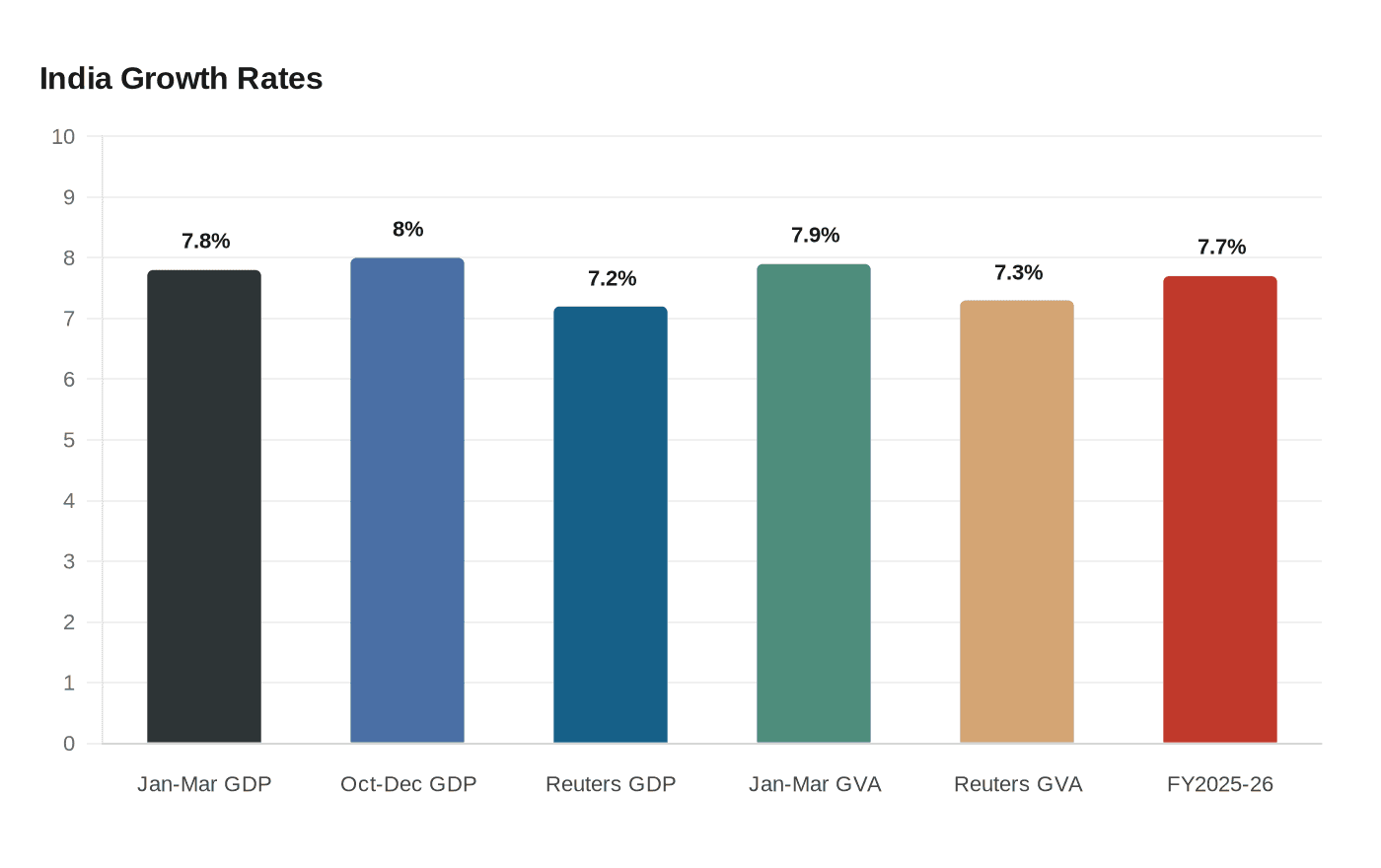
The latest figures came from a revamped national accounts system that uses 2022-23 as the base year, replacing the earlier 2011-12 series and widening coverage across the economy. The Ministry of Statistics and Programme Implementation said the quarterly and annual estimates were the first full set under the new framework. It also revised the October-December quarter up to 8.0% from 7.8%, suggesting momentum at the end of the fiscal year was stronger than first reported. Gross value added, a cleaner measure of underlying activity that strips out taxes and subsidies, rose 7.9% in the January-March quarter.
The result landed well above expectations. A Reuters poll of 45 economists taken from May 22 to June 1 had pointed to 7.2% growth, with estimates ranging from 6.1% to 7.7%. The same survey had expected gross value added to rise 7.3%. The National Statistics Office also estimated full-year FY2025-26 growth at 7.7%, above the 7.4% projected in the Economic Survey 2025-26.
For policymakers in New Delhi, the data suggests India entered the new fiscal year with more resilience than many analysts expected. For investors, it reinforces the view that domestic consumption, infrastructure spending and agriculture continue to cushion the economy against external shocks. Still, the outlook is less secure than the headline suggests. Sakshi Gupta of HDFC Bank said the disruption from West Asia appeared to have had only a limited effect on momentum, but she warned growth was likely to moderate from the April-June quarter onward.
That caution matters because India has so far avoided a sharper hit from the conflict, not eliminated the risk. If energy costs rise further, or if trade and inflation worsen, the current pace may prove harder to sustain in the months ahead.
This article was produced by Prism’s automated news system from verified source data, official records, and press releases, then run through automated quality and moderation checks before publishing. The system is built and supervised by the people who set the standards it runs under. Read our full AI policy.
Know something we missed? Have a correction or additional information?
Submit a Tip