Inside Trump's Cabinet: How Advisers Voiced Iran War Concerns to the President
JD Vance warned Trump face-to-face that war with Iran would cause regional chaos, while Pete Hegseth pushed hardest for strikes the day before the final order was given.

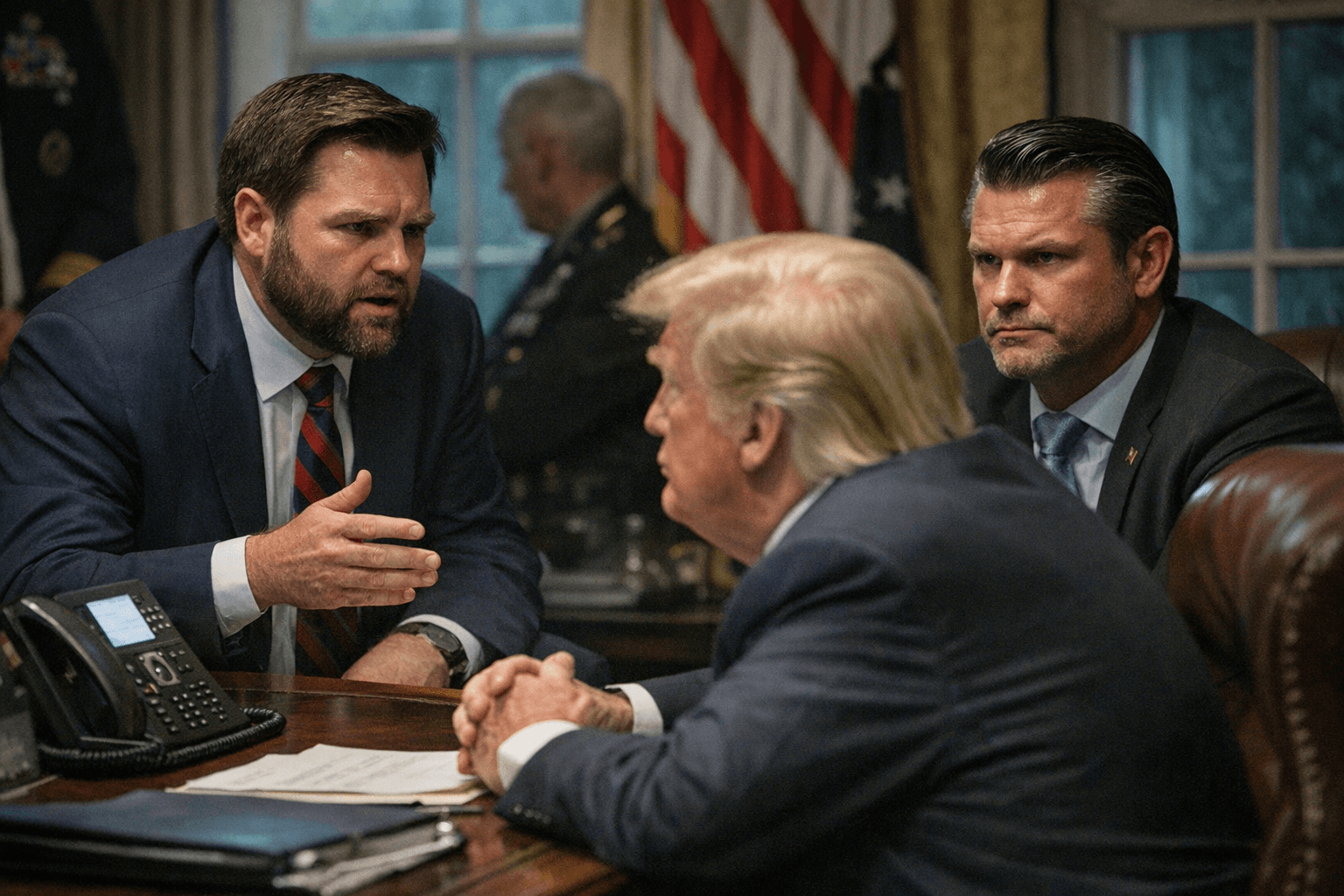
The sharpest internal divide over America's war with Iran was not a memo, not a quiet word in a hallway, and not a backchannel. Vice President JD Vance opposed President Trump's authorization of strikes against Iran, and he made his objections known directly to the president, in front of his assembled colleagues. Vance warned Trump that a war against Iran could cause regional chaos and untold numbers of casualties. His case, however forcefully made, did not hold.
Defense Secretary Pete Hegseth was the most enthusiastic advocate for military action. On February 26, the day before Trump issued his final order to strike Iran, Hegseth told the group directly: "We're going to have to take care of the Iranians eventually, so we might as well do it now." Secretary of State Marco Rubio occupied more ambivalent ground, warning the administration would need clear, limited objectives before committing to conflict.
The pivotal meeting with Israeli Prime Minister Benjamin Netanyahu drew together a tight circle: White House chief of staff Susie Wiles, Rubio, Hegseth, Joint Chiefs chairman Gen. Dan Caine, CIA director John Ratcliffe, Jared Kushner, and Middle East envoy Steve Witkoff, with Israeli military leaders joining by video screen. Vance was not in the room. He was out of the country when the meeting was called with little notice, and the gathering had been deliberately kept small to guard against leaks.
That absence compressed whatever leverage his dissent carried. Vance, a U.S. Marine Corps veteran who had served in the Iraq War, had argued against foreign military entanglements for years. He reportedly sought to dissuade Trump by warning that any full-scale conflict would entail "a huge distraction of resources" and prove "massively expensive." Nobody in Trump's inner circle was more worried about the prospect of war with Iran, or did more to try to stop it, than the vice president. None of it changed the outcome.
Reporting by Jonathan Swan and Maggie Haberman for their forthcoming book, "Regime Change: Inside the Imperial Presidency of Donald Trump," found that Trump's decision to take the country to war was not driven by intelligence assessments or a strategic consensus among his advisers, which did not exist. It was driven by instinct. Unlike his first-term team, many of whom regarded him as a danger to be managed or obstructed, Trump in his second term is surrounded by advisers who view him as a great man of history. That shift in how the inner circle relates to the president is inseparable from how dissent traveled, and how little it ultimately mattered.
Rubio has since justified the war by arguing that the United States intends to prevent Iran from ever developing a nuclear weapon and to destroy its ballistic missile program. Vance, widely considered a leading contender for the 2028 Republican presidential nomination, has kept a careful distance from the conflict's consequences, consistent with the posture of someone who delivered his objections plainly before the order was signed and has been measured in his public statements ever since.
This article was produced by Prism’s automated news system from verified source data, official records, and press releases, then run through automated quality and moderation checks before publishing. The system is built and supervised by the people who set the standards it runs under. Read our full AI policy.
Did this article answer your question?


