Iranian Diaspora Fractures Deepen Amid Protest, Repression, and War
Since Israel and the U.S. bombed Iran in June 2025, diaspora communities worldwide have split bitterly over whether regime change at any cost can be justified.
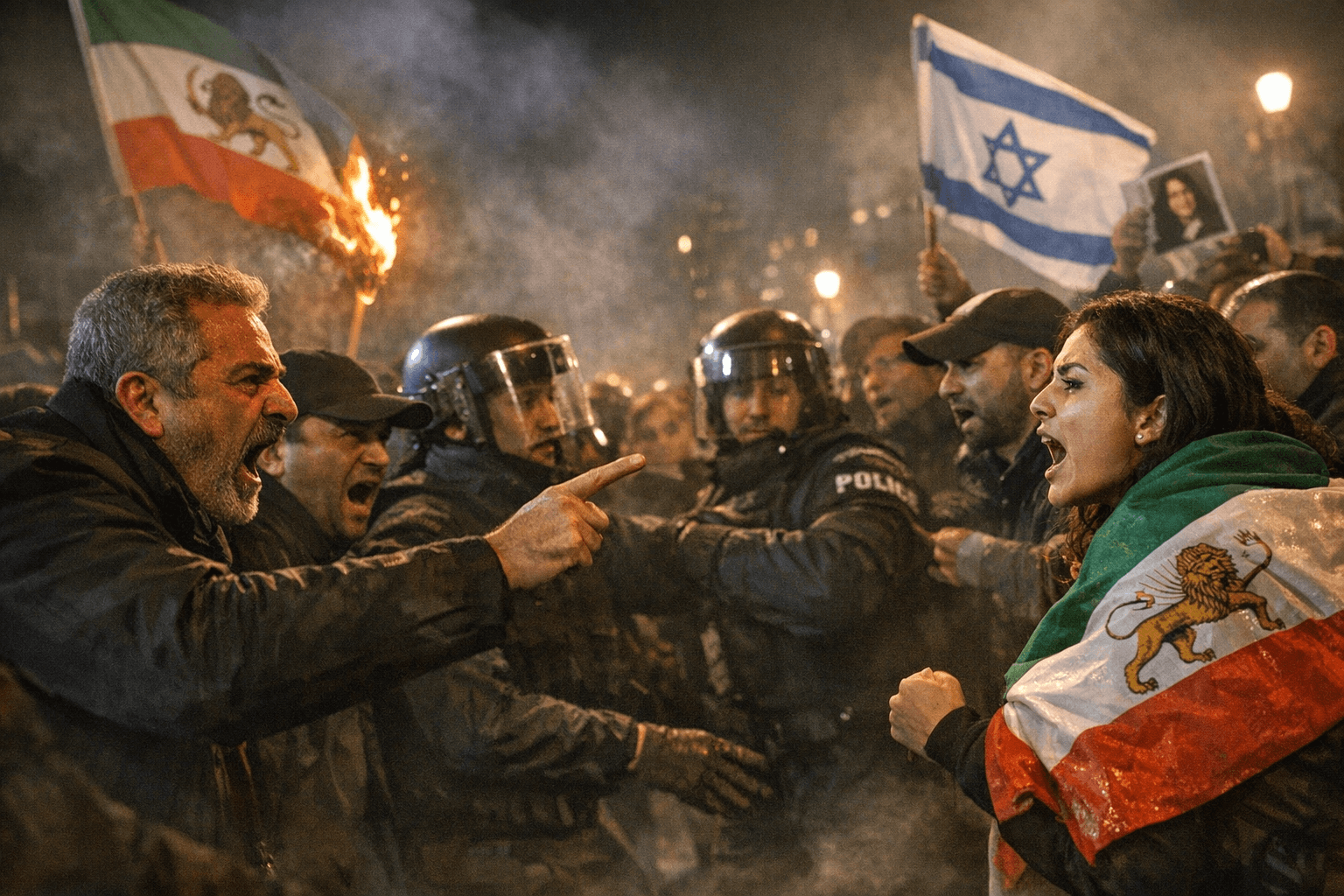
The question of what a free Iran should look like has fractured the country's diaspora along lines that cut through families, friendships, and living rooms from Los Angeles to London. Since the June 2025 Twelve-Day War, in which Israeli and American strikes destroyed Iran's nuclear facilities and killed more than 1,000 Iranians, most of them civilians, and a sweeping internet blackout was imposed during protests that followed a dramatic economic collapse, the ruptures inside diaspora communities have deepened in ways that may take years to repair.
The protests began on December 28, 2025, when the Iranian rial collapsed to a historic low of 1.4 million rials per American dollar. A sit-in at Tehran's Grand Bazaar spread rapidly to cities across the country, drawing merchants, students, and ordinary citizens into the streets. The regime responded with force. Executions had already doubled in 2025 compared to 2024, and the government accelerated them further as protests widened.
For Iranians abroad, the cascade of crises turned every family group chat into a political fault line. The internet blackout Tehran imposed to suppress coverage of its crackdown left diaspora members watching message delivery receipts the way earlier generations listened for a dial tone. Bahareh Sahebi, a writer and clinical psychologist in the Chicago area, described monitoring two check marks on her phone each morning as her only measure of whether family in Tehran remained reachable, knowing that gray check marks meant the worst scenarios her mind had not yet named.
The deeper rupture is political. Abbas Milani, director of Iranian studies at Stanford University, captured the central divide: "Some people are so aggrieved at this regime that they say, 'At any cost, come and destroy this regime even if it means destroying parts of the country.' Others want to get rid of the regime but not at the expense of war."
That division has corroded diaspora organizations that the Woman, Life, Freedom movement of 2022, sparked by Mahsa Amini's death in police custody, had briefly unified. Since the June 2025 war, exiled Crown Prince Reza Pahlavi intensified his campaign, calling for solidarity protests in Munich, Toronto, and Los Angeles while presenting himself as a transitional leader. Inside Iran, chants of "Javid Shah," Long live the Shah, re-emerged alongside slogans from 2022, reflecting how monarchist nostalgia has merged with an uprising that originally began as a demand for economic survival.
Scholars studying the period have described a faction of the diaspora opposition as practicing what they call "retrotopia," a romanticized attachment to the pre-1979 order that distorts the pluralist, grassroots ideals of the Woman, Life, Freedom movement and embraces the logic of foreign military intervention. Online, those who expressed support for the American and Israeli strikes found themselves labeled "Zionists" in social media arguments; those who opposed the strikes were accused of defending the regime. Neither label allows for the ambivalence most diaspora members actually carry.
The Iranian state has also worked to deepen the fractures. In January 2026, a federal judge in Manhattan sentenced Carlisle Rivera to 15 years in prison for his role in a 2024 Islamic Republic-directed plot to kill Iranian-American dissident Masih Alinejad, one in a documented series of operations using Russian mobsters, Mexican cartel hitmen, and a Canadian Hells Angel to silence critics abroad. In February 2026, Canadian police declared the disappearance of Iranian dissident Masoud Masjoudi a matter of urgent concern.
The battles over identity, loyalty, and tactics play out daily across diaspora dinner tables, WhatsApp threads, and community centers. What makes them intractable is that nearly everyone involved shares the same grief but cannot agree on what it demands.
Know something we missed? Have a correction or additional information?
Submit a Tip