Iranian Embassy Accounts in Africa Lead Social Media Information Warfare Campaign
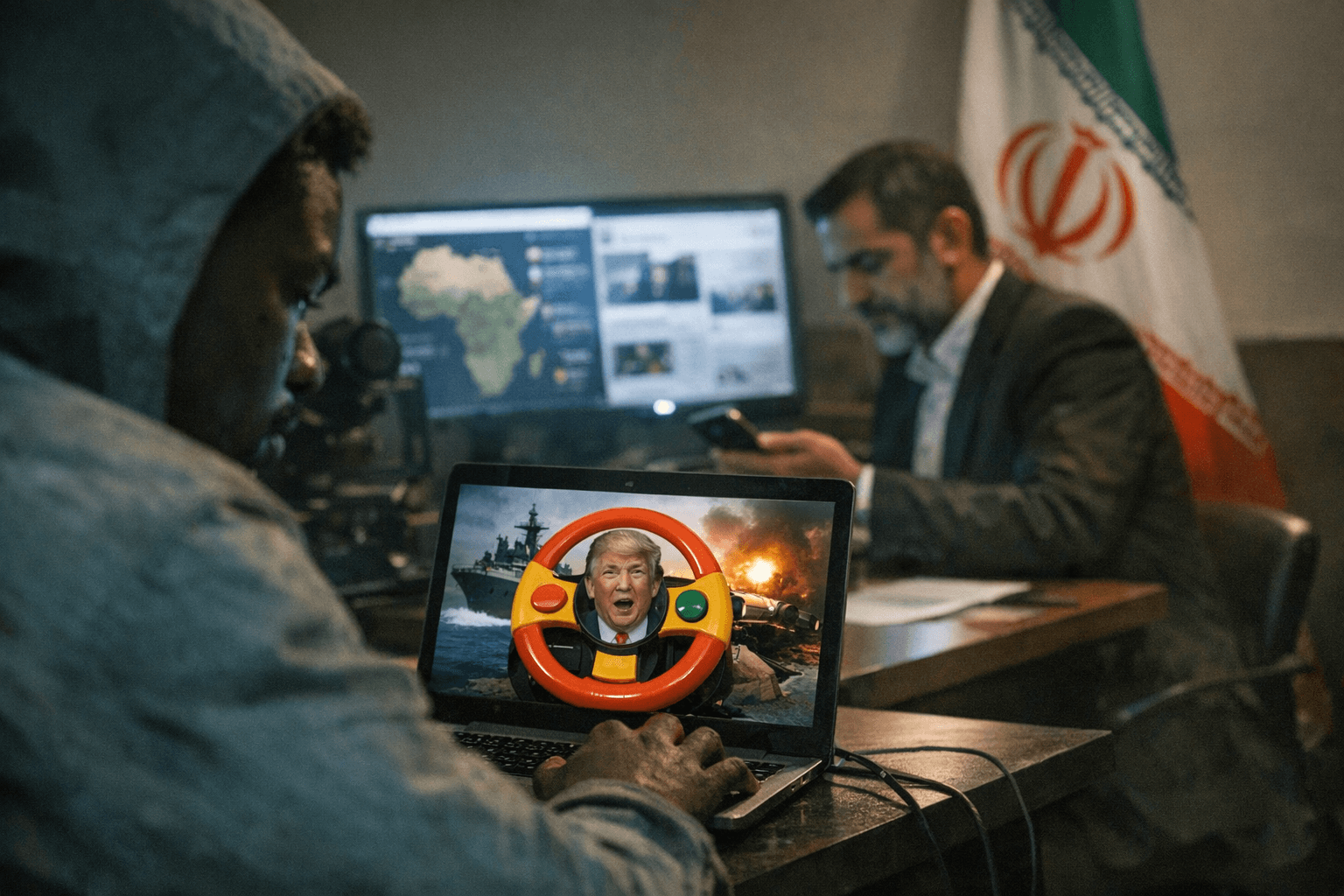
Iran's embassy in South Africa posted a toy-steering-wheel meme mocking Trump's Hormuz claims that racked up 3.1 million views, part of a coordinated Africa-led trolling campaign.
When Trump posted a profanity-laden ultimatum on April 5 demanding Iran reopen the Strait of Hormuz or face U.S. strikes on bridges and power plants, the first significant counterpunch came not from Tehran's foreign ministry but from a verified diplomatic account in sub-Saharan Africa. Within hours, the Iranian Embassy in Zimbabwe had turned a geopolitical standoff into a punchline, and the mission in South Africa was amplifying the signal globally.
The most viral exchange centered on Trump's blunt demand to "Open the Strait." The Iranian Embassy in Zimbabwe posted on X: "We've lost the keys." The Iranian Embassy in South Africa chimed in, telling Zimbabwe, "Shh… the key's under the flowerpot. Just open for friends." The Iranian Embassy in Bulgaria then landed a sharper jab: "Doors open for friends. Epstein's friends need keys," a reference to Trump's political rivals who accused him of launching the war to distract from the release of Epstein documents.
The Zimbabwe mission had already mocked Trump's 8 P.M. deadline directly, posting: "8 P.M. is not that good. Could you change it to between 1 and 2 P.M., or if possible, 1 and 2 A.M.? Thank you for your attention to this important matter. I.E.Z." The sign-off mimicked the closing phrase Trump routinely uses on his Truth Social posts.
The South Africa account proved the most prolific and highest-reach node in the network. Following Trump's claim that the U.S. and Iran would share control of the Strait of Hormuz, the embassy posted a photograph of a car's interior with a toy pink-and-blue steering wheel affixed to the passenger-side dashboard beside the real one, captioned "The Strait of Hormuz will be controlled by me and the Ayatollah." The post accumulated 3.1 million views on X. In a separate post, the account staged fake leaked texts between Trump and himself, captioned "Good and productive talks with Iran," a sly reference to Trump's claims that diplomacy was underway to end the war. After ceasefire negotiations concluded with both sides claiming victory, the South Africa account posted "Say hello to the new world superpower" alongside a picture of the Iranian flag.
Across X, Instagram, TikTok and YouTube, Iranian embassy accounts posted into the moment often within minutes, using a tone that departed from diplomatic convention. The language was direct, sometimes sarcastic, with humor deployed strategically. The operation carried clear objectives beyond mockery: reshaping the Hormuz narrative as Iranian defiance rather than capitulation, seeding doubt about Trump's domestic credibility, and broadcasting a Global South solidarity message to audiences in Africa, Asia, and Latin America already skeptical of U.S. foreign policy framing.
The Africa-based accounts functioned as particularly effective amplifiers. South Africa's membership in BRICS and its history of non-alignment give Iranian diplomatic messaging there a credibility backstop that missions in Western capitals cannot easily claim, and the accounts appear to have faced less platform scrutiny than higher-profile state-affiliated accounts in Europe and North America. The pattern was visible across multiple accounts, including in southern Africa, with posts following a recognizable structure: humour to undercut Western political figures, recasting escalation as spectacle, and historical imagery drawing on resistance narratives.
Analysts said the deep grasp of U.S. politics and culture underlying the campaign was the fruit of a decades-long Iranian government program to promote narratives against the United States and Israel. "This meme war comes from institutions that are very aware what the American public is aware of and pop cultural references that can appeal to them," said Alimardani, an analyst tracking the campaign. Analysts noted that the U.S. and Israel did not appear to be engaging in the same kind of campaign, and given the restrictions Iran placed on internet access domestically, the operation was clearly engineered for external audiences.
Neil Lavie-Driver, an AI researcher at the University of Cambridge, framed the effort plainly: "This is a propaganda war for them. Their goal is to sow enough doubt." With a single toy steering wheel and 3.1 million organic impressions, the embassy in Pretoria demonstrated that the lowest-cost instruments of modern statecraft are now verified diplomatic accounts and a reliable sense of timing.
This article was produced by Prism’s automated news system from verified source data, official records, and press releases, then run through automated quality and moderation checks before publishing. The system is built and supervised by the people who set the standards it runs under. Read our full AI policy.
Did this article answer your question?