Iran’s fast attack boats threaten Strait of Hormuz oil flows
Iran’s speedboat fleet can disrupt a chokepoint that carries a quarter of seaborne oil, and the shock can ripple from tankers to fuel prices far beyond the Gulf.
The world’s energy trade runs through a narrow lane
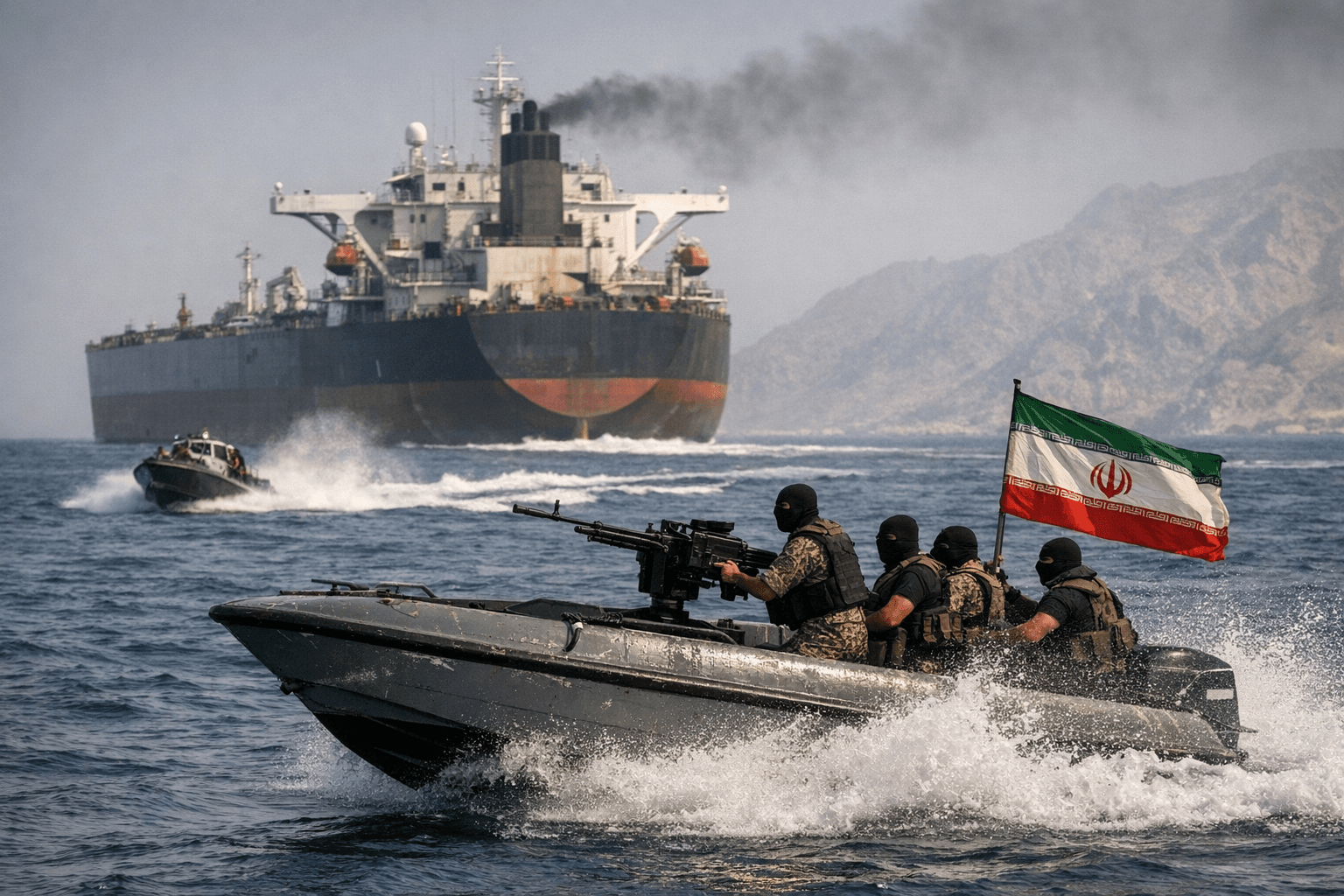
Iran does not need a blue-water navy to rattle global markets. A fast-moving swarm of small boats, built to harass rather than to dominate, can make the Strait of Hormuz expensive, dangerous, and unpredictable for everyone who depends on steady oil and gas flows.
That matters because the strait, which borders Iran and Oman, is one of the world’s most important energy chokepoints. Roughly 27% of global maritime trade in crude oil and petroleum products moves through it, along with about 20% of global liquefied natural gas trade. It is also a transit route for helium, fertilizers, and other industrial products, which means the consequences of disruption go well beyond tankers and gas carriers.
Why fast boats are such a serious threat
Iran’s Islamic Revolutionary Guard Corps Navy, not the regular Iranian Navy, operates the smaller, faster vessels designed for this mission. Some of these boats can travel at more than 115 miles per hour, giving them the speed to close distance quickly, swarm targets, and complicate the job of escort ships trying to protect commercial traffic.
The point of the mosquito-fleet strategy is not to win a conventional naval battle. It is to create uncertainty. A tanker captain, a shipping insurer, and a military commander all react to that uncertainty by slowing down, rerouting, raising premiums, or escalating protection, and each response increases the economic cost of passing through the strait.
Iran has also widened the toolkit. Alongside fast attack boats, it has deployed waterborne drones, mines, and shore-based missile batteries. That combination matters because even one tool can force a rerouting decision, while the mix of all three can turn the strait into a corridor where every crossing becomes a calculation under pressure.
How the IRGC Navy built this capability
The buildup is not improvised. On May 28, 2020, Iran said it delivered 112 new-generation offensive speed boats of different classes to the IRGC Navy in Bandar Abbas, including Zolfaqar, Heidar, and Meead-class vessels. Those boats were described as capable of high speed, with a low radar cross-section and a high level of offensive power, exactly the qualities that make them useful in a crowded waterway.
That investment signals a long-term strategy: instead of matching the United States ship-for-ship, Iran has concentrated on asymmetry. The result is a force optimized for disruption, one that can surge around chokepoints, force defensive deployments, and keep commercial shipping on edge without needing to dominate the broader Persian Gulf.
A retired U.S. official called it a “disruptive force,” and that is the right economic framing. A disruptive force does not have to sink every ship to change behavior. It only has to make enough operators believe the next transit could be delayed, damaged, or denied.
What the current closure has already done to markets
The latest phase of pressure began when Iranian forces declared the Strait “closed” starting March 4, 2026, and began attacking ships attempting to transit the waterway. That immediately raised the stakes from geopolitical tension to direct market risk, because traders know the strait is not just a shipping lane, it is a pressure valve for the global energy system.
The price response was swift. Brent crude jumped 8%, from $71.32 on February 27, 2026, to $77.24 on March 2, 2026, and later moved above $100 per barrel. That kind of move is not simply a headline for traders. It filters into fuel contracts, airline costs, diesel prices, petrochemical inputs, and the broader inflation outlook.
The Congressional Research Service has warned that a prolonged disruption of Middle East oil trade would create market conditions with no historical precedent. That warning matters because the world has seen oil shocks before, but not one centered on a sustained chokehold over one of the most important export routes on earth, with energy markets already tightly integrated and inventories often lean.
Why shipping risk becomes consumer risk
The first pressure point is the tanker itself. When the risk of attack rises, shipowners and charterers face higher war-risk premiums, longer voyage times, and the possibility that a vessel cannot sail at all without military escort. Those costs do not stay on the balance sheet for long. They are typically pushed down the chain into freight rates, refined product prices, and eventually the cost of gasoline and diesel.
That is why the Strait of Hormuz is so closely watched in U.S. energy policy. Even though the United States imports much less Gulf oil than in past decades, global oil prices still set the tone for American consumers. If Brent moves sharply higher, U.S. pump prices can follow, along with the cost of heating, freight, and consumer goods that rely on fuel-intensive transport.
The broader macroeconomic risk is that a shipping choke point can amplify inflation just when policymakers are trying to keep it contained. A disruption in the Strait of Hormuz does not stay confined to the Gulf. It spills into shipping contracts, refinery margins, and retail energy bills in the United States and across import-dependent economies.
The U.S. response is built around keeping the lane open
Iran’s maritime pressure has already put it into direct conflict with the United States before, including during the 1987-1988 tanker war. That history matters because it shows the standoff is not theoretical. The strait has long been a place where military signaling and energy security collide.
In the current confrontation, President Donald Trump has raised the prospect of U.S. action to reestablish free transit. Reuters reported that he warned Iranian fast-attack ships approaching a U.S. maritime blockade would be eliminated. At the same time, the U.S. military has discussed escorting commercial vessels through the strait if necessary, and it has also been involved in mine-clearing planning.
Those are not abstract contingency plans. Escort missions, blockade enforcement, and mine clearing are all expensive, resource-intensive ways of restoring confidence in a route that markets need to believe is usable every day. The goal is not just to move a few tankers through the water. It is to convince insurers, traders, and ship operators that the lane is open enough to price normally again.
Why the next phase still looks unstable
Even after weeks of U.S.-Israeli strikes, more than 60% of the IRGC fast-attack ships patrolling the strait reportedly remained intact, according to a Reuters-cited report. That suggests the force Iran has built is resilient enough to remain a live threat even under sustained pressure.
That resilience is what makes the economic picture so dangerous. The Strait of Hormuz is not vulnerable because Iran has conventional naval superiority. It is vulnerable because a dense mix of fast boats, drones, mines, and missiles can impose enough risk to interrupt one of the world’s most important energy arteries. As long as that threat endures, oil prices, shipping costs, and U.S. consumer prices will remain exposed to a conflict that starts in a narrow waterway and ends in household budgets far from the Gulf.
This article was produced by Prism’s automated news system from verified source data, official records, and press releases, then run through automated quality and moderation checks before publishing. The system is built and supervised by the people who set the standards it runs under. Read our full AI policy.
Did this article answer your question?


