Iran’s parliament declares EU militaries 'terrorist groups' after EU listing
Iran says EU militaries are 'terrorist groups' in retaliation for the EU listing of the IRGC.

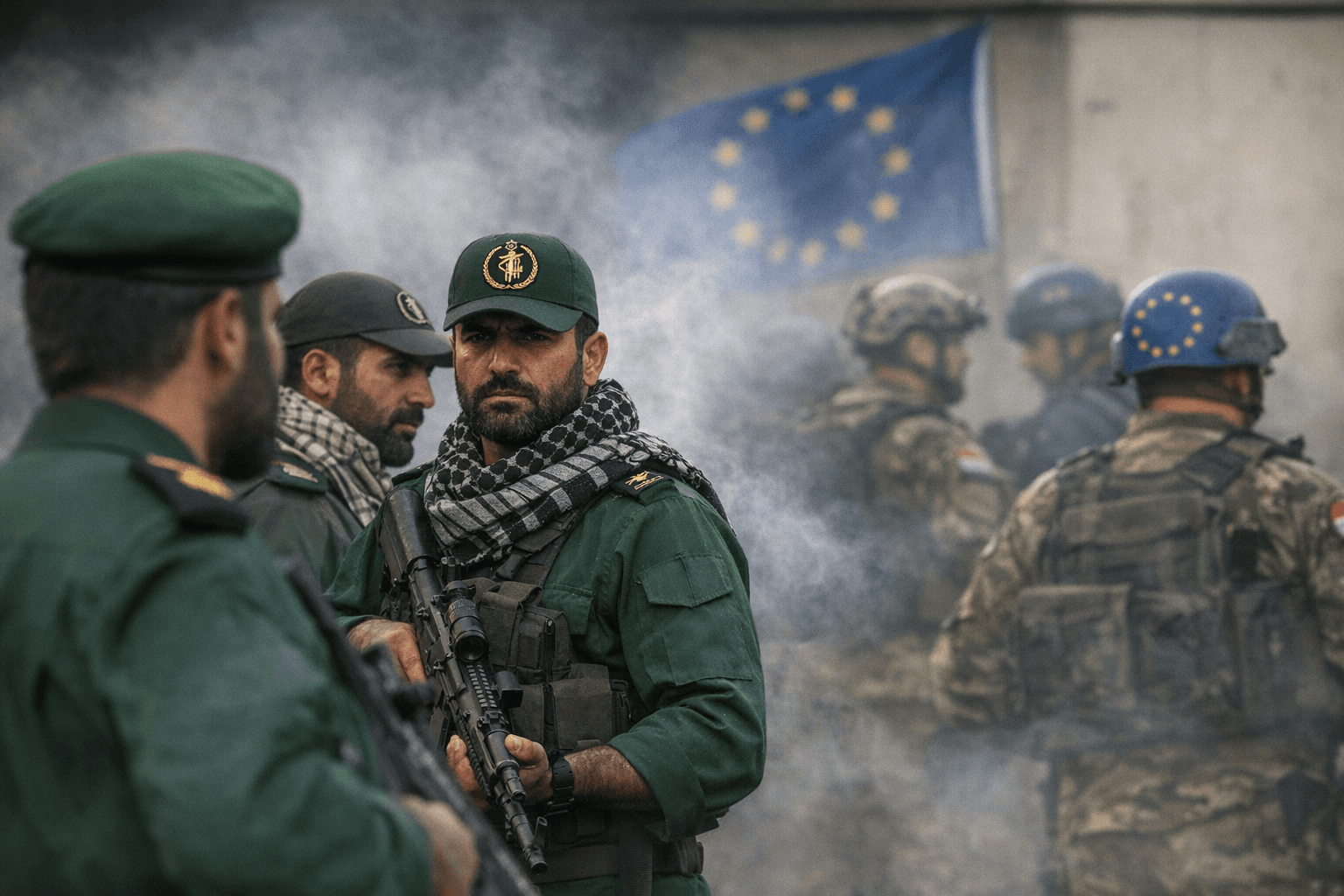
Iran’s parliament speaker Mohammad Bagher Qalibaf announced that Tehran now considers the militaries of European Union members to be "terrorist groups," framing the move as a direct response to the EU’s recent decision to put the Islamic Revolutionary Guard Corps on a terror list. Qalibaf, a former IRGC commander, made the declaration in parliament on Feb. 1 as lawmakers wore Guard uniforms and chanted “Death to America!” and “Death to Israel!” in a session marked by stark symbolism and sharp rhetoric.
Qalibaf accused European governments of acting at Washington’s behest, saying, “By seeking to strike at the (Guard), which itself has been the greatest barrier to the spread of terrorism to Europe, Europeans have in fact shot themselves in the foot and, once again through blind obedience to the Americans, decided against the interests of their own people.” Xinhua, citing ICANA, reported additional remarks from Qalibaf that the EU move was “irresponsible,” “baseless,” done “in compliance with the orders from U.S. President Donald Trump and Israeli leaders,” and that “the consequences of this action will be borne by the EU.”
Iran invoked legal language that critics say amounts to a tit-for-tat response to a 2019 pattern of reciprocal measures. Euronews cited Article 7 of a 2019 Iranian law on countermeasures tied to the original U.S. designation of the IRGC, saying that under that statute "the armies of European countries are considered terrorist groups." Multiple Western and regional outlets and analysts characterize Tehran’s declaration as largely symbolic, noting that extensive sanctions and listings already target the IRGC and its networks.
The announcement came amid intense international tension and contested reporting about military moves. The Associated Press reported that Tehran planned a live-fire drill in the Strait of Hormuz for the weekend following the parliamentary session, an escalation that would touch a chokepoint through which roughly one fifth of globally traded oil passes. Deutsche Welle, citing Reuters, reported an unnamed Iranian official saying the Revolutionary Guards had no plan to exercise in the strait, a direct contradiction that reflects the fog accompanying fast-moving crises.
The diplomatic standoff is additionally complicated by sharply divergent tallies of casualties from Iran’s domestic unrest, which helped prompt the EU action. The Human Rights Activists News Agency, cited by AP and NBC, reported more than 49,500 detentions and at least 6,713 deaths, mostly protesters. Tehran’s government, as of Jan. 21, put the death toll at 3,117 and labeled some casualties “terrorists.” Euronews said several EU foreign ministers spoke of "possibly up to 30,000 victims." AP noted it could not independently verify figures because Iranian authorities restricted internet access.
Across the Atlantic, U.S. posture has hardened. Deutsche Welle quoted President Donald Trump telling Fox News, "[Iran is] talking to us, and we'll see if we can do something, otherwise we'll see what happens ... We have a big fleet heading out there." Reports also describe U.S. naval deployments, including a nuclear-powered aircraft carrier, to the region.
For diplomats and legal analysts, the parliamentary declaration raises questions about practical effect versus political signaling. Tehran’s step appears designed to rally domestic support for the IRGC and to punish EU capitals that publicly linked the Guard to repression of protests. The international community now faces a narrow window to de-escalate: key items to watch are whether Tehran formalizes the measure in law, how Brussels responds diplomatically or legally, and whether contested military movements in the Gulf materialize or remain rhetorical.
This article was produced by Prism’s automated news system from verified source data, official records, and press releases, then run through automated quality and moderation checks before publishing. The system is built and supervised by the people who set the standards it runs under. Read our full AI policy.
Did this article answer your question?


