Irish police clear Whitegate refinery blockade amid nationwide fuel protests
Gardaí backed by Defence Forces recovery trucks cleared the Whitegate blockade on April 11, allowing seven tankers to depart and easing access to Ireland’s only oil refinery.
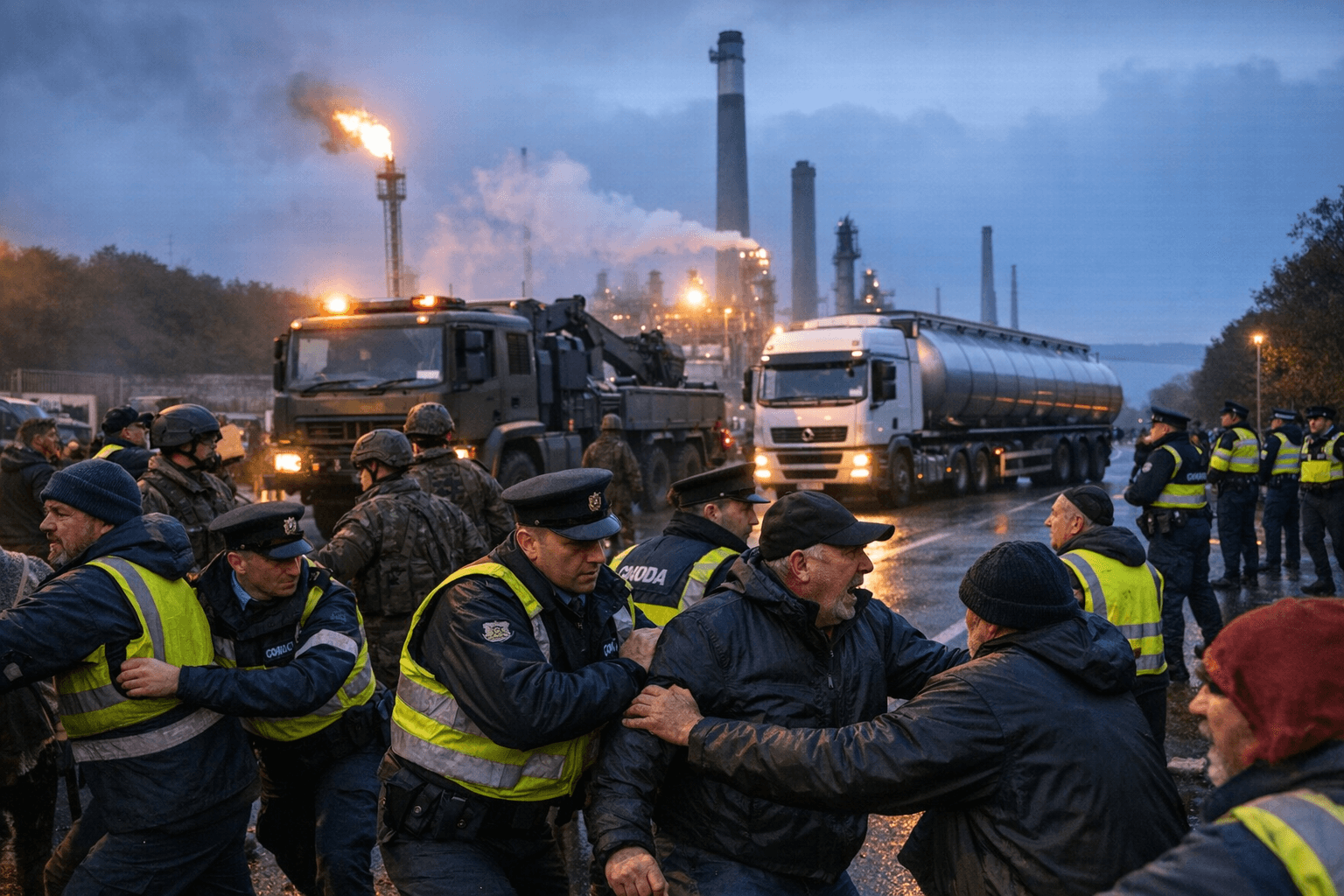
Blocking Whitegate, the country’s only oil refinery in County Cork, exposed how quickly a cost‑of‑living protest can threaten fuel security and emergency services. On April 11, 2026, An Garda Síochána, supported by Defence Forces heavy‑lift recovery vehicles and public‑order units, moved to clear the multi‑day blockade; reports cite seven tankers leaving the site after the operation and four heavy‑lift recovery trucks made available to assist. The clearance began a fragile process to reopen a node that had left large parts of the country short of fuel.
The Garda operation followed an escalation that began on April 7, when farmers, truckers and other demonstrators began coordinated blockades at depots, ports and motorway junctions. Garda Commissioner Justin Kelly declared the response had entered an enforcement phase and the force internally designated an exceptional event to mobilise additional personnel. Justice Minister Jim O’Callaghan confirmed a formal C70 request for Defence Forces aid to the civil power; Defence Forces statements limited their role to engineering and vehicle recovery and denied deployment of armoured vehicles used for unrelated UNIFIL readiness exercises. Official social‑media posts and on‑the‑ground footage showed tractors and vehicles being repositioned and police using public‑order tactics, including pepper spray in some clashes, to secure tanker routes.
The political calculation was immediate. Protest organisers, including John Dallon and James Geoghegan, demanded steep cuts to fuel taxes and other relief; Geoghegan has been publicly scrutinised over reported Revenue judgments of roughly €548,000. The government had already introduced temporary excise cuts on March 24, 2026, reducing diesel duty by €0.20 per litre and petrol duty by €0.15 per litre through the end of May, but ministers said those measures failed to halt the blockades and warned prolonged obstruction could force Ireland to refuse oil deliveries and disrupt essential infrastructure.
The economic effects were measurable. Industry body Fuels for Ireland estimated that by April 11 about 600 forecourts out of roughly 1,500 nationwide were out of fuel, and CEO Kevin McPartlan warned that, even if blockades ended immediately, full distribution could take up to a month to normalise as stocks locked in terminals and the refinery were unlocked. The National Emergency Co‑ordination Group convened to assess cascading risks to ambulances, fire services and supplies such as chemicals for water treatment, signalling the government’s concern about system‑wide vulnerabilities.
Restoring pump supplies will depend on reopening depots and ports beyond Whitegate and on clearing logistical bottlenecks created by days of disruption. Ministers have signalled stepped‑up enforcement alongside a willingness to negotiate targeted measures such as the Irish Farmers Association’s Temporary Farm Fuels Support Scheme. Analysts say the episode will trigger rapid reviews of emergency fuel supply planning and contingency capacity, and it serves as a stark stress test of how democracies balance the political potency of rising energy prices against the imperative of keeping critical infrastructure functioning.
This article was produced by Prism’s automated news system from verified source data, official records, and press releases, then run through automated quality and moderation checks before publishing. The system is built and supervised by the people who set the standards it runs under. Read our full AI policy.
Did this article answer your question?


