Israel expands control across Gaza, Lebanon and Syria since 2023
Israel has taken about 1,000 square kilometers across Gaza, Lebanon and Syria since Oct. 7, 2023, redefining the map before any peace talks begin.

Israel has taken control of roughly 1,000 square kilometers across Gaza, Lebanon and Syria since Hamas’ Oct. 7, 2023 cross-border attack, a territorial expansion that is the largest in decades and one that reaches far beyond any single battlefield. Israeli forces have carved out what they call security buffer zones and say they intend to hold them indefinitely, turning military gains into a new baseline that could shape any future settlement.
The scale is not abstract. In Gaza and Lebanon alone, evacuation warnings and military operations have pushed out more than 3 million people, while troops have demolished towns, neighborhoods and border communities. The result is a string of depopulated strips of land where civilian return, reconstruction and normal administration would be difficult even if the fighting stopped tomorrow. These are not formal borders, which would require agreements between states, but they are hardening facts on the ground.
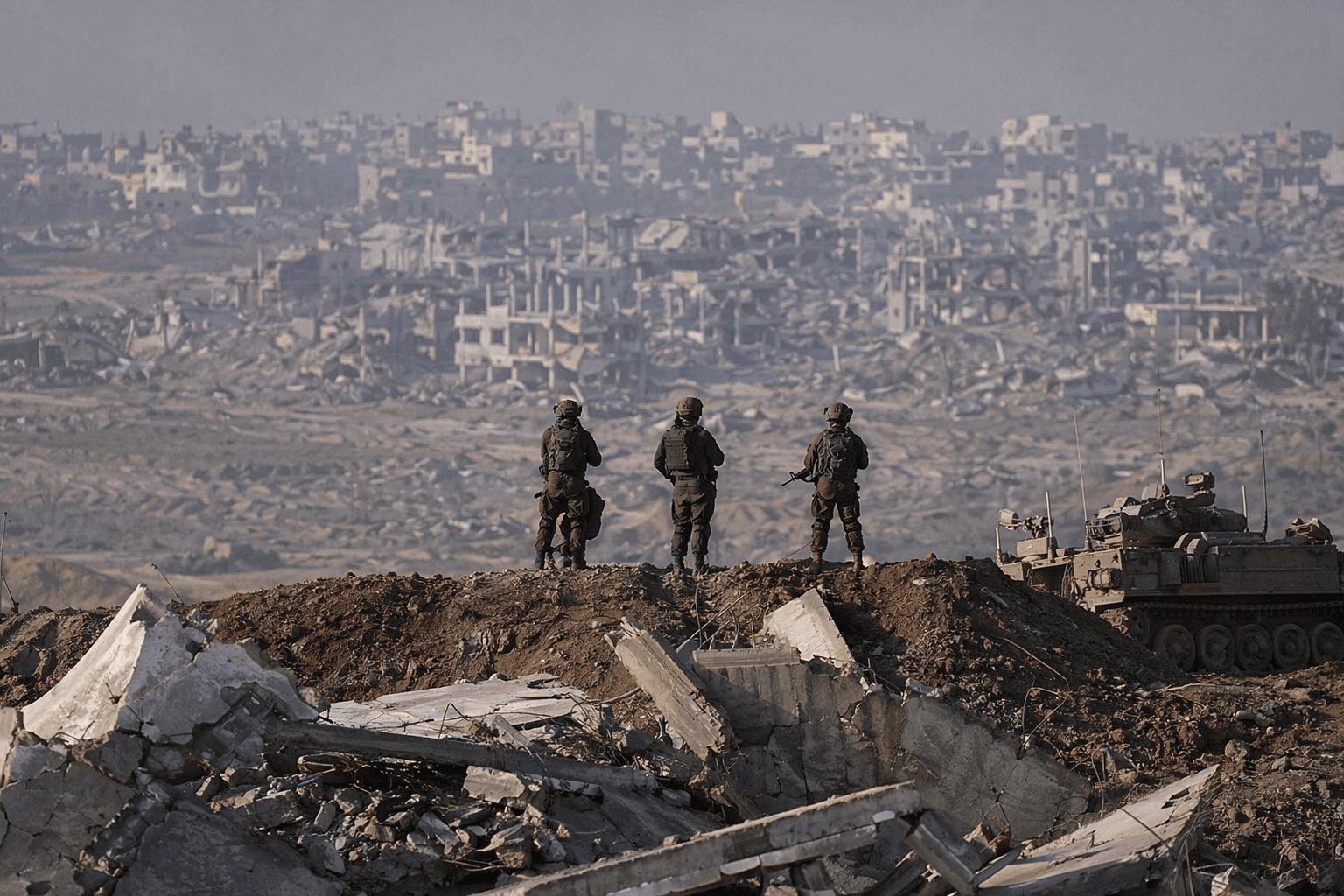
That distinction matters because land under military control often becomes a bargaining chip that is anything but temporary. Israel’s current holdings across the broader area are even larger when other seized terrain is counted, and Benjamin Netanyahu’s government has given no indication that withdrawal is planned. By holding these zones open-ended, Israel is not only creating depth for its forces; it is altering the legal and diplomatic starting point for talks with Palestinians, Lebanon and Syria, each of which would now have to confront a changed map rather than the one that existed before the wars.
The precedent is visible beyond Gaza and Lebanon. In the occupied West Bank, Israeli authorities and settlement monitors said 2024 marked the peak year for land grabs in more than three decades, including the declaration of 12.7 square kilometers in the Jordan Valley as state land in June 2024. That pattern has sharpened concern that temporary military control can become durable territorial change, especially when civilian access is restricted and settlement or security claims follow.
The wider historical backdrop makes the shift more consequential. Israel has never had fixed borders since its founding in 1948, and the region’s lines have moved through war, annexation, ceasefires and peace agreements. Israel’s occupation of the West Bank and the Golan Heights dates to 1967, while Gaza’s status after the 2005 withdrawal remains disputed in international law and human-rights debates because Israel retained extensive control over borders, airspace and access. In Lebanon, renewed destruction, displacement and panic have returned amid the deaths of three peacekeepers, underscoring that the front with Hezbollah remains unstable even after the November 2024 Israel-Lebanon agreement. The military map being redrawn since 2023 is therefore not just a wartime episode. It is the new terrain on which any cease-fire, reconstruction plan or regional settlement will now have to be negotiated.
This article was produced by Prism’s automated news system from verified source data, official records, and press releases, then run through automated quality and moderation checks before publishing. The system is built and supervised by the people who set the standards it runs under. Read our full AI policy.
Know something we missed? Have a correction or additional information?
Submit a Tip

