Israel Levels Homes and Bridges as Fears of Lebanon Occupation Grow
Rose El Khoury rebuilt her Tyre home after 2024 bombings. Now it's rubble again, and Israel's buffer zone plan means she may never return.
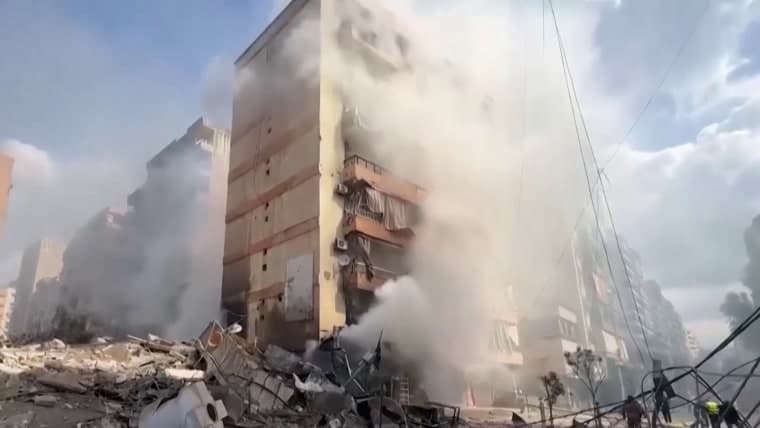
Rose El Khoury rebuilt once. After Israeli strikes badly damaged her home in Tyre during the 2024 conflict, the housewife in her 30s salvaged what she could and put it back together. "In 2024, it was livable, even though we didn't have the money to fix it," she said. Today, the home she shared with her husband and three children is a pile of rubble. "My house is on the ground. So there is no hope to return."
El Khoury and her children are among more than 1 million people forcibly displaced from their homes in Lebanon, mainly in the south, amid a sweeping aerial and ground assault by Israeli forces. The assault has killed more than 1,000 people in Lebanon, according to Lebanese authorities. Over 80 towns and villages have been emptied by successive evacuation orders.
What makes return look increasingly impossible is not just the destruction but the explicit intent behind it. Israeli Defense Minister Israel Katz said all houses in Lebanese villages near the border will be destroyed "in accordance with the Rafah and Beit Hanoun model in Gaza, in order to permanently remove the threats near the border." He added that the Israeli military will establish a security zone inside Lebanon and maintain security control over the entire area up to the Litani River once hostilities cease. More than 600,000 residents who evacuated northward will be "completely prohibited south of the Litani, until the safety and security of northern Israeli residents are guaranteed," he said, without specifying how long that might be.
The physical separation is being enforced bridge by bridge. Israel has destroyed five bridges over the Litani River since March 13 and accelerated the demolition of homes in Lebanese villages near the border. Israeli army spokesman Avichay Adraee announced plans to destroy additional crossings, including the Sohmor and Mashghara bridges. Lebanese President Joseph Aoun called the bridge strikes "an attempt to sever the geographical connection between the southern Litani region and the rest of Lebanese territory," warning they fell within what he described as schemes to solidify an occupation and expand Israeli territorial control.
The displacement is now straining Lebanon's fractured social fabric in ways that mirror and deepen older sectarian divisions. Some landlords in Christian areas of Beirut refuse to rent to Shiites. Others demand inflated rents and deposits that few can afford. Fatima Zahra, 42, from Beirut's southern suburbs, said she and her sister sold their finest jewelry to pay the $5,000 a landlord charged up front for two months' rent. In some Beirut neighborhoods, displaced people who can afford to pay high rents are only allowed to take an apartment after landlords inform security agencies to check on the family.

The shelter system is at its limit. More than 132,000 individuals are currently sheltering in over 620 collective shelters across Lebanon, with nearly 94 percent at full capacity. The government has converted hundreds of public schools into shelters and pitched tents for displaced families beneath the bleachers of the city's main sports stadium. One charity refashioned an abandoned slaughterhouse destroyed in Beirut's 2020 port explosion into a dormitory for almost 1,000 displaced people. On the seafront in Beirut, Sara Kassem, who fled the village of Khiyam in southern Lebanon, fed her 8-month-old son Amir inside a tent shelter on April 3.
Aid groups say Lebanon must prepare for the possible "long-term displacement" of hundreds of thousands. UNHCR spokesperson Dalal Harb warned that the figure of 1 million displaced is almost certainly an undercount, as it misses anyone who has not formally registered with Lebanon's Ministry of Social Affairs.
Israel previously occupied a similar security buffer in southern Lebanon from 1982 until 2000, when it was pushed out by Hezbollah. Senior Hezbollah lawmaker Hassan Fadlallah signaled the pattern could repeat. "We have no choice but to confront this aggression and cling to the land," he told Reuters. Human Rights Watch researcher Kaiss argued that tying civilian return to a vague Israeli security guarantee amounts to forced displacement, which he called a possible war crime.
For families like El Khoury's, the legal arguments are distant from the immediate reality: a flattened home, a buffer zone taking shape across the Litani, and a return timeline that no government has defined.
This article was produced by Prism’s automated news system from verified source data, official records, and press releases, then run through automated quality and moderation checks before publishing. The system is built and supervised by the people who set the standards it runs under. Read our full AI policy.
Did this article answer your question?


