Italian caver rescued after 12-hour operation in north-west Italy
A 20-year-old speleologist was freed after a boulder pinned his leg 120 meters underground. The 12-hour rescue drew dozens of specialist technicians from across Italy.

A boulder pinned a 20-year-old Italian caver 120 meters underground and triggered a 12-hour rescue that pulled specialist crews into the Garessio mountains of north-west Italy.
Rescuers worked through the night in Grotta dei Cinghiali Volanti, in the province of Cuneo about 120 kilometers south of Turin, after the man’s leg became trapped in one of the region’s best-known caving areas. By Monday morning, emergency services had brought him out alive. Officials said he was stable enough that rescuers did not need to use a stretcher evacuation.

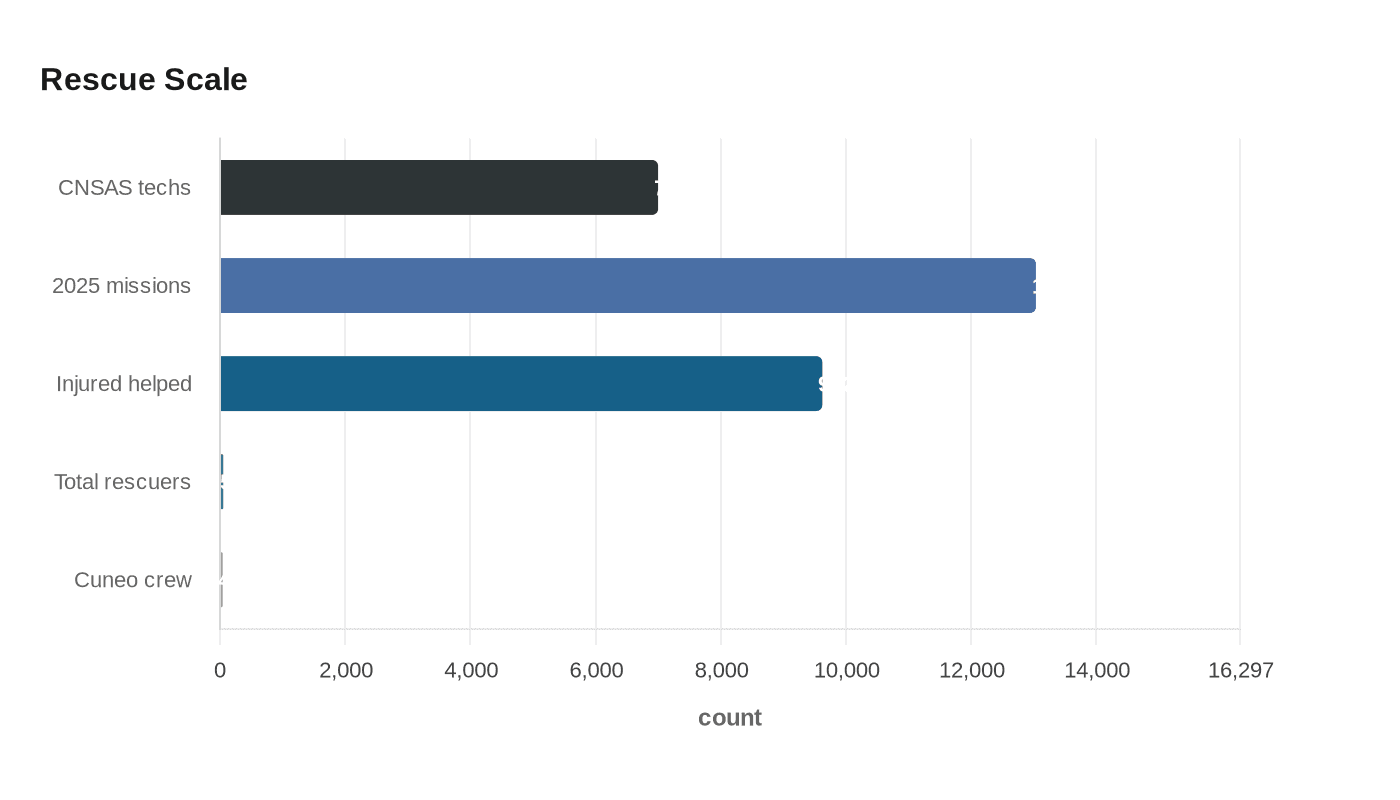
The operation was handled by CNSAS, Italy’s national alpine and speleological rescue corps, with 42 Alpine Rescue technicians and operators working in Cuneo province and a total of 53 rescuers involved, according to emergency services. The man was first treated at a makeshift medical post inside the cave before being taken outside by ambulance.
The case is a sharp reminder of what a single underground accident can demand. Cave rescues are among the most technically difficult emergency missions because teams must move medical care, lifting gear and communications into narrow, unstable passages before they can even begin extracting the casualty. In this case, the injured caver was deep enough below the surface that simply reaching him required a specialized operation in darkness and confined terrain, not a conventional ambulance response.

That burden is built into the work of CNSAS, which says it has about 7,000 highly specialized technicians and carries out more than 8,000 missions a year in mountains, underground environments and other hard-to-reach areas. The organization’s 2025 figures put the scale of that effort at 13,037 rescue missions and 9,624 injured people assisted, illustrating how often public rescue systems are stretched by terrain as much as by weather or speed.
The rescue also reflects a broader policy tension that recurs in adventure-heavy regions such as Piemonte. Caving and mountaineering are legal, voluntary risks, but when something goes wrong the public sector absorbs the cost in manpower, training and time. A single trapped explorer can mobilize dozens of technicians, medical staff and support crews for hours, even when there is only one casualty and no mass disaster.
Italy’s cave-rescue capability has also proved its reach beyond national borders. In 2023, 46 Italian speleological rescue technicians were sent to Turkey for the Morca Cave rescue of U.S. speleologist Mark Dickey, who was trapped about 1,000 meters underground. The Cuneo operation showed the same principle on a smaller scale: in high-risk underground terrain, saving one person can become a major logistical campaign, and success depends on the kind of specialist coordination that few emergency services can sustain.
This article was produced by Prism’s automated news system from verified source data, official records, and press releases, then run through automated quality and moderation checks before publishing. The system is built and supervised by the people who set the standards it runs under. Read our full AI policy.
Know something we missed? Have a correction or additional information?
Submit a Tip