Italy National Air Traffic Control Strike Threatens Major Airports Friday Afternoon
Italy's ENAV controllers staged a four-hour national walkout Friday, hitting Rome Fiumicino, Milan Malpensa and Naples during the peak afternoon flying window.
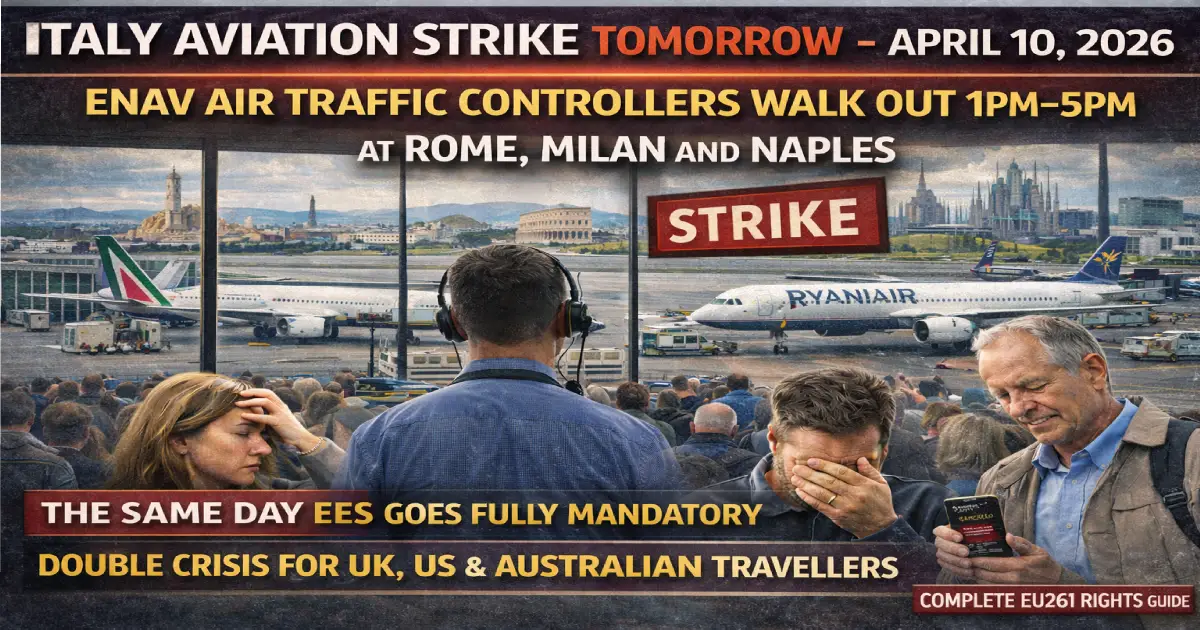
A four-hour national walkout by ENAV personnel and Techno Sky technical crews disrupted Italian airspace from 13:00 to 17:00 CET on Friday, hitting every airport in the country during the busiest slot of the European afternoon flight schedule. Rome Fiumicino, Milan Malpensa, Milan Linate and Naples International bore the heaviest pressure, given their high traffic volumes and reliance on ENAV-managed airspace.
The strike's scope made it more damaging than a single-airport action. ENAV, the Ente Nazionale di Assistenza al Volo, operates tower and en-route services across 45 airports and the area control centers that sequence aircraft through Italian airspace, including the Rome and Milan ACCs. Techno Sky, ENAV's technical subsidiary, handles the underlying systems. When both layers stopped simultaneously, throughput across the entire national network contracted, forcing airlines to pre-emptively cancel flights rather than wait for ground holds to compound into chain delays. ADR Security staff at Rome Fiumicino and Rome Ciampino joined the walkout during the same four-hour window, adding a third pressure point at the capital's airports.
Five unions, including UILT-UIL, UGL-TA, Uiltrasporti, FAST-Confsal and Astra, authorized the action, citing pay disputes and staffing levels. Airlines across the board anticipated selective cancellations and reroutings, with international and transatlantic operators among those affected alongside short-haul carriers. Italian law, enforced through ENAC, the civil aviation authority, mandates two protected service windows each day: 07:00 to 10:00 and 18:00 to 21:00 CET. Flights scheduled within those bands were more likely to operate, though crew rotations dependent on earlier canceled legs could still cascade delays into even the protected slots. ENAC also shields intercontinental departures and arrivals and lifeline routes to Sardinia, Sicily, and Italy's island territories from full suspension.

For passengers whose flights fell inside the 13:00 to 17:00 strike window, rebooking options were constrained by the same capacity squeeze that grounded their original service. ATC strikes are typically classified as extraordinary circumstances under EU261 regulations, generally relieving airlines of their obligation to pay delay compensation, though carriers remained responsible for offering rerouting and care provisions. Regional airports and carriers issued notices urging passengers to check flight status and prepare for rebooking before heading to the terminal.
The April 10 action was the latest in a series of spring 2026 labor actions affecting Italy's transport sector, arriving just one day before a separate nationwide rail strike compounded pressure on travelers. Travel security analysts noted that even short strikes at the en-route level can produce extended recovery times, because air traffic flows are finely balanced and a late-afternoon slowdown can push aircraft into evening and overnight schedules. For Italy's aviation sector, Friday's walkout signaled that the underlying disputes over pay and controller workloads remain unresolved heading into the summer peak, when the cost of any repeat disruption would be considerably higher across a continent-wide network.
This article was produced by Prism’s automated news system from verified source data, official records, and press releases, then run through automated quality and moderation checks before publishing. The system is built and supervised by the people who set the standards it runs under. Read our full AI policy.
Did this article answer your question?


