Japan, Vietnam deepen ties with energy, critical minerals focus
Japan and Vietnam put energy and rare earths at the center of a tie-up aimed at insulating supply chains from China.
Japan used Sanae Takaichi’s Hanoi visit to turn a political reset into an economic-security play, putting energy cooperation and critical minerals at the heart of a relationship both governments want to harden against supply shocks. Takaichi met Vietnamese Prime Minister Le Minh Hung and later planned talks with To Lam, while the two sides signed six agreements spanning infrastructure, climate action, agriculture, technology, digitalization and space.
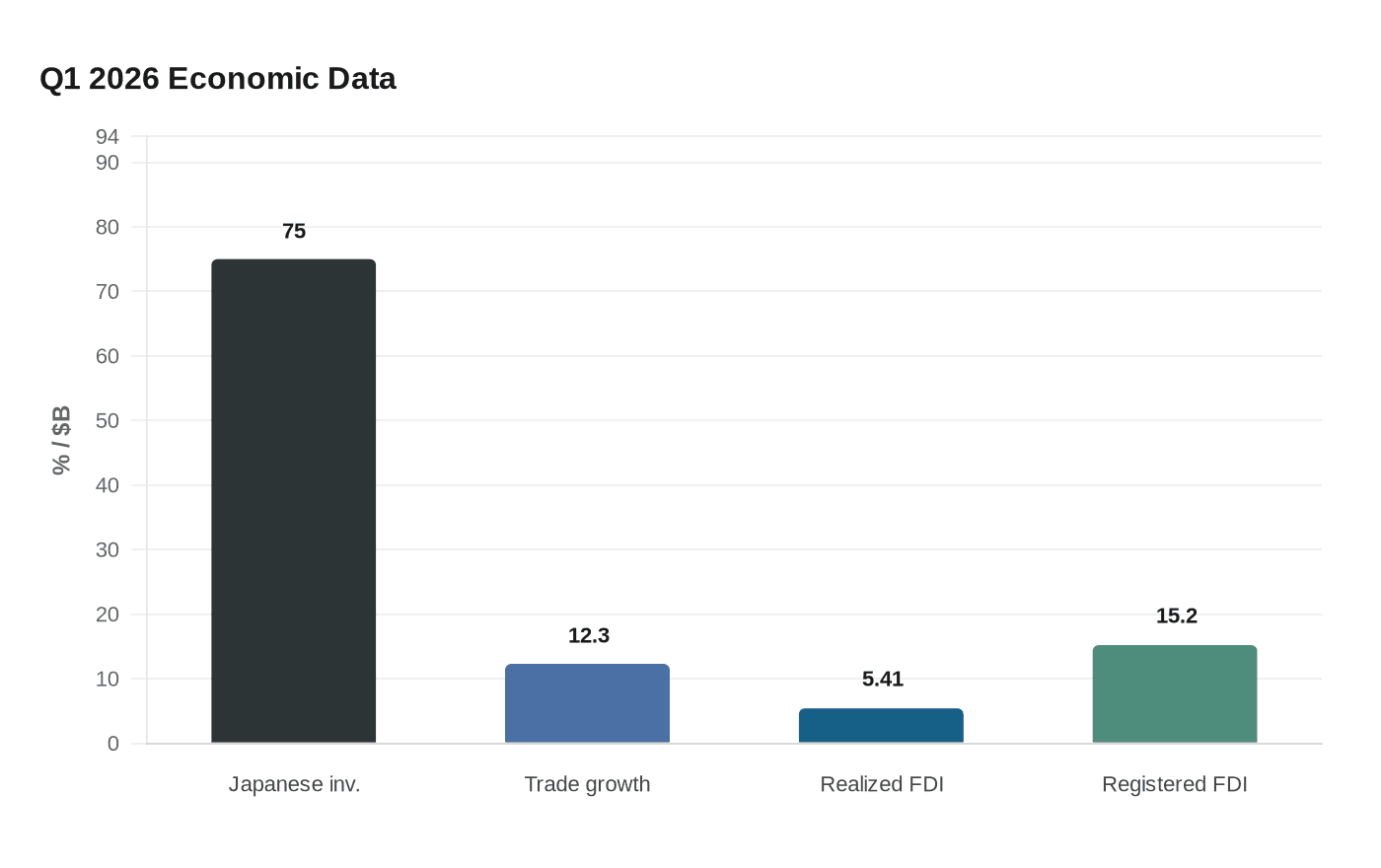
The trip built on a partnership that has deepened in stages since diplomatic relations began in 1973, rose to an Extensive Strategic Partnership in 2014 and was upgraded on November 27, 2023, to a Comprehensive Strategic Partnership for Peace and Prosperity in Asia and the World. That diplomatic framework now carries a commercial urgency: Japanese investment in Vietnam fell about 75% year on year to $233 million in the first quarter of 2026, even as bilateral trade rose 12.3% to $13.7 billion. Vietnam’s broader investment picture remained strong, with realized FDI at $5.41 billion and registered FDI at $15.2 billion in the same quarter, underscoring that Japan’s slowdown is happening inside a still-competitive market.
The most tangible sign of the relationship’s practical value came on the energy side. Under Japan’s Power Asia Initiative, Tokyo said it would help arrange crude-oil supplies for Vietnam’s Nghi Son refinery, and Idemitsu Kosan recently organized about 4 million barrels of crude for the plant in Thanh Hoa province, a volume equal to roughly 10 days of Vietnam’s crude consumption. That kind of coordination matters to Hanoi because refinery stability affects fuel security, industrial output and price pressure across the economy, and it matters to Tokyo because Japanese firms remain embedded in Vietnam’s energy infrastructure and supply chains.
Critical minerals were the other pillar of the talks. Vietnamese coverage has described Vietnam as holding the world’s sixth-largest rare earth reserves, a resource base that gives Hanoi leverage as Japan seeks alternatives to China-centered material flows for batteries, semiconductors and advanced manufacturing. Takaichi also planned a keynote speech at Vietnam National University, marking a decade since Shinzo Abe introduced the Free and Open Indo-Pacific concept, a reminder that the visit sat inside a broader regional strategy as much as a bilateral one. For Japan, the bet is clear: lock in access to energy and minerals, deepen industrial links and keep a fast-growing Southeast Asian partner inside a resilient U.S.-allied supply-chain architecture.
This article was produced by Prism’s automated news system from verified source data, official records, and press releases, then run through automated quality and moderation checks before publishing. The system is built and supervised by the people who set the standards it runs under. Read our full AI policy.
Did this article answer your question?