Japan’s arms export opening draws allies seeking alternatives to U.S. supplies
Allies from Poland to the Philippines were pressing Japan for weapons as doubts about U.S. reliability widened, turning a once-closed arms industry into a new supply option.
Japan’s long-sealed arms market was opening just as allies were hunting for alternatives to U.S. weapons, and the change was pulling in interest from Warsaw to Manila. Prime Minister Sanae Takaichi’s ruling party approved easing export rules this week, setting up a formal adoption that could come as soon as this month and marking one of the biggest shifts in Japan’s postwar defense policy.
The timing gave the move its geopolitical force. Donald Trump’s erratic posture on security commitments, along with the strain of the wars in Ukraine and Iran, has pushed partners to question whether U.S. production lines and U.S. guarantees can be counted on in a crisis. For Japan, that doubt is creating an opening that would have been almost unthinkable for decades.
Tokyo’s restrictions go back to Eisaku Sato’s 1967 remarks in the Diet and a 1976 collateral policy guideline under the Miki cabinet. Those rules were later folded into the 2014 Three Principles on Transfer of Defense Equipment and Technology, which Japan amended again on December 22, 2023. The defense ministry has said the revised policy was meant to strengthen cooperation with allied and like-minded countries, support joint development and production, and reinforce Japan’s own defense industrial base in a far tougher security environment.
The scale matters because Japan already spends about $60 billion a year on its own military, enough to sustain a sophisticated industrial base that can produce submarines and fighter jets. The Defense Ministry requested a record 8.8 trillion yen, about $60 billion, for fiscal 2026, and the cabinet later approved 9.04 trillion yen, about $58 billion. That spending has helped companies such as Toshiba and Mitsubishi Electric expand capacity, and one Mitsubishi Electric job listing covered overseas sales of fighter aircraft and other military exports.
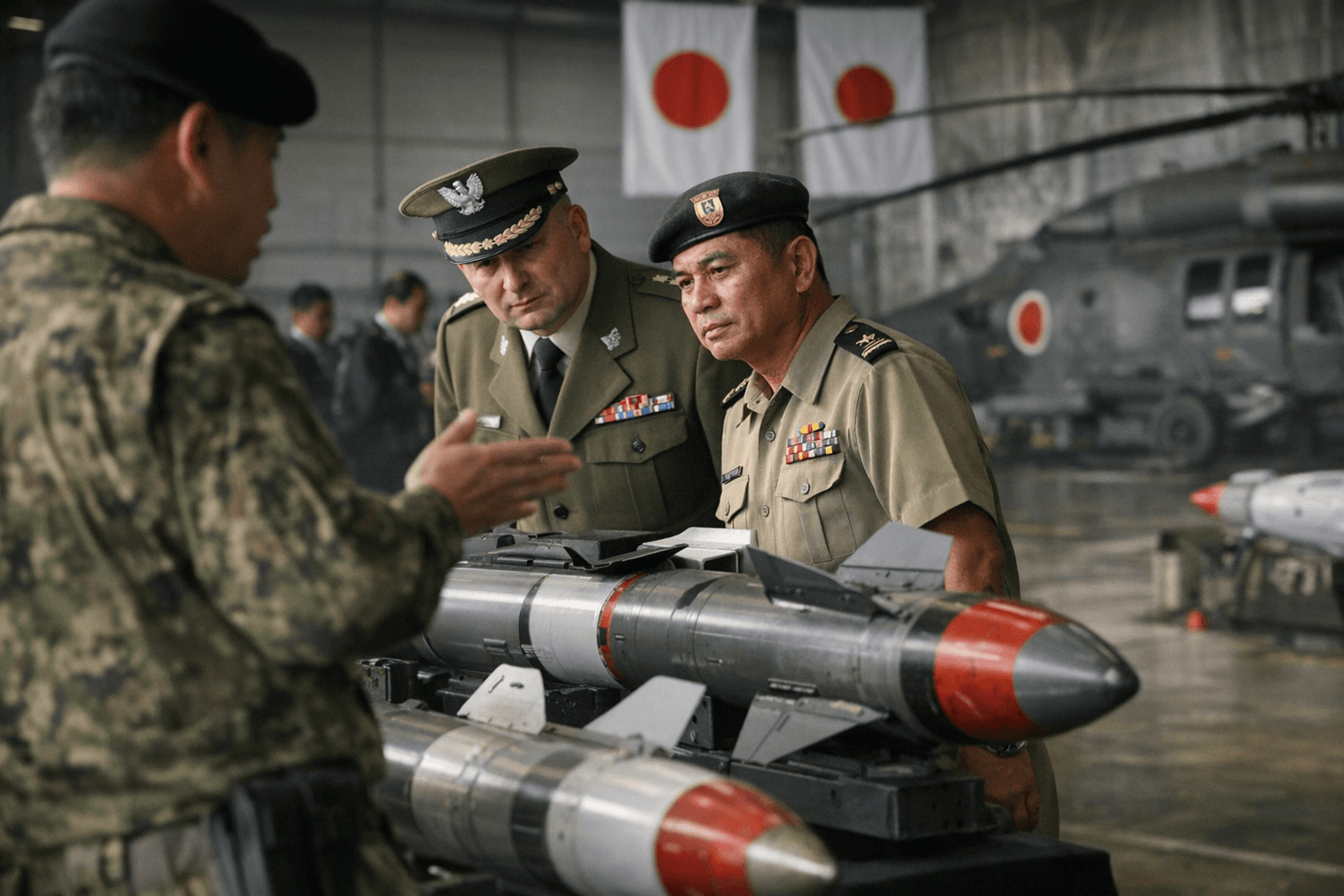
The most immediate deal likely to move forward is the export of used frigates to the Philippines, a country locked in confrontation with Beijing in the South China Sea. Japanese officials said that sale could be followed by missile-defense systems. Manila and Tokyo have deepened ties in parallel: their Reciprocal Access Agreement took effect on August 12, 2025, and the two countries were marking 70 years of normalized diplomatic relations in 2026.
Poland is another early test case. Mariusz Boguszewski, deputy chief of mission at Poland’s embassy in Japan, said Warsaw and Tokyo could plug gaps in each other’s arsenals and that there were “some bottlenecks” they could overcome with Japan on board. Poland’s WB Group had already signed a tentative drone deal with ShinMaywa last year, and Polish officials have been pushing drone capability-building and broader defense-industrial cooperation. In Europe and Asia alike, Japan’s shift was starting to redraw the map of who can supply the systems allies want, and who can still be trusted to deliver them.
This article was produced by Prism’s automated news system from verified source data, official records, and press releases, then run through automated quality and moderation checks before publishing. The system is built and supervised by the people who set the standards it runs under. Read our full AI policy.
Did this article answer your question?