Japan’s school blackboards become a canvas for young artists
Japan’s school blackboards are becoming serious canvases for young artists, where low-cost chalk work is designed to be photographed before it is erased.
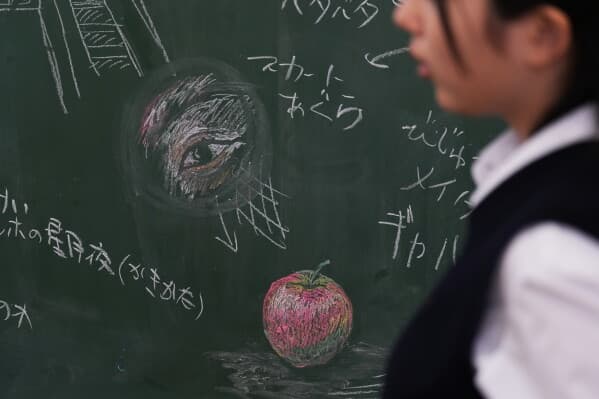
School blackboards in Japan have become a serious stage for young artists, not a classroom novelty. In Kumagaya, northwest of Tokyo, blackboard work has moved into the center of school-club culture, with Kumagaya Girls High School art club members taking first prize in a national contest in 2023. The result is art made for a room full of students, then for a camera roll, then for erasure.
A national contest built around the classroom
At the center of the trend is Kokuban Art Koshien, an annual national chalk art championship for high school students. The name joins “kokuban,” the Japanese word for blackboard, with Koshien, the famous high school baseball stadium, which gives the contest the feel of a major school-stage competition rather than a gallery event. That framing matters: it places student art in the same high-visibility world as other prestigious high school showcases, but with chalk and slate instead of uniforms and bats.
Kumagaya Girls High School is one of the clearest examples of how the format works in practice. Its art club members won first prize in the national contest in 2023, and the school setting gives the work a daily audience of students, teachers, and visitors before any image ever leaves the building. The art does not wait for a museum wall to validate it; it emerges where school life already happens.
Why blackboards resonate now
The appeal starts with access. A blackboard is already there, the surface is large, and the material cost is low compared with paint, canvas, or formal exhibition spaces. That makes it an unusually open medium for young people, especially in schools where clubs can turn an ordinary classroom into a temporary studio without needing expensive supplies or professional infrastructure.
The medium also imposes discipline. Chalk art is temporary, mistakes are harder to cleanly erase than digital edits, and the finished piece is expected to disappear. A Mainichi article captured that logic directly: “It’s meant to be erased.” That impermanence pushes artists to work with speed, confidence, and a clear plan, because the work has to land before the board is wiped clean.
From lessons to visual culture
The AP feature places the phenomenon squarely inside high school and school-club culture, not professional gallery spaces. That is part of what gives the work its force: a classroom blackboard can reflect seasonal themes, local events, student identity, or pop-cultural references, turning a teaching tool into a communal visual space. In Japan, where craftsmanship and detail are often valued, that public school surface becomes a place to show both precision and imagination.
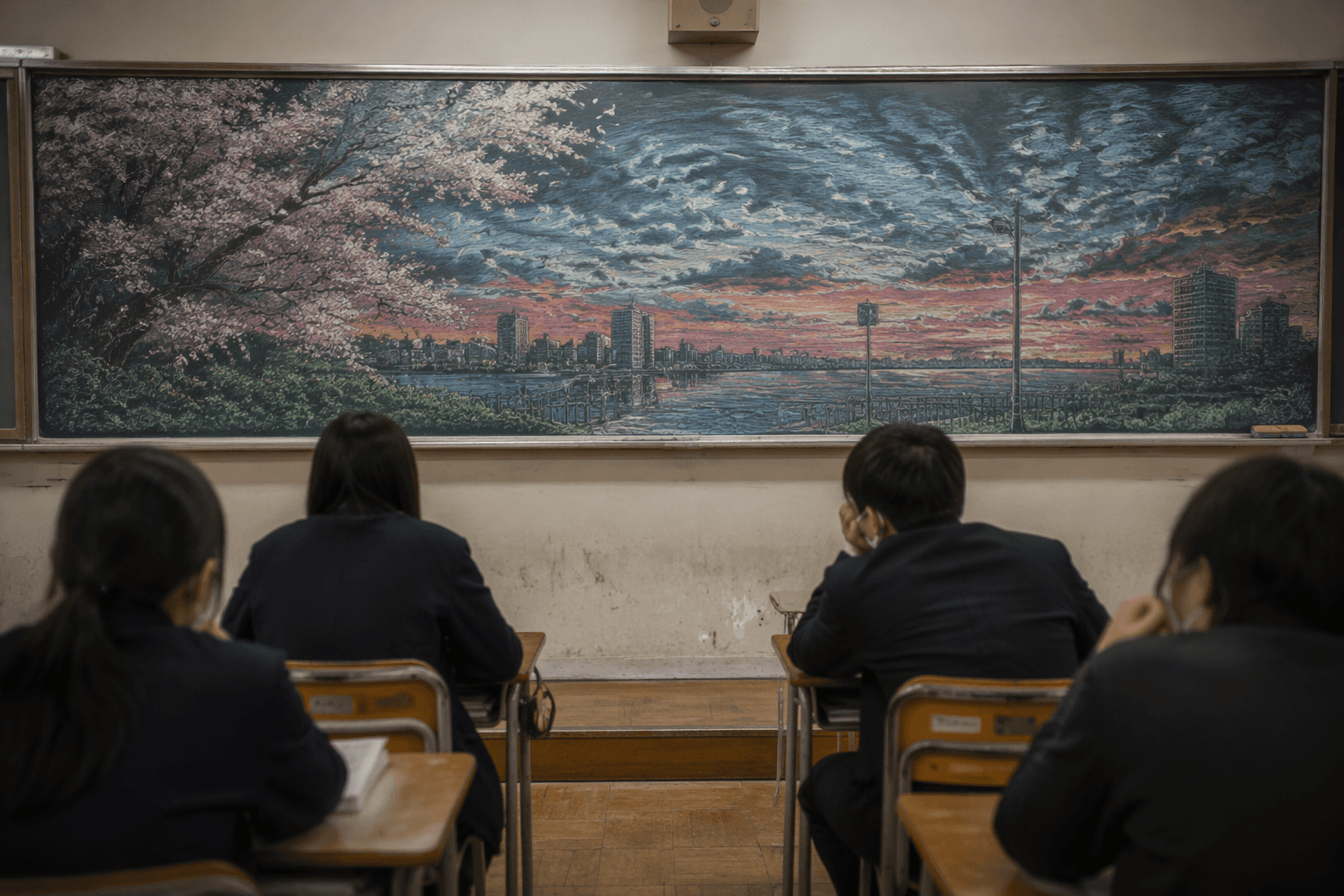
Hirotaka Hamasaki, a high school teacher and artist, appears in the reporting as another example of the form’s range. His classroom blackboard drawings show how a school wall can carry detailed, deliberate work that sits between instruction and exhibition. The setting matters as much as the drawing itself, because the board is not separate from school life, it is part of it.
Why the images travel beyond the school
Blackboard art gains power from being seen in person and then carried outward through photographs. The work is meant to be shared before it is erased, and that has helped the medium move quickly through social media and wire distribution. Reposted coverage, including from The Star, and a video summary from the Embassy of Japan in the United States helped push the images far beyond Kumagaya.
That wider circulation is not an accident. A blackboard mural can be read instantly, even by someone who has never entered the school, and the temporary nature of the medium adds urgency to the image. Once the board is wiped, the photograph becomes the record, which turns a school corridor into a production line for short-lived but highly shareable art.
What the medium says about young artists
The blackboard trend points to a practical way young artists are building audiences: they are using a familiar surface, visible to everyone in the building, and then extending its reach through social platforms. It also shows how students can turn a standard school environment into a creative commons without waiting for formal institutional permission from the art world. In that sense, the medium fits both the discipline of school life and the logic of online attention.
What began as classroom furniture now functions as a test of skill, timing, and restraint. The work has to be strong enough to matter in the room, and fleeting enough to leave only an image behind. That combination has made Japan’s blackboards into one of the clearest examples of how young artists can build a public from something ordinary, temporary, and shared.
This article was produced by Prism’s automated news system from verified source data, official records, and press releases, then run through automated quality and moderation checks before publishing. The system is built and supervised by the people who set the standards it runs under. Read our full AI policy.
Did this article answer your question?