JPMorgan boosts 2026 tech budget to $19.8 billion with $1.2 billion for AI
JPMorgan will raise its 2026 technology budget to $19.8 billion, directing roughly $1.2 billion of the increase toward AI and modernization, shifting costs and competitive stakes.

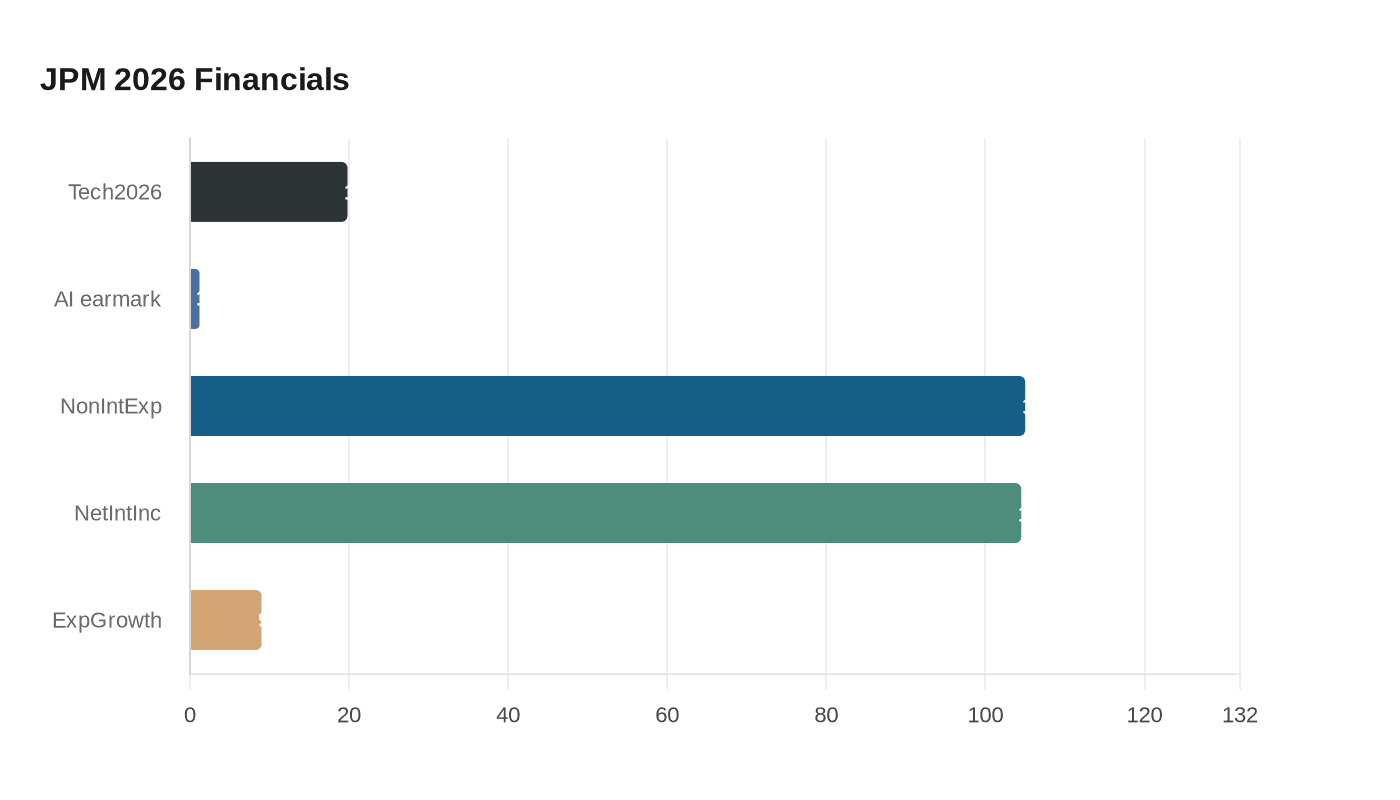
JPMorgan Chase will increase its technology budget for 2026 to about $19.8 billion, adding roughly $2 billion year over year and earmarking approximately $1.2 billion of that increment for investments that include artificial intelligence projects, the bank said at a company update. The move cements AI as a core operational focus for the nation’s largest bank and amplifies pressure on management to show measurable returns from large, multi-year technology programs.
CFO Jeremy Barnum framed the shift as a driver of rising costs, saying, "technology remains a major driver of our expense growth." Management projects overall non-interest expenses of $105 billion for 2026, an increase of more than 9 percent from 2025, and expects net interest income of $104.5 billion as the firm models two rate cuts and some deposit margin compression into its outlook.
Executives emphasized that the investment is strategic rather than discretionary. CEO Jamie Dimon acknowledged uncertainty around payoffs, noting that "AI returns are difficult to quantify," while describing technology leadership as necessary for competitive positioning. That tension between explicit spending plans and limited ROI metrics will be a focal point for investors as JPMorgan seeks efficiencies to offset macro headwinds and expense growth of roughly $9 billion for the year, according to management commentary.
The bank said the incremental technology spending will support cloud infrastructure, cybersecurity, data systems, and AI tools as well as broader platform modernization. JPMorgan reports it doubled AI use cases in production in 2025 and has deployed an internal generative AI toolkit described as an "LLM suite," with employees moving from pilots to secure API-based integrations of GenAI into business applications and workflows. Targeted use cases include call-center efficiency, personalized client insights, developer productivity, marketing, fraud detection, and middle- and back-office processing.
Beyond AI, the bank continues platform build-outs in payments, custody and client solutions and is advancing blockchain and tokenization work, including tokenized deposits and related digital-ledger capabilities. Management also said the bank will expand its physical footprint, aiming for more than 160 new branches and about 600 renovations by 2027, a reminder that digital investment sits alongside traditional retail costs.
The scale of the commitment contrasts with peers. At the company update management cited industry spending differences, with some rivals planning materially less in technology outlays, underscoring an arms race in infrastructure and data capabilities. Rising costs driving the higher budget include inflation, higher AI hardware prices amid chip and memory tightness, and growing public cloud and software expenses tied to volume and new features.
Policy and institutional implications are immediate. A near $20 billion tech budget concentrated on data platforms and generative models raises governance questions for regulators and boards around auditability, model risk, consumer protections and workforce impacts as AI moves from experiments into core systems. For customers the bank projects faster service and more personalized offerings; for investors the test will be whether projected efficiencies meaningfully offset expense growth and margin pressures.
Practical takeaway: JPMorgan’s $1.2 billion targeted investment in AI and a reported doubling of production use cases in 2025 make it a bellwether for how large banks translate AI spending into operational gains. Shareholders and regulators alike will be watching for a granular breakdown of spending and for concrete KPIs that tie these investments to measurable outcomes.
This article was produced by Prism’s automated news system from verified source data, official records, and press releases, then run through automated quality and moderation checks before publishing. The system is built and supervised by the people who set the standards it runs under. Read our full AI policy.
Did this article answer your question?