Judge Permanently Blocks Trump Order Cutting Federal Funding to NPR, PBS
A federal judge permanently blocked Trump's executive order defunding NPR and PBS, but Congress already dissolved the CPB through separate legislation.
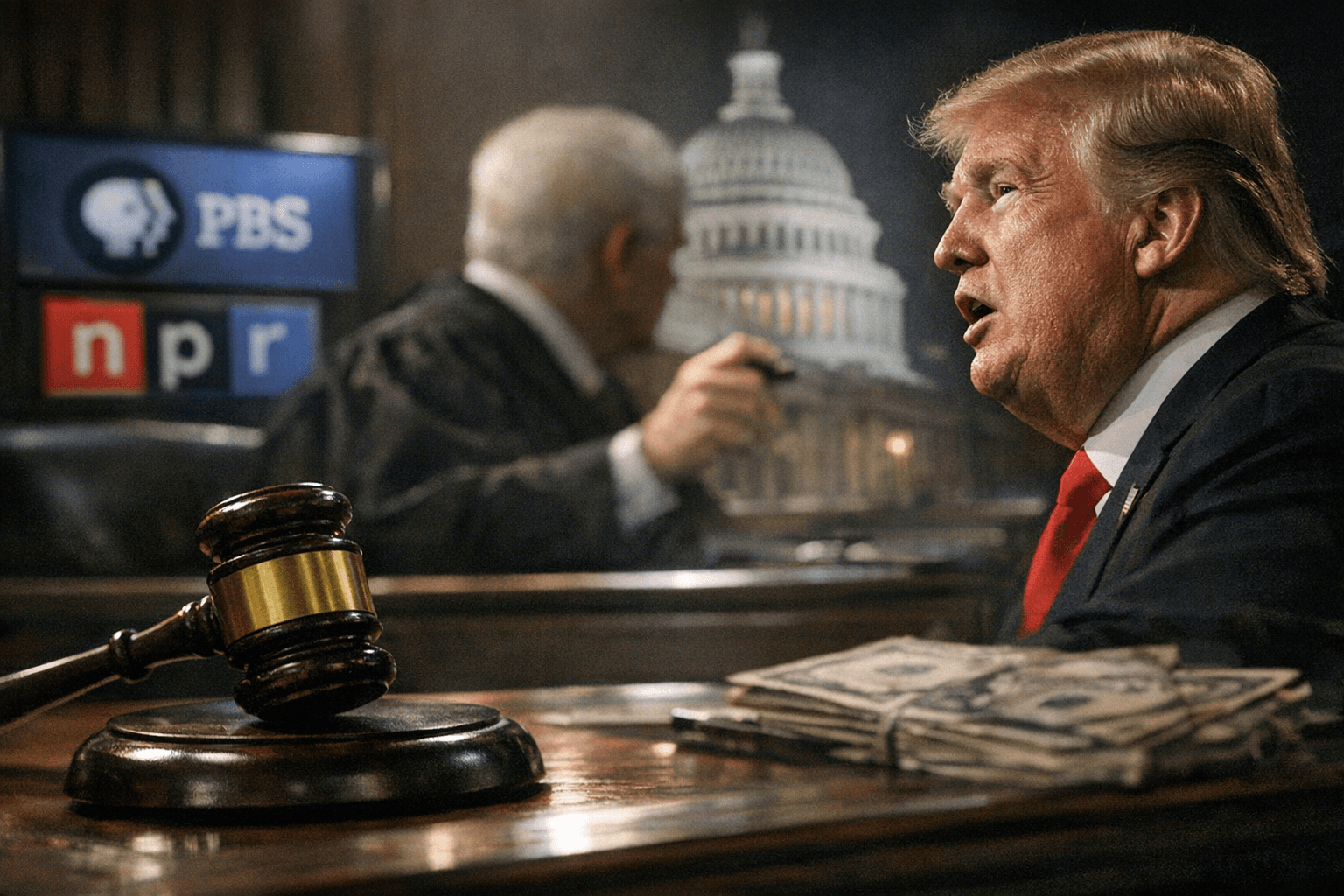
A federal judge declared Trump's executive order defunding NPR and PBS "unlawful and unenforceable" Tuesday, issuing a permanent injunction that nonetheless arrives after Congress had already dismantled the public broadcasting system's financial foundation through separate legislation.
U.S. District Judge Randolph Moss, an Obama appointee in the District of Columbia, ruled in a 62-page opinion that Executive Order 14290, titled "Ending Taxpayer Subsidization of Biased Media" and signed by President Trump on May 1, 2025, violated the First Amendment's prohibition on government viewpoint discrimination and retaliation.
"The message is clear: NPR and PBS need not apply for any federal benefit because the President disapproves of their 'left wing' coverage of the news," Moss wrote. "It is difficult to conceive of clearer evidence that a government action is targeted at viewpoints that the President does not like and seeks to squelch."
Moss also flagged a damning absence in the government's defense: "The Federal Defendants fail to cite a single case in which a court has ever upheld a statute or executive action that bars a particular person or entity from participating in any federally funded activity based on that person or entity's past speech." Drawing on a 2024 Supreme Court ruling, he wrote that "The First Amendment draws a line, which the government may not cross, at efforts to use government power, including the power of the purse, to punish or suppress disfavored expression by others."
NPR filed suit in Washington naming Treasury Secretary Scott Bessent and the Office of Management and Budget as defendants, joined by Colorado Public Radio, Aspen Public Radio, and KUTE, Inc., which operates KSUT Public Radio in Ignacio, Colorado. PBS filed separately. Moss cited Trump's own public statements as evidence of retaliatory intent, including a news conference in which Trump said he would "love to" defund the broadcasters, and his branding of both outlets as "arms of the Radical Left Democrat Party."
PBS said it was "thrilled with today's decision declaring the executive order unconstitutional." NPR called the order "textbook unconstitutional viewpoint discrimination and retaliation, in violation of longstanding First Amendment principles."
The ruling's practical force is constrained by damage already inflicted on a separate legislative track. The executive order triggered a $23 million cut in Department of Education funding for PBS children's educational programming, forcing the layoff of one-third of the PBS Kids staff. That proved a prelude to a far larger congressional blow.
A Republican-led Congress passed the Rescissions Act of 2025 on a largely party-line vote, clawing back $1.1 billion in previously approved public broadcasting funding through fiscal year 2027 as part of a $9 billion package that also targeted foreign aid. The cuts eliminated CPB advance appropriations approved on a bipartisan basis since 1976. The Corporation for Public Broadcasting, the nonprofit created by Congress in 1967 to channel federal funds to NPR, PBS, and more than 1,500 local stations, wound down its roughly 100-person staff by September 2025.
On January 5, 2026, the CPB board formally voted to dissolve after 58 years. "After nearly six decades of innovative, educational public television and radio service, Congress eliminated all funding for CPB, leaving the Board with no way to continue the organization," the dissolution statement read.
Because the congressional rescission is a separate legal matter neither lawsuit addressed, Moss's ruling cannot restore the CPB or the $1.1 billion in clawed-back funding. The Trump administration is expected to appeal; Trump had proposed eliminating CPB funding in each annual budget during his first term, though Congress rejected those proposals each time.
Sources:
Know something we missed? Have a correction or additional information?
Submit a Tip