Judge presses Trump administration to justify $10 billion IRS lawsuit
Judge Kathleen Williams forced Trump’s team to defend a $10 billion IRS suit that may fail on basic jurisdiction. The case tests whether a president can sue agencies he controls.
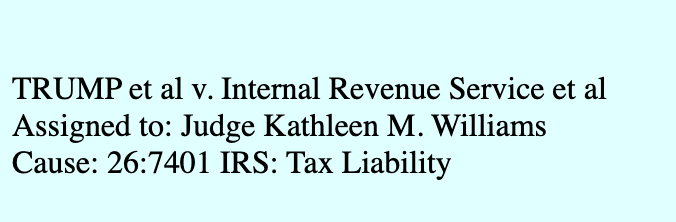
A federal judge put President Donald Trump’s $10 billion IRS lawsuit on a tight legal leash Friday, ordering the White House and Justice Department to explain why the case belongs in federal court at all. U.S. District Judge Kathleen Williams said the lawsuit may lack the adversarial dispute the Constitution requires, a warning that signaled deep skepticism about whether Trump can press a personal grievance against agencies he oversees.
Williams gave Trump’s private lawyers and Justice Department attorneys until May 20 to submit briefs and set a hearing for next month. Her order focused on a basic jurisdictional question: whether the president, in his personal capacity, can sue the Internal Revenue Service and Treasury Department when those agencies sit inside an executive branch he controls. Williams wrote that Trump’s named adversaries are entities whose decisions are subject to his direction, raising doubts that the parties are truly adverse enough for a federal case.
The lawsuit, filed in January by Trump, two of his sons, Eric Trump and Donald Trump Jr., and the Trump Organization, seeks damages for the unauthorized disclosure of confidential tax information during Trump’s first term. Court filings describe the alleged leak as having caused reputational and financial harm, public embarrassment and damage to the family business’s standing. The claims trace back to disclosures that prosecutors later tied to former IRS contractor Charles Edward Littlejohn, who was sentenced in 2024 to five years in prison for leaking tax information to news outlets between 2018 and 2020.

The judge’s scrutiny matters because the case is about more than money. It goes to the legal threshold for any lawsuit brought in federal court, including standing, ripeness and the requirement that the dispute be real rather than staged. Williams also pointed to Trump’s efforts to tighten control over the executive branch through presidential orders, including one that obligates executive-branch employees to follow the president’s legal positions. That dynamic, she suggested, complicates the Justice Department’s role in defending the IRS against the president himself.
If the administration cannot show a genuine controversy between opposing parties, the suit could be delayed, narrowed or thrown out. The court’s skepticism also carries broader institutional weight: it tests whether a president can use litigation to turn a grievance over tax enforcement and privacy into a viable claim against the government he leads, or whether the judiciary will draw a line against that kind of executive-power loop.
Sources:
Know something we missed? Have a correction or additional information?
Submit a Tip