Kevin Rudd to leave Washington ambassador post early for Asia Society
Australia’s ambassador to the U.S., former prime minister Kevin Rudd, will resign March 31, 2026 to lead the Asia Society in New York.
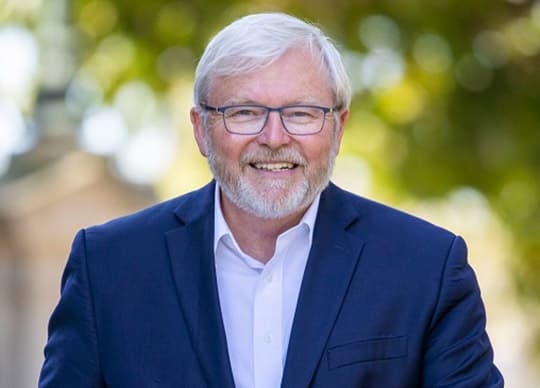
Prime Minister Anthony Albanese announced that Kevin Rudd will end his posting as Australia’s ambassador to the United States on March 31, 2026, about a year earlier than the four‑year term that began with his appointment in March 2023. Rudd is set to take up a senior role at the Asia Society in New York, a move that the government framed as his own decision.
Albanese described the resignation as “entirely” Rudd’s decision and paid tribute to his service, saying Rudd “has served the nation well” and “has delivered concrete outcomes for Australia, during both Democrat and Republican Administrations.” The prime minister and Foreign Minister Penny Wong said a successor will be appointed in due course.
Rudd’s tenure in Washington was marked by high‑profile diplomatic and trade work as well as moments of controversy. Government officials and former diplomats credit him with advancing implementation of AUKUS, including efforts to streamline export controls tied to Australia’s acquisition of nuclear‑powered submarines. He also helped secure co‑operation on critical minerals and worked to mobilise Australian superannuation capital into U.S. markets, priorities Canberra has highlighted in conversations with investors and policymakers.
Former ambassador Arthur Sinodinos praised Rudd’s efforts, calling him “hard‑working” and noting accomplishments such as tightening export control arrangements and strengthening investment links. Sinodinos said he would like an explanation for the early departure.
Rudd’s role extended beyond security and investment. The government credited him with playing a part in securing the release of WikiLeaks founder Julian Assange in 2024, a diplomatic episode that drew intense public and political attention. His diplomatic style and public profile also made him a polarising figure in Washington. During a White House visit in October 2025, President Donald Trump told Rudd, “I don’t like you either, and I probably never will,” and reportedly asked, “Where is he? Is he still working for you?” Trump was also reported to have described Rudd as “a little bit nasty” and “not the brightest bulb” in other interviews.

Rudd, who served as Australia’s prime minister from 2007 to 2010 and briefly in 2013, issued a statement expressing enthusiasm for his next role, saying he “looks forward to continuing” work with Asia Society staff. The move to a major policy and cultural organization in New York signals a shift from frontline diplomacy to international policy research and advocacy.
Economically, Rudd’s departure will be watched for its implications for supply chain negotiations and investor confidence in sectors where Australia is deepening ties with the United States. Officials say the most immediate task for his successor will be sustaining momentum on AUKUS implementation, critical minerals cooperation and the channeling of Australian institutional capital into U.S. assets. Markets and corporate actors that have recalibrated to the new security and investment architecture will look to Canberra for continuity.
Albanese stressed gratitude “on behalf of our nation” and promised continuity of representation. For Canberra and Washington, the coming appointment will test how quickly Canberra can replace a senior, high‑profile envoy while keeping strategic and economic projects on track.
This article was produced by Prism’s automated news system from verified source data, official records, and press releases, then run through automated quality and moderation checks before publishing. The system is built and supervised by the people who set the standards it runs under. Read our full AI policy.
Did this article answer your question?