Khaleda Zia Dies at 80, End of a Polarizing Political Era
Begum Khaleda Zia, Bangladesh’s first female prime minister and a central figure in the nation’s rivalry with Sheikh Hasina, died on December 30 at age 80 after a prolonged illness, her party announced. Her death removes a long standing focal point of partisan politics, raising immediate questions about opposition leadership and the economic consequences of renewed political uncertainty.
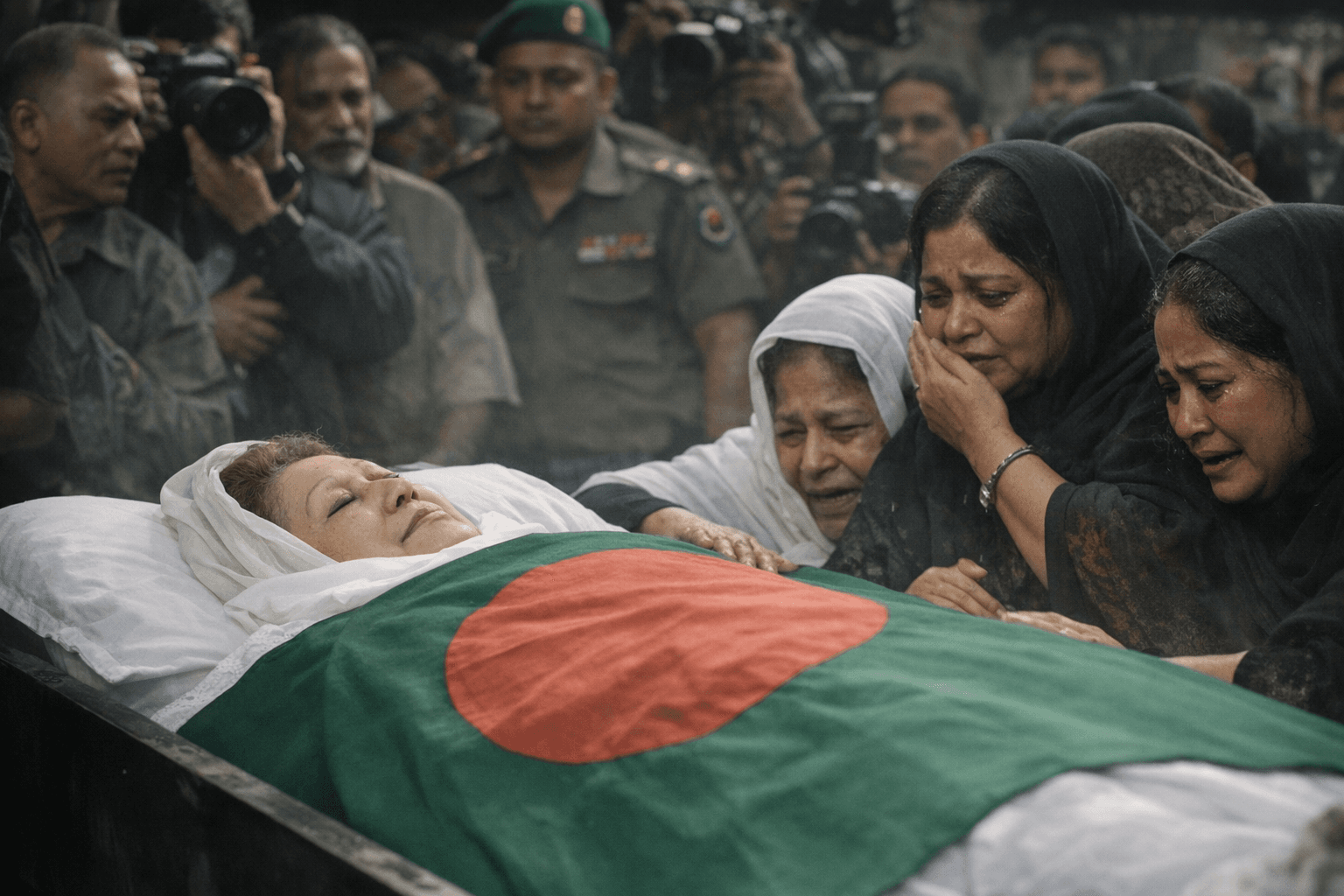
Begum Khaleda Zia, who became the first woman to lead Bangladesh and who for decades embodied the main opposition to Prime Minister Sheikh Hasina, died on December 30 at the age of 80 following a prolonged illness, party officials said. Zia’s political life shaped the country’s post independence trajectory, and her death closes a chapter in a political rivalry that often defined governance, protest cycles and the framing of national policy.
Zia rose to prominence after the assassination of her husband, army chief Ziaur Rahman, and took the helm of the Bangladesh Nationalist Party, the center right party that alternated in power with the Awami League led by Sheikh Hasina. She served as prime minister in the 1990s and again in the early 2000s, holding office from 1991 to 1996 and from 2001 to 2006. During her terms, Zia oversaw a period of political liberalization that returned parliamentary democracy after years of military rule, even as her administrations were marked by intense partisan conflict with the Awami League.
Her passing crystallizes a long running pattern in Bangladeshi politics where two personalities and their parties have dominated national life. Analysts say that pattern contributed to political stability at times and to severe instability at others, as successive cycles of street protests, strikes and disputed elections have periodically disrupted economic activity. For investors and policy makers the immediate question is how the BNP will reorganize and whether the absence of Zia’s symbolic leadership will moderate or intensify confrontation with the government.
Economic implications vary by horizon. In the short term, political shocks in Bangladesh have historically produced bouts of market volatility and localized disruptions to commerce. Foreign direct investment inflows and export oriented sectors, notably the ready made garments industry which accounts for the dominant share of exports, are sensitive to disruptions in transport and port activity. Bangladesh’s economy has been characterized in recent years by robust growth near 6 percent and steady gains in per capita income, alongside reliance on remittances and garment exports to sustain export earnings and employment. Policy continuity will be essential to preserve investor confidence and the trajectory of poverty reduction achieved over decades.
Longer term, Zia’s death could accelerate a generational shift within the BNP and within broader political networks. Succession dynamics, the party’s organizational coherence and its strategy toward parliamentary participation or street mobilization will determine whether the opposition can present a cohesive alternative policy agenda. That, in turn, will affect fiscal choices on public investment and social spending, and how the government addresses structural reforms needed to sustain growth.
For ordinary Bangladeshis the loss of a figure who symbolized both female political ascendancy and bitter partisanship will resonate differently across regions and constituencies. The immediate weeks will test institutional responses, the capacity of security forces to manage public order, and the resilience of markets to political news. What follows will shape whether Bangladesh moves toward a less personalized and more programmatic politics, or whether old patterns of rivalry continue to influence policy and the economy.
This article was produced by Prism’s automated news system from verified source data, official records, and press releases, then run through automated quality and moderation checks before publishing. The system is built and supervised by the people who set the standards it runs under. Read our full AI policy.
Did this article answer your question?