Kohl’s fights to rebuild relevance as stock plunges
Kohl’s is fighting more than weak sales. Its real challenge is proving that a middle-market department store still belongs in shoppers’ lives.
Kohl’s is trying to recover from a slide that looks less like a bad season than a slow loss of purpose. The chain still has scale, with 1,153 stores and a website as of January 31, 2026, but scale has not protected it from shrinking sales, weaker traffic and a brand identity that no longer feels automatic to many shoppers.
The relevance problem came first
Kohl’s began in Brookfield, Wisconsin, in 1962 and went public in 1992 with 76 stores in the Midwest. That history matters because the company was built for a retail world shaped by suburban convenience, broad assortments and repeat in-store visits, not by instant price comparison and endless online choice. Kohl’s has said 80% of Americans live within 15 miles of one of its stores, which sounds like an asset until those nearby shoppers decide that proximity alone is no longer enough.
That is the central trap for legacy middle-market retailers. For years, chains like Kohl’s could rely on a mix of coupons, familiar brands and a department-store format that sat comfortably between discounters and higher-end rivals. Today, that middle can be a weak place to stand: off-price chains press on price, specialty retailers sharpen their identity, and e-commerce removes much of the friction that once made a nearby store convenient by default.
Kohl’s problem is therefore not just a weak quarter or a temporary consumer slowdown. It is the harder question of whether the brand still means anything distinct enough to earn a repeat visit when shoppers can compare prices instantly and decide, in seconds, whether a store trip is worth the time.
The numbers show how deep the pressure runs
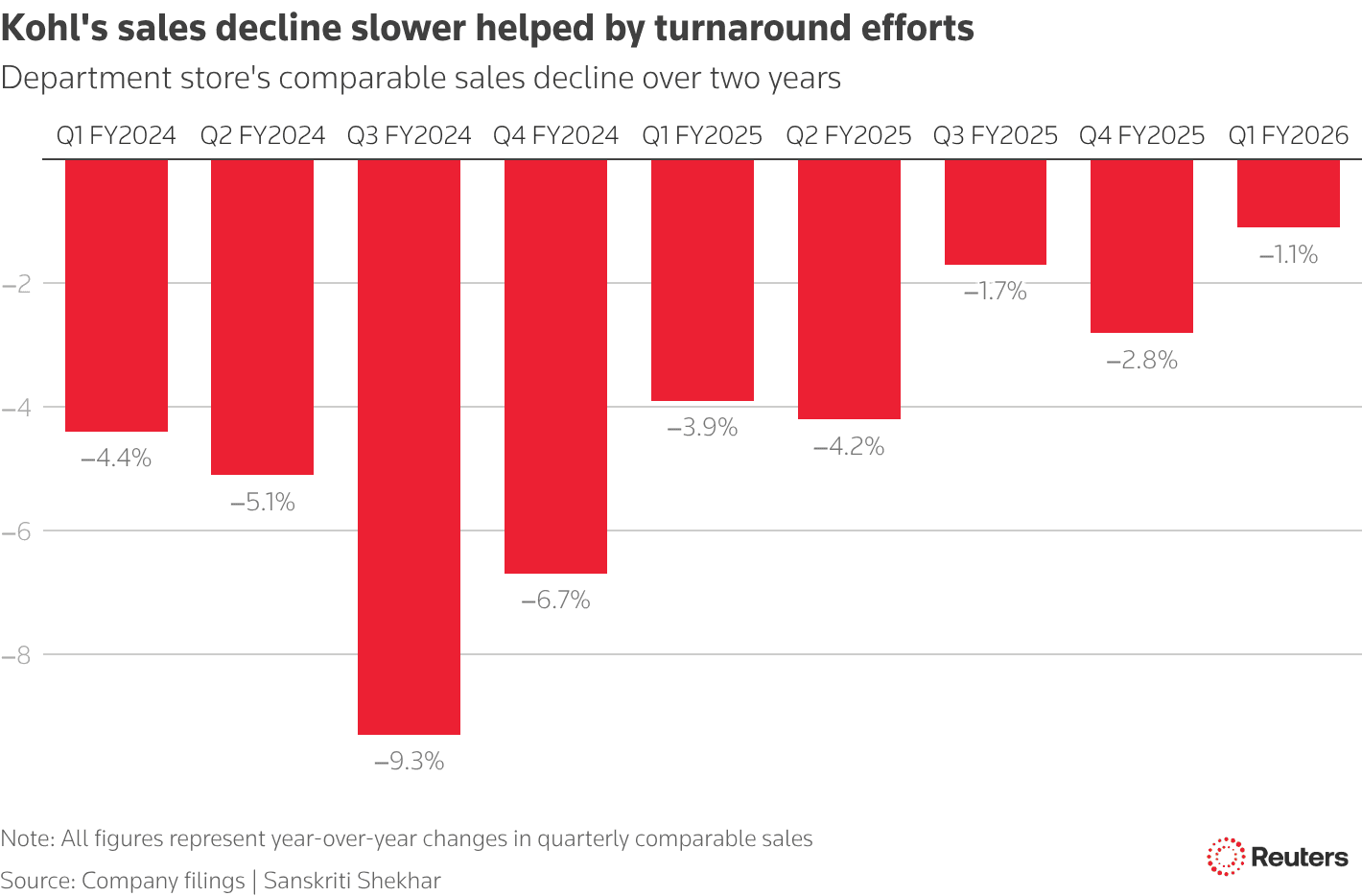
Kohl’s latest results show a business that has not yet stabilized. Fiscal 2025 net sales fell 4.0% to $14.8 billion, comparable sales declined 3.1%, and diluted earnings per share came in at $2.38, with adjusted diluted EPS of $1.62. That combination points to a retailer that is still generating revenue at meaningful scale but is doing so with less customer momentum than it needs.
The first quarter of fiscal 2026 added more evidence that the turnaround is unfinished. Net sales fell 1.7%, comparable sales slipped 1.1%, and the company reported a diluted loss of $0.13 per share. Kohl’s still reaffirmed its full-year 2026 financial outlook, but the message from the quarter was that the company can keep guiding for improvement only if it can arrest the erosion in traffic and transactions that has already weakened the core business.
Those figures matter because they show the difference between cyclical softness and structural drift. A few quarters of pressure can be explained by a consumer slowdown; years of falling comparable sales suggest a retailer whose place in the shopping routine has become less secure. Kohl’s is large enough to absorb mistakes for a while, but not large enough to ignore the fact that relevance is what keeps a chain in the consideration set.
Merchandising changes are trying to rebuild a reason to visit
Kohl’s response has been to tighten its identity through partnerships and targeted merchandising. The Sephora at Kohl’s rollout now reaches more than 1,100 stores, giving the chain a stronger beauty offer and a clearer reason for shoppers to walk in rather than simply click elsewhere. That partnership is a bet that a department-store format can still work if it gives customers something more specific than a generic middle-market mix.
The company has made a similar move with Babies“R”Us at Kohl’s. Kohl’s announced that partnership in March 2024, said the first shops would open in August, and planned a rollout to approximately 200 stores in fall 2024. The logic is straightforward: if the chain can anchor itself around younger families and more defined trips, it may be able to replace some of the undifferentiated browsing that used to sustain its larger assortment model.
But these initiatives also expose the limits of the turnaround. Shop-in-shop partnerships can add traffic and sharpen merchandising, yet they do not automatically solve the deeper problem of what Kohl’s wants to be outside those branded corners. A retailer that relies on added concepts to create relevance still has to prove that the core store experience, value proposition and merchandise mix can stand on their own.
Leadership changes are aimed at execution, not just image
Kohl’s has also been reshaping its leadership bench. In November 2025, the company named Michael J. Bender its permanent chief executive after he had been serving as interim chief. That move signaled a desire for stability after a period in which the company needed a leader who could both steady operations and continue the identity reset.
More recently, Kohl’s named Elliott Rodgers chief operating officer on June 15, 2026, effective September 9, 2026. His remit includes enterprise operations across nearly 1,200 stores, along with supply chain, procurement and loss prevention. That portfolio shows where the company sees its biggest operating leverage: the turnaround is not just about branding, but about making the store network run more efficiently and more consistently.
Still, operational tightening is only part of the answer. A chain can improve scheduling, sourcing and store control and still fail if shoppers no longer feel that the merchandise, price architecture and shopping experience justify the trip. The question for Kohl’s is whether these leadership moves can convert into a cleaner customer promise before relevance slips further.
Kohl’s now stands as a test case for the middle of American retail. If a chain with nationwide reach, a large store base and well-known brand recognition can rebuild traffic, it would suggest that physical stores still have power when the proposition is sharp enough. If it cannot, the lesson will be harsher: for legacy department stores, the hardest part of the turnaround is not cutting costs or launching partnerships, but persuading shoppers that the store still deserves a place in their routines.
This article was produced by Prism’s automated news system from verified source data, official records, and press releases, then run through automated quality and moderation checks before publishing. The system is built and supervised by the people who set the standards it runs under. Read our full AI policy.
Did this article answer your question?