Labour faces pressure from Greens and Reform in London councils
Labour still dominates London, but a 12-point lead and surges from the Greens and Reform show how fast its coalition is fraying.

London has become Labour’s clearest warning as well as its biggest prize. The party won 59 of the capital’s 75 Westminster seats in the 2024 general election, yet that sweep did not stop pressure from building in both directions, with the Greens cutting into Labour’s inner-city base and Reform making inroads across more socially conservative outer London.
The numbers underline how quickly the capital can shift. Labour took 43% of the London vote in the general election, against 21% for the Conservatives, but a Mile End Institute poll at Queen Mary University of London found that lead had fallen to 12 points within four months. That is happening in a city with more than six million eligible voters, roughly the combined size of Scotland and Wales, and with borough politics that shape schools, social care and rubbish collection as much as any national debate.
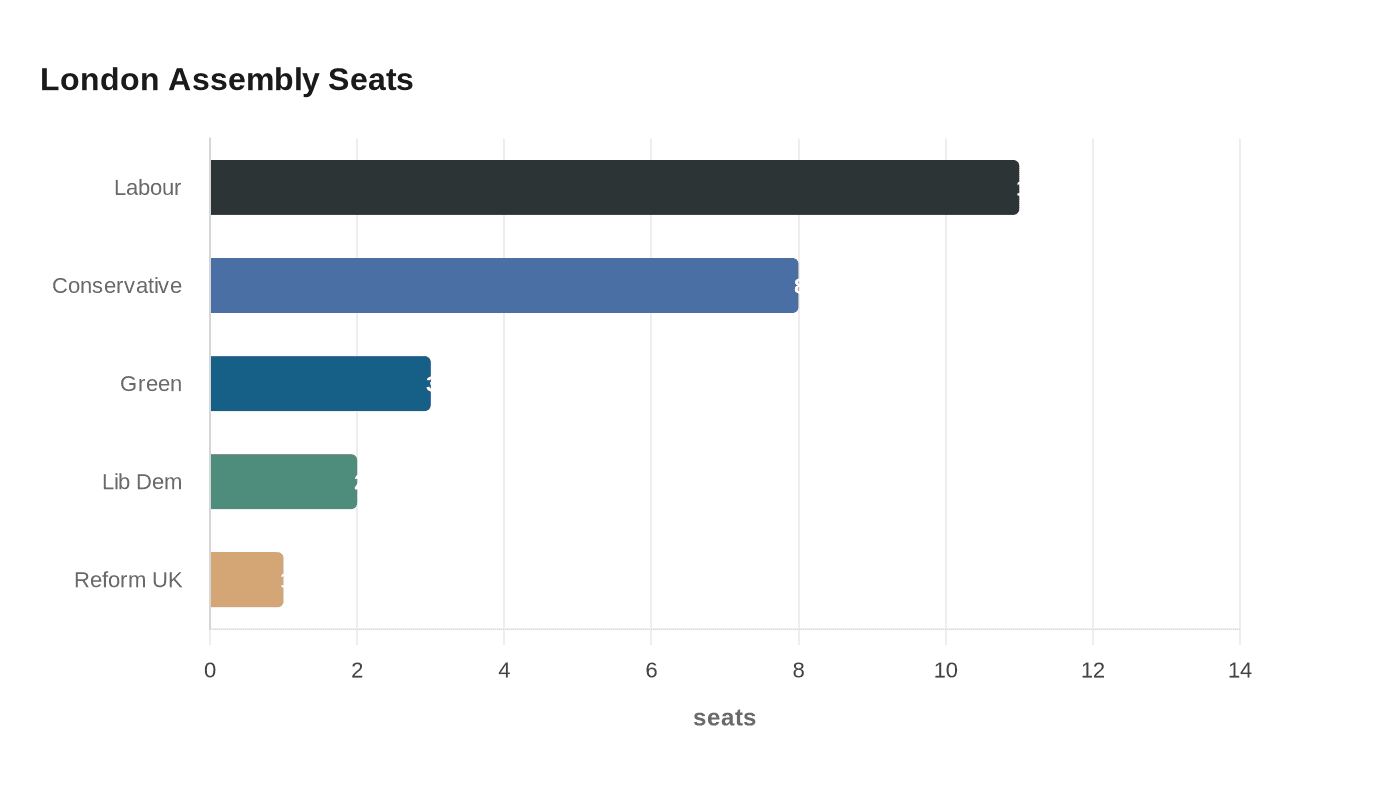
Labour still held the mayoralty in 2024, when Sadiq Khan was re-elected, and it kept the London Assembly, winning 11 of the 25 seats. The Conservatives took 8, the Greens 3, the Liberal Democrats 2 and Reform UK 1. Turnout was 40.50%, and the election used first-past-the-post for the first time after the Elections Act 2022. The result showed Labour’s strength, but also how many more political currents are now competing in the capital.
That fragmentation is why the coming borough contests carry so much weight. LSE modelling, based on a JL Partners survey of 2,022 Londoners, said the 2026 council elections could bring the biggest shift in London local politics since 1968. It said Labour could be pushed into second place in seven boroughs it currently controls, while more no-majority councils could emerge as the Greens and Reform become major forces in the race.
YouGov’s MRP projection pointed in the same direction. It suggested Labour would top the vote in only 15 of London’s 32 councils, down from 21 in 2022, while the Greens could lead in four councils and Reform in three, an unprecedented prospect in London council polling. Labour still holds 21 of the 32 boroughs, while the Conservatives control five, after losing Wandsworth and Westminster in 2022.
That is the deeper political lesson of London for Keir Starmer’s party. Labour can dominate Westminster seats and still face strategic strain from competing urban, suburban and class-based demands. If the capital is splitting between inner London, outer London, Greens and Reform, it is not just a local story. It is an early test of whether the centre-left can still hold together the broad coalition that won in 2024.
This article was produced by Prism’s automated news system from verified source data, official records, and press releases, then run through automated quality and moderation checks before publishing. The system is built and supervised by the people who set the standards it runs under. Read our full AI policy.
Did this article answer your question?


