Latvian defense minister resigns after Ukrainian drones strike oil tanks
Ukrainian drones that hit oil tanks in Rezekne forced Latvia’s defense minister out and exposed a NATO air-defense gap along the alliance’s eastern flank.
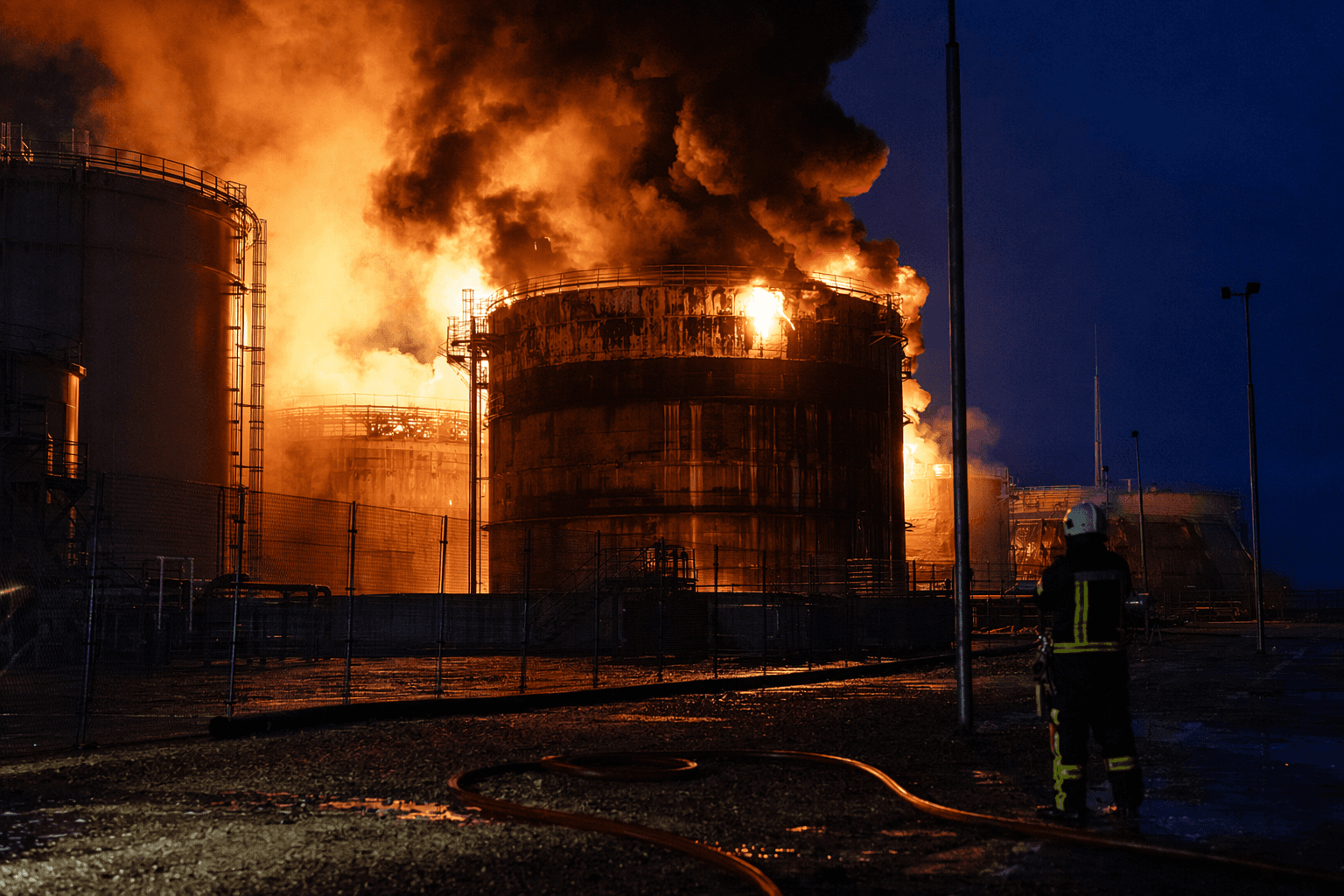
Latvia’s defense minister resigned after two Ukrainian drones crossed in from Russia and struck oil storage tanks in Rezekne, turning a border incident into a test of NATO’s ability to protect its eastern flank. Prime Minister Evika Silina demanded Andris Spruds’ resignation, saying anti-drone systems had not been deployed fast enough, and appointed Latvian army colonel Raivis Melnis as his replacement.
The drones hit the eastern city on Thursday, May 7, 2026, about 40 km, or 25 miles, from the Russian border. Four empty oil tanks were damaged at the storage facility, and police and firefighters said possible debris from a crashed drone was found at the site. Firefighters later extinguished a smouldering part of one oil tank, underscoring how quickly a cross-border drone flight can become a public safety incident.
Latvian authorities issued drone alerts to residents along the Russian border between 4:09 a.m. and 8:51 a.m. local time and closed schools in several municipalities. French military jets from the multinational NATO Baltic air police mission in Lithuania were summoned during the alert, a reminder that the alliance’s air policing mission can be pulled into fast-moving incidents even when the threat is low-flying, fragmented and difficult to track.
The political fallout has centered on accountability for air defense and border security, not just on the resignation itself. Spruds had said the drones were probably launched by Ukraine against Russian targets and had fallen by accident on the wrong side of the frontier. He also argued that airspace defense is a shared NATO responsibility. The episode has sharpened that debate, because Latvia and Lithuania called on NATO the same day to bolster air defenses after two drones crossed the Russian border and exploded on Latvian soil.
Ukraine’s foreign minister, Andrii Sybiha, said the drones were Ukrainian but were diverted into Latvia by Russian electronic warfare. He added that Ukraine is considering sending experts to help strengthen air security over the Baltic states. That offer reflects the unusual reality of the war: even when drones are not aimed at NATO territory, the spillover can still threaten civilian infrastructure, force school closures and trigger emergency military responses.

The incident did not come out of nowhere. Similar stray Ukrainian military drones hit Latvia, Lithuania and Estonia in late March, including one that slammed into a chimney at a local power station and another that crash-landed in a frozen lake and exploded. For NATO’s Baltic members, the pattern has become harder to dismiss: the alliance’s eastern border is not only a line of defense against Russia, but also a zone where the war in Ukraine can ricochet across frontiers with little warning.
This article was produced by Prism’s automated news system from verified source data, official records, and press releases, then run through automated quality and moderation checks before publishing. The system is built and supervised by the people who set the standards it runs under. Read our full AI policy.
Did this article answer your question?